
Rome moves in chapters when you ride. This golf cart tour stitches together Rome’s legends and big eras, from Romulus and Remus to the Baroque period, so you get the story without spending all day on your feet. I like that it feels like a timeline you can see, not just a list of monuments.
I also love the live storytelling from guides such as Salvo (often paired with Mike), because the landmarks connect like scenes in a film. You get short photo stops and hop-on moments at major stops like the Colosseum, Pantheon, and San Pietro in Vincoli, which gives you just enough time to look, shoot photos, and ask questions. One possible drawback: you do not go to the Trevi Fountain.
Quick hits
- A timeline route from mythical origins through Kingdom of Rome, Republic, Empire, and on to Renaissance and Baroque
- Colosseum and Pantheon on your schedule, with guided time where it matters most
- Hop-on photo breaks at key viewpoints, including Pincio Terrace and two church stops with time to get your bearings
- Panoramic views at the Aventine Hill Orange Garden for a Rome-at-a-glance moment
- Iconic church stops, including San Pietro in Vincoli (Michelangelo’s Moses time permitting) and Santa Maria Sopra Minerva
Why a golf cart timeline makes Rome easier
Rome can feel like a lot. The ruins are huge, the churches have layers, and the city keeps changing names as fast as it changes emperors.
This tour is built around a simple promise: you move through time while you move through the city. You start with Rome’s mythical beginning, then the Kingdom of Rome, then the Republic and Empire, and finally the later Renaissance and Baroque chapters. The comfort part is real too. You still get out for stops, but you are not doing nonstop long-distance walking to connect the dots.
You can also read our reviews of more historical tours in Rome

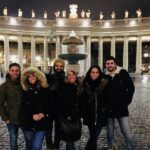

Meeting point, pacing, and what the 3 hours really buys you
You meet at the office at Villa Santa Marta, 12 (Via Santamaura, 12). If the office happens to be closed on your day, you meet next door at a bar called Expresso. The tour is 3 hours, so it is long enough to feel like a proper arc, but short enough to keep the rest of your day flexible.
The pace is practical. Parts of the route are scenic drives or pass-bys, and other parts include quick guided time and photo stops. You will be walking briefly at specific points, but the golf cart keeps the overall effort reasonable, even if you are the type who hates arriving to a ruin site already tired.
One note for your planning brain: entry to sites is not included. So you are mostly seeing exteriors, learning at the stops, and using the time for orientation. If you want full inside access, you will need to plan that separately.
St. Peter’s area to Castel Sant’Angelo: early power meets city swagger
The tour begins with the sights that set the tone for central Rome. You pass by St. Peter’s Basilica during a short scenic drive, so think of it as a quick orientation moment rather than a deep visit. Then you move to Castel Sant’Angelo, where you get guided time.
Castel Sant’Angelo is the kind of stop that helps you understand Rome as a lived-in city, not just a museum. It gives your guide room to connect how power and architecture evolved across centuries, and it is a good early anchor before you head into the more famous ruins phase.
Practical tip: bring a camera ready. The first section is full of angles from the road, and you are already building your visual map.
Largo di Torre Argentina: a photo stop with story fuel
Next comes Largo di Torre Argentina. This is a photo stop plus guided time, with a hop-on moment built in. It is one of those places where you can get the “oh, that’s what this spot is” feeling fast, because your guide is framing what you are seeing in the larger Rome timeline.
The advantage here is time. You are not trying to figure out connections alone at street level. Instead, you get the interpretation first, then you can look around with more confidence. If you like learning as you go, this is one of the smarter stops on the whole route.
Piazza Venezia, Trajan’s Market, and the Empire feeling
As the tour continues, you reach Piazza Venezia and then Trajan’s Market, mostly as pass-bys and scenic views. This part matters because it supports the tour’s big shift into Roman Empire scale. Even when you are not going inside buildings, you are getting that “this is where the city flexed” perspective.
Rione Monti also enters the picture with a scenic drive. Monti tends to give you street-level Rome energy, and it helps break up the heavier monument moments so the tour stays fun and readable.
If you have limited time in Rome, this section is a win. It makes you feel like you are moving through neighborhoods and eras, not just driving between famous photos.






The Colosseum stop: how to see it without getting crushed by the day
Then comes the Colosseum, and this is one of the headline moments. You get a photo stop plus guided time, and there is a hop-on option here. Because entry is not included, you focus on what you can do best: look, understand the shape of the place, and learn the why behind it.
Your best move at the Colosseum: treat it like a learning stop, not a checklist stop. Let your guide set the context, then use your photos to capture details you might miss when you are rushing. The guide-driven pacing is the main value because it helps you avoid that feeling of staring at a famous site and not knowing what you are looking at.
Also, the golf cart makes this easier if you do not want to arrive at the Colosseum already exhausted from walking. You will still do some steps, but you are not paying for the stop with sore legs.
Arch of Constantine, Palatine Hill views, and skyline framing
After the Colosseum, you continue with scenic views on the way to the Arch of Constantine and Palatine Hill. These are not long stay stops, so you are getting viewpoints and visual context rather than a full guided walk-through.
This is still important. Palatine Hill in particular helps the story feel grounded in how the Romans lived and ruled. Even from the outside and from road-side vantage points, you start to understand why this area became such a gravitational center for later generations.
Think of this portion as your Rome diagram. You are building the mental map that makes later stops feel connected instead of random.
Pincio Terrace: the 15-minute “get your photos now” moment
At Pincio Terrace, you get a photo stop, guided time, and an aerial view style moment. There is also a hop-on break with 15 minutes listed for this stop, which is perfect if you want to catch big-picture photos without losing the tour flow.
This is the kind of stop where a little patience pays off. Look around before you shoot, so you can frame the skyline and understand what you are seeing. Then use those photos as bookmarks. Later, when you walk on your own, those images help you remember where you were.
San Pietro in Vincoli: Michelangelo’s Moses, time permitting
San Pietro in Vincoli is next, with a photo stop, guided time, and another hop-on break listed as 15 minutes. The star attraction here is Michelangelo’s Moses, but the important phrase is time permitting. Translation: you may get the full highlight, or you may get the surrounding value of the visit and learn how it fits into Rome’s art and religious shifts.
Either way, this church stop is a strong mid-to-late anchor because it pulls the tour from pure ancient spectacle into later cultural meaning. It also gives you that mix of Roman eras the tour promises, without turning into a march of endless ruins.
If you are sensitive to crowds or lighting, plan to arrive ready to slow down for a few minutes. A church stop is different from a ruin stop. You need your eyes to adjust, and the guided framing helps.
Pantheon and Santa Maria Sopra Minerva: two “churches that remember” stops
After San Pietro in Vincoli, you go toward the Pantheon for a photo stop and guided time, with a hop-on moment included. The tour describes the Pantheon as a temple turned church, and that idea is the whole point of this stop. You are watching Rome’s transformation show up in the same spot, under the same roof line, with the layers still visible in how it is experienced.
Then Santa Maria Sopra Minerva comes next, again with photo stop and guided time and a hop-on break. The tour calls it a Gothic treasure. If you like architecture and how styles change, this stop is a great contrast to the more ancient-feeling sights earlier in the ride.
Practical photo advice: for churches, photos can look flat if you rush. Use your guided time to understand angles, then take photos during your hop-on minutes when you know what to look for.
Campo de’ Fiori and the Aventine Hill Orange Garden views
Near the end, you reach Campo de’ Fiori. You get a photo stop and guided time with a hop-on moment listed at 10 minutes, and it is the finish point named for the tour. Campo de’ Fiori is where street Rome shows up in a different way: you are not trapped in ruins or church interiors, you are in the city’s public square life.
The tour also includes a climb to the Aventine Hill Orange Garden for panoramic views. This is the kind of stop that helps you breathe after monuments. You get that wider Rome perspective, the one that makes you feel the city is more than an archaeological map.
If your day includes more walking later, treat these final minutes as your payout. Take photos, check your bearings, and then decide where you want to go next on foot.
Price and value: what $64.01 gets you for 3 hours
At about $64.01 per person for a 3-hour guided golf cart tour, you are paying for three things at once: transportation inside central Rome, a live guide, and structured access to major landmarks without entry tickets. Since entry to sites is not included, you are not buying museum passes, you are buying interpretation plus comfort plus efficiency.
For first-time visitors, that can be a great deal. Instead of spending your precious energy figuring out where to start and what connects, you get a guided timeline that makes the city feel organized. For people who hate sore feet, the cart portion is the value. You will still do some walking, but the tour keeps the heavy effort out of your day.
If you already plan to visit every interior and every ticketed site, you might split your plans. Use this tour for orientation and story, then add separate paid visits afterward where you truly want to go inside.
What to bring, what not to do, and small comforts that matter
Bring comfortable shoes, hat, camera, sunscreen, and water. That list is not filler. Rome sun is real, and your time out of the cart at stops adds up.
A couple rules to keep things smooth: alcohol and drugs are not allowed. That means the tour stays focused and family-friendly in tone.
Wheelchair note: the tour is listed as wheelchair accessible, but wheelchairs cannot be brought on the golf cart due to limited space, so they must be left at the office. Guests who rely fully on a wheelchair need to stay on the cart throughout the tour. If mobility is a deciding factor for you, plan ahead and ask the operator what option fits best.
Who this tour fits best, and who should choose differently
This is a good fit if you:
- want a guided timeline through multiple Roman eras in one half day
- prefer a comfortable pace over long walking days
- like your history with storytelling, not just dates on a sign
- want major stops like the Colosseum and Pantheon without trying to stitch them together alone
It may not be ideal if you need guaranteed inside access everywhere, since entry to sites is not included. It also is not suitable for children under 3 years, so if you are traveling with very young kids, choose accordingly.
And one more planning point: you are not going to the Trevi Fountain on this tour. That is not a deal-breaker for many people, but if Trevi is your one must-see, you will want a separate plan.
Should you book this Rome golf cart history tour?
If your goal is to get oriented fast and see a strong set of Rome landmarks with a guide who tells the story in an entertaining way, I think this is a smart booking. The stop structure, the hop-on breaks, and the way the route moves through eras make the time feel purposeful instead of scattered.
I would book it especially if you are trying to balance sightseeing with energy management. Rome rewards slow wandering, but it also punishes overplanning. This tour gives you the foundation, then you can wander after with a clearer sense of where you are and why it matters.
If Trevi Fountain is non-negotiable for you, plan a separate stop before or after. Otherwise, you are set up for a smooth, low-stress introduction to Rome’s chapters, told where you can actually look up and see them.
FAQ
How long is the Rome golf cart tour?
The tour duration is 3 hours. Starting times vary, so check availability for the schedule.
What is included in the price?
It includes a live tour guide and a golf cart tour of Rome’s historical sites.
Are entry tickets to the sites included?
No. Entry to sites is not included in the tour.
Which languages does the live guide speak?
The live guide is available in English and Italian.
Is the tour wheelchair accessible?
Wheelchairs are allowed, but due to limited space they cannot be brought on the golf cart and must be left at the office. Guests who rely fully on a wheelchair will need to stay on the cart throughout the tour.
Does this tour include the Trevi Fountain?
No. The tour does not go to the Trevi Fountain.
Is it suitable for young children?
It is not suitable for children under 3 years.
Can I cancel for a refund?
Yes, free cancellation is available up to 24 hours in advance for a full refund.
More Historical Tours in Rome

More Tours in Rome



More Tour Reviews in Rome
Not for you? Here's more nearby things to do in Rome we have reviewed












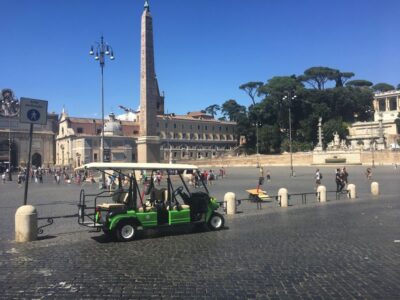
Rome Golf Cart Tours, compared.
 ★ 4.8Imperial City Tour by Golf Cart with Optional TransferFrom $1241,024 reviews
 ★ 5.0Golf Cart Small-Group Guided Tour: Rome City HighlightsFrom $104907 reviews
 ★ 4.8City Highlights Golf Cart TourFrom $45857 reviews
 ★ 5.0Private/Group 4 Hours Golf Cart SightseeingTourFrom $168780 reviews
 ★ 5.0Explore Rome on a Golf Cart: Private TourFrom $83757 reviews
 ★ 4.8City Highlights Golf Cart Tour with Local GuideFrom $71752 reviews
 ★ 4.5Rome by Night: Golf Cart TourFrom $108688 reviews
 ★ 5.0Rome Catacomb & Appian Way Small-Group Tour by Golf CartFrom $107681 reviews
Browse the lists this tour appears in