
Reviewed · WALKING TOURS
Piazza del Popolo and Historical Sights Walking Tour in Rome
Rome starts with a gate. This 2.5-hour walk links major landmarks with a real guide, so the city feels organized instead of random chaos, and it stays to a small group of up to 15. I also liked the guided stories that explain what you are actually looking at, including the big-picture connections across centuries.
You will move at an easy walking pace and pause often, with a well-timed gelato stop that doubles as a bathroom break. By the end, you are finishing outside Castel Sant’Angelo with a clear view toward St. Peter’s Basilica, plus a quick orientation to the Vatican area.
One thing to consider: the stops are brief by design, so if you want long inside visits or slow browsing, you will probably want to add separate time at your favorite sites.
Key highlights to know before you go
- Max 15 people keeps the tour from turning into a crowd shuffle
- English-speaking guide with a mobile ticket for straightforward check-in
- Built-in route logic from Porta del Popolo to Castel Sant’Angelo in one continuous walk
- Quick “pause and understand” stops that help you see more in about 2.5 hours
- Gelateria della Palma break for a restroom reset and lots of flavor choices (150-plus options)
- Guides like Justin, Luccio, Nick, and Claus are praised for answering questions clearly
How this Rome route helps you get your bearings fast
If you have ever wandered Rome and thought, I see buildings, but what am I actually seeing, this tour is built to fix that. You are not just moving from photo spot to photo spot. You are walking a route where each stop adds a layer, from the ancient city gate to the bridges and tomb-linked landmarks that funnel you toward Vatican territory.
The pacing matters here. You are out for about 2 hours 30 minutes, and you get short, purposeful stops. That is perfect when you want a first-week understanding of the city without spending the whole day in one area.
The group size also changes the vibe. With a 15-person cap, it is easier to hear your guide and ask questions without raising your voice like you are on a sports field.
You can also read our reviews of more walking tours in Rome

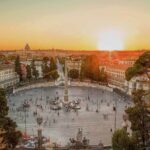
Start at Piazza del Popolo, where the story begins at Porta Flaminia
You begin at Piazza del Popolo, where the tour points you toward Porta del Popolo, also known as Porta Flaminia. This matters because a gate is not just a gateway. It is a map clue. It tells you where people entered and how the city pulled travelers and trade inward.
You get an introduction that sets the tone for what comes next. Instead of “here is a square, good luck,” the guide frames the area so Piazza del Popolo becomes a landmark with context, not a postcard you move through.
You will get about 10 minutes here, which is enough to understand the location and start spotting the symbolism that the guide will connect throughout the walk.
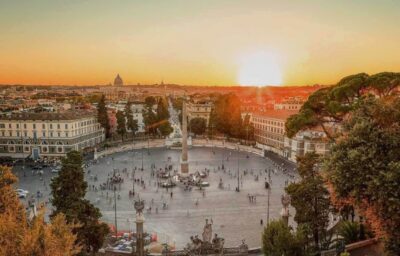
Piazza del Popolo: twin churches by Bernini and an obelisk with a long memory
Next comes Piazza del Popolo itself. This is one of those Rome squares that looks instantly impressive, but it can feel mysterious if you do not know what you are looking at.
Here are the two biggest anchors your guide will draw your attention to:
- The twin churches designed by Bernini
- The Obelisk of Ramses II, standing as a visual reminder that Rome liked to collect and reuse prestige from elsewhere
The obelisk is especially useful because it gives you a “Rome habit” to notice. Rome kept importing status, reshaping it, and placing it in new settings. You will start seeing that pattern more clearly after this stop.
Mausoleum of Augustus: why Octavian still matters
From the piazza area, the walk passes by the Mausoleum of Augustus, tied to Octavian Augustus. This is the kind of landmark that can be easy to miss if you are only looking for the headline sites. But it is a key piece in the puzzle of early Roman power.
Your guide frames Augustus as the first Roman Emperor and as a founder figure for the Julio-Claudian dynasty. Even if you do not leave with every date memorized, you should leave with a cleaner mental timeline: Rome shifts from republic-era structures toward imperial rule, and Augustus sits right at that turning point.
Because this is a pass-by segment with a pause, the goal is understanding rather than deep interior exploration.
Palazzo Borghese: the Rome of powerful families
After Augustus, you pass through the area connected with Palazzo Borghese, a 16th-century palace tied to the Borghese family. You might not stop for long, but the point of including it is to show you how wealth and influence shaped the city’s look.
The Borghese were not just rich. They were powerful enough to leave their mark in architecture, and the tour helps you connect that to the broader story of how Rome kept reinventing itself.
In a short walk like this, the value is not spending an hour at one building. The value is building a “mental map” of who held power, and how that power turned into stone.
You can also read our reviews of more historical tours in Rome


Gelato at Gelateria della Palma: a practical break built into the day
Around the midpoint, the tour makes a stop at Gelateria della Palma. This is listed as a gelato (bathroom) break, and that is a small detail that makes a big difference in real life.
After walking and standing for long stretches, you want two things:
- A restroom break you do not have to hunt for
- A snack that actually feels like part of your Roman day, not a rushed stop
Gelateria della Palma is known for offering over 150 different flavors, so you will have plenty of choices. You might find this especially helpful if you are traveling with someone who wants to pick something sweet quickly and move on.
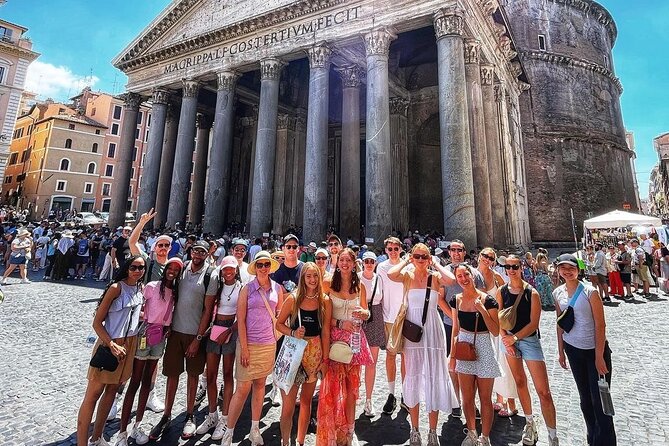
Pantheon: the Temple of all the gods, plus famous burials
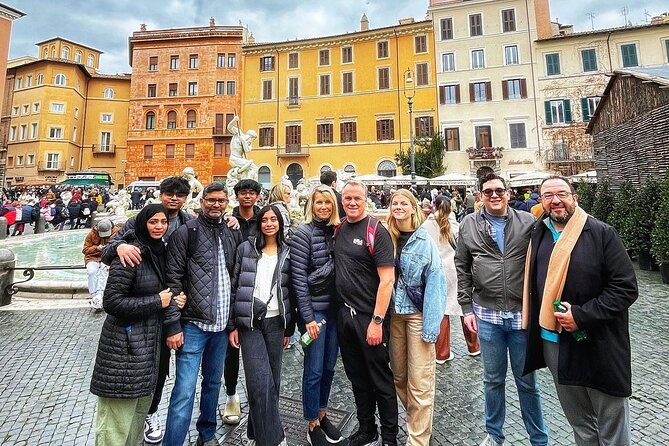
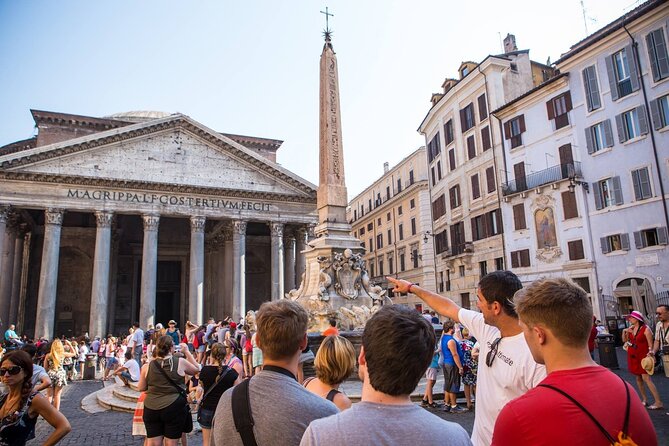
One of the major stops is the Pantheon, often described as the Temple of all the gods. Even if you have seen it in photos, this is still one of those places where the scale clicks only when you are close.
Your guide will also mention the idea that bodies of Raphael and the first Italian royalties are buried here. Whether you already know the story or not, that kind of detail adds a human layer. It turns the Pantheon from a “cool building” into a site that holds cultural memory in a very Roman way.
This stop is about 15 minutes, so you should use that time actively:
- Look up and notice proportions
- Listen for what your guide highlights, not just what you can see from your phone
The Pantheon is often busy. A shorter guided pause is a benefit here because it helps you avoid getting stuck in decision fatigue while still soaking in the essentials.
Piazza Navona and the stadium-shaped story
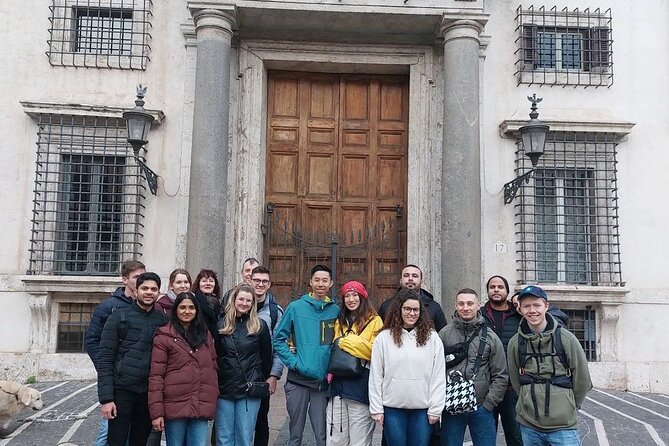
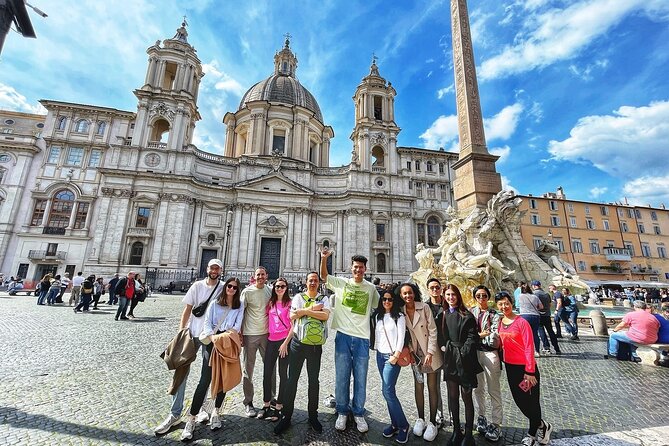
Next comes Piazza Navona. The tour frames it as a space originally known, and still shaped, like the Stadium of Domitian. That one sentence can change how you see the square, because suddenly the oval form is not random design. It is a piece of continuity.
You will spend about 20 minutes here, which is long enough to let the shape sink in and to connect the present-day square with its earlier purpose. If you enjoy architecture and urban design, this is a great place to slow your eyes for a moment and track how the edges of the square guide the flow of people.
Via dei Coronari: Renaissance street steps and pilgrim energy
After Piazza Navona, you walk through Via dei Coronari, described as famous and “untouched” from Renaissance days, with steps associated with the original pilgrims. This is a quieter stretch compared to the big set-piece squares, and it can feel more like a neighborhood walk.
Your guide uses this part of the route to show how streets carry history, even when the surface level looks unchanged. If you like walking Rome rather than only seeing it from a bus window, this stretch is a strong payoff.
It is also a nice contrast before the tour heads back toward dramatic river landmarks.
Bridge of Angels and St. Angelo Bridge: Christian story meets stonework
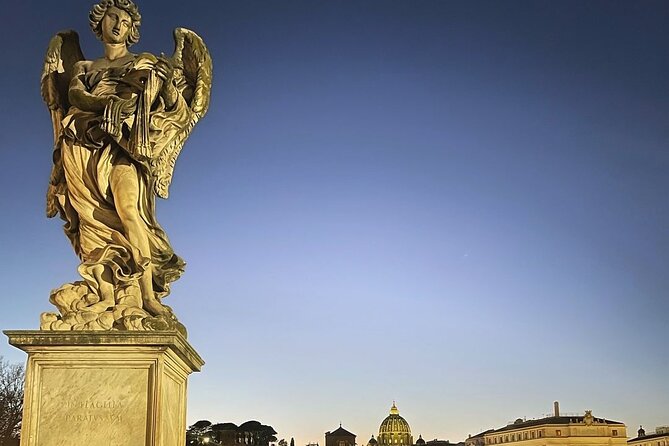
Then you head to St. Angelo Bridge, where the tour connects the bridge to the story of the martyrdom of Christ. Bridges in Rome do more than get you across water. They tell stories, too.
This stop is about 15 minutes, which works well because it gives you time to pause and orient yourself across the Tiber. You can think of this as the tour’s “transition chapter,” shifting from the older urban core to the riverfront structures that funnel toward Castel Sant’Angelo.
Castel Sant’Angelo: Hadrian’s ashes and a medieval landmark
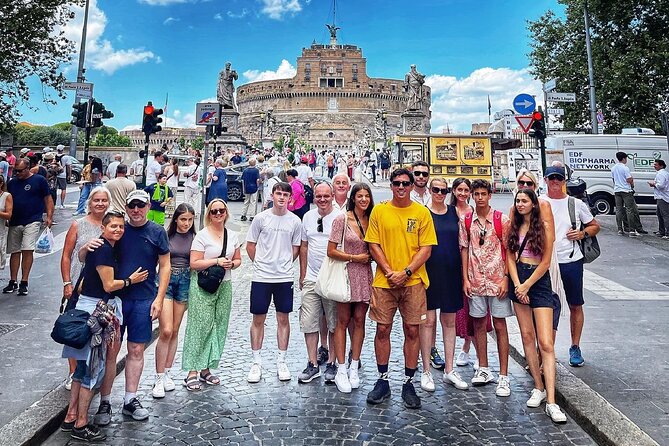
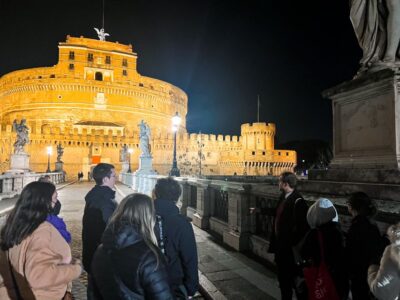
After crossing the Tiber via Ponte Sant’Angelo, you reach Castel Sant’Angelo. The tour notes that it was originally built to host the ashes of Emperor Hadrian, and it highlights the medieval side of the complex.
Even if you do not go inside, the outside stop helps you anchor the building in its origin story. Hadrian’s connection also ties back to the wider theme of emperors and their lasting footprints. Rome loves that idea: power becomes architecture, and architecture becomes memory.
You only get around 5 minutes at this point. For many people, that is enough to feel oriented, and it sets you up for the final visual payoff right after.
Via della Conciliazione and the St. Peter’s Basilica view
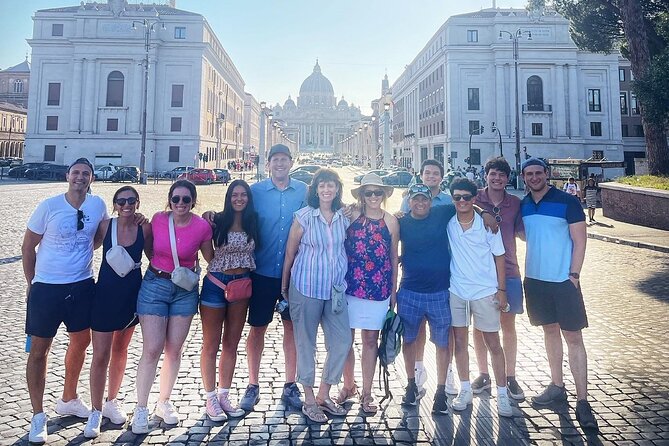
The walk ends near Via della Conciliazione, described as a masterpiece of Mussolini’s architects, with a stunning view toward St. Peter’s Basilica. This is where the route feels like it closes a loop.
The tour also frames this as a brief introduction to Vatican territory, so you get the sense of where the Vatican sits geographically and why this area dominates Rome’s skyline.
Finishing outside Castel Sant’Angelo with the basilica in view is a smart way to end. It gives you a final landmark that feels clear, big, and emotionally satisfying, even if you only spent a short time there.
Price and value: what your $4.23 booking fee is really buying
The listed price is $4.23 per person, which may look small because it is not the full “entry ticket” cost. Instead, the tour is tip based at the end, and the stops are described with admission ticket entries listed as free.
So the value is mainly three things:
- A trained guide who connects the sites into a readable story
- Time saved by hitting a logical route in a single morning block
- Small-group comfort, up to 15 people
When you add in that you can often book about 50 days in advance on average, this feels like a plan you can slot in early during your trip. I like that approach because early-booking tours help you avoid the “we ran out of time” feeling later.
If you are the kind of traveler who wants to understand what you are seeing, this price structure can be a great deal. If you only want a self-guided photo walk, you might not get as much out of paying even a small booking fee plus a tip.
What kind of traveler this is best for
I think this tour is a good match for:
- First-timers who want a quick understanding of Rome’s main layers, ancient power, baroque squares, river bridges, and the approach toward the Vatican
- People who prefer a small group and ask lots of questions
- Anyone who wants a “check off key sights” approach without doing intense museum-level time commitments
It might be less ideal if:
- You want long time inside big sites and are okay skipping a connected route
- Your schedule demands very flexible routing, since this is a structured walk with set stops and brief pauses
Also, if you are traveling solo, the small-group limit makes the experience feel easier to join and enjoy without getting swallowed by a tour pack.
Final thought: should you book this Porta del Popolo to Castel Sant’Angelo walk?
Yes, I would book it if you want a guided Rome foundation that ends with a major visual payoff. The standout reasons are simple: small group size, a guide who explains what you are seeing, and a route that takes you from Porta del Popolo all the way to Castel Sant’Angelo with meaningful stops along the way.
Book it earlier if you can, since it is commonly reserved well ahead of time. Wear comfortable shoes, plan for lots of short stands and pauses, and treat the gelato break as part of your strategy, not an optional add-on.
If you already have your week fully planned with deep museum time, this still works as an orientation walk. If you want more slow wandering later, do that after you know the city’s main story beats.
FAQ
How long is the Piazza del Popolo and Historical Sights Walking Tour?
It runs for about 2 hours 30 minutes.
What does the tour cost?
The price is $4.23 per person. It is also tip based at the end of the tour.
Is the tour offered in English?
Yes, it is offered in English.
How many people are in the group?
The group size is capped at a maximum of 15 travelers.
Where does the tour start?
The tour starts at Piazza del Popolo, 00187 Roma RM, Italy.
Where does the tour end?
It ends outside Castel Sant’Angelo, with a view toward St. Peter’s Basilica.
Are admission tickets required for the stops?
The stops listed for the tour show admission ticket free.
Is there a scheduled restroom break?
Yes. There is a stop at Gelateria della Palma for a gelato break that also functions as a bathroom break.
Can I bring a service animal?
Yes, service animals are allowed.
What is the cancellation policy?
You can cancel for free up to 24 hours before the experience for a full refund. If you cancel less than 24 hours before, the amount you paid will not be refunded, and changes within 24 hours are not accepted.
More Walking Tours in Rome

More Tours in Rome






More Tour Reviews in Rome

Not for you? Here's more nearby things to do in Rome we have reviewed












Walking Tours, compared.
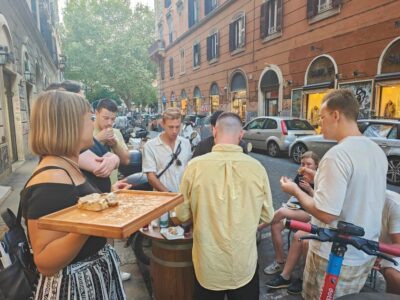 ★ 4.9Trastevere & Campo de Fiori Street Food Walking TourFrom $512,768 reviews
 ★ 4.9Paranormal Night Walking Tour & Secret BackstreetsFrom $341,921 reviews
 ★ 4.4Guided City Center Evening Sightseeing Walking TourFrom $46953 reviews
 ★ 4.5Best of Rome Walking Tour including Trevi FountainFrom $4923 reviews
 ★ 4.8Under the Moonlight Evening Walking TourFrom $28852 reviews
 ★ 4.9Forbidden History Walking Tour & Pub Crawl with DrinksFrom $61688 reviews
 ★ 5.0Guided Small Group Walking Tour of City HighlightsFrom $30682 reviews
 ★ 4.5Rome Walking Tour with Piazza Navona, Trevi Fountain and PantheonFrom $35676 reviews
Browse the lists this tour appears in