
Reviewed · ROME GOLF CART TOURS
Tour of Rome in Golf Cart: Seven Hills of Rome
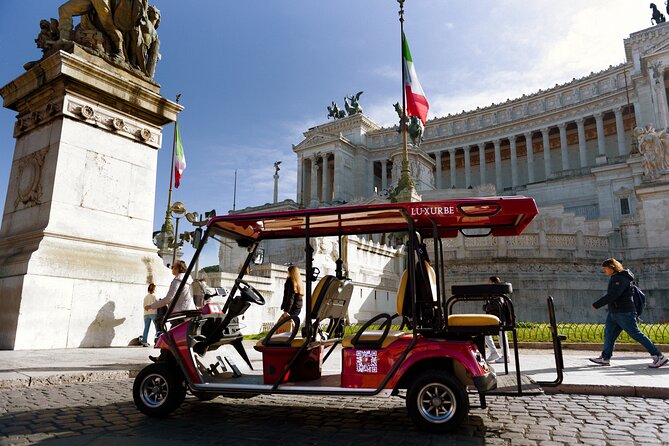
Skip the long walks and ride the hills. This electric golf cart tour is built for seeing a lot of Rome without sweating through every transfer, while still pausing in quieter spots like the Orange Garden on the Aventine. You also get photo stops at big-name landmarks plus a driver who helps you connect the dots across centuries, from Piazza Venezia to the Colosseum area.
My favorite parts are the mix of famous monuments and calmer viewpoint breaks, especially the Aventine stops where St. Peter’s feels close enough to touch. I also like the practical flow, you cover wide areas of the city without leaning on public transport, which is huge if your legs are tired or you want a first-night orientation.
One thing to factor in: timing and how long you linger can shift with traffic and safety, and the Colosseum entrance is not included. So bring patience for the route pace, and plan your paid monument time separately if you want a deeper stop inside.
Key highlights worth planning around
- Giardino degli Aranci and the Aventine viewpoint route, for skyline photos that feel calmer than the main streets
- Orientation value in 3 hours, with electric-cart access across Rome’s busy zones
- Piazza Venezia to the ancient hills, pairing big symbolism at the Vittoriano with classic ruins viewpoints
- Capitoline and Quirinale panoramas, where you get “Rome from above” moments in a short loop
- Bocca della Verita plus Caelian Hill stops, mixing playful legend with domestic ancient life
Price and what you actually get for $84.09
At $84.09 per person for about 3 hours, this is aimed at the people who want Rome coverage without hours of bus rides, stop-and-go ticket lines, or trial-and-error navigation. The value is strongest because the tour wraps together a lot of “major area” sightseeing with an English-speaking driver/guide, plus photo stops at the headline locations.
Most of the listed stops are free to visit, which matters when you compare this to tours that mostly take you past sights from the street. The Colosseum is the main exception on your route, since Colosseum admission is not included, so budget for that separately if you want to go in. In other words, the cart helps you reach the sights and see them well, but it does not pay your way into every monument.
Group size is capped at 15, which usually makes this feel more personal than large-bus touring. That also helps when the guide is trying to explain what you’re seeing while you’re moving between viewpoints.
You can also read our reviews of more tours and experiences in Rome.
The golf cart advantage on Rome’s hills
Rome is not built for effortless “see it all on foot.” This tour leans into the reality of the city’s elevation and traffic by using an electric cart that can move through areas where buses struggle. The practical win is that you get the backstory and context while you’re still fresh, not at the end of a long day when your feet are done.
You also get access to streets and corners that feel more local than the main tourist routes. The clearest example is the Aventine section, where you reach the Orange Garden and the keyhole view without turning your tour into a hike.
The other big benefit is mental. Instead of guessing where things are, you get a route that connects key neighborhoods and viewpoints. That makes it easier to plan the rest of your trip after this, because you’ll know which areas you want to return to for a longer, slower visit.
Start at Piazza del Popolo, then into classic landmarks
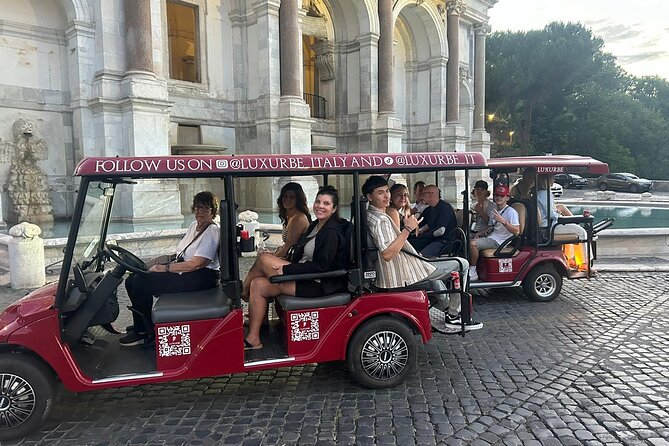
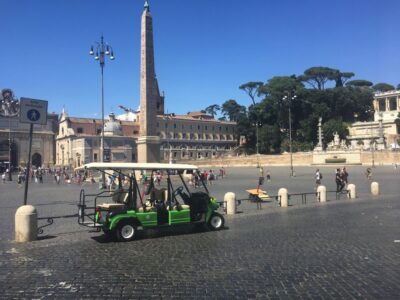
Your tour begins at Piazza del Popolo (address: Piazza del Popolo, 11, 00187 Roma RM). If you choose hotel pickup, the tour operator notes that pickup is limited and is offered off-season only. In that case, you wait outside your hotel at street level and the driver arrives at the scheduled time or within a 10-minute waiting window.
If you are not doing pickup, this is straightforward: arrive a bit early near the meeting point so you are not stressed when the cart line forms.
Via dei Condotti, a luxury street lesson
One of the first stops is Via dei Condotti, right in the fashion-and-architecture heart of the city. This cobblestone stretch is known for designer boutiques, but what I find useful is how it sets the tone of Rome as a layered city: historic stonework mixed with modern glamour.
The Spanish Steps are at one end of the street, so even if you do not stop there deeply, you understand what that landmark anchors nearby. If shopping is your thing, this is a good orientation moment. If shopping is not your thing, you still get a sense of Rome’s “high society” geography.
Piazza Venezia and the Vittoriano viewpoint
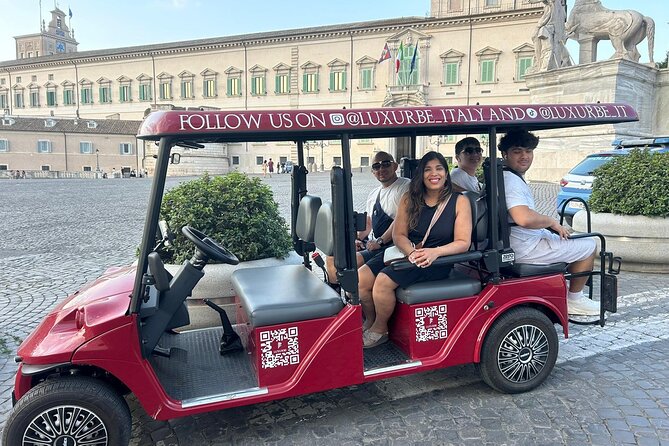
Next up is Piazza Venezia with the Altare della Patria, also called the Vittoriano. This is a big, white marble monument built to honor Italy’s unification, and the square around it feels like a crossroads of eras. You get a quick sense of the national symbolism here, plus an easy “from this point, Rome opens up” feeling.
It is also a smart starting anchor because from Piazza Venezia you can mentally place the ancient core, the modern center, and the museum-and-monument zone. Even if you only have a short time in Rome, this makes your later stops easier to understand.



Capitoline to Quirinale: Rome from above
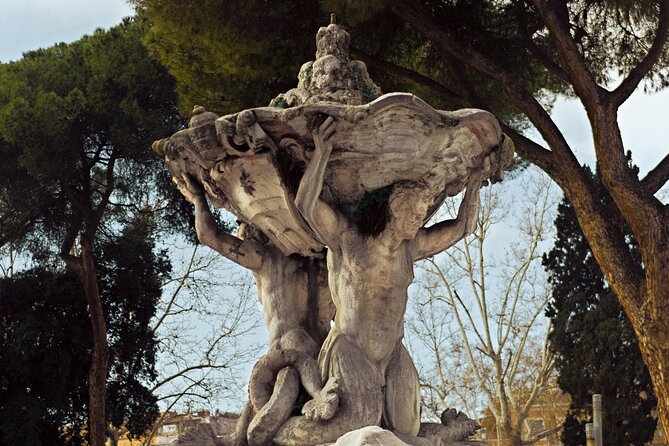
From Piazza Venezia you head toward the hilltop viewpoints that make Rome so dramatic. These stops are short, but they matter because they shift your perspective.
Piazza del Campidoglio, Michelangelo’s square
At Piazza del Campidoglio, you are on Capitoline Hill with a Renaissance design credited to Michelangelo and the iconic equestrian statue of Marcus Aurelius. This is one of those places where you can look around and feel the geometry of the city, not just the individual building faces.
Palazzo del Quirinale, presidential views
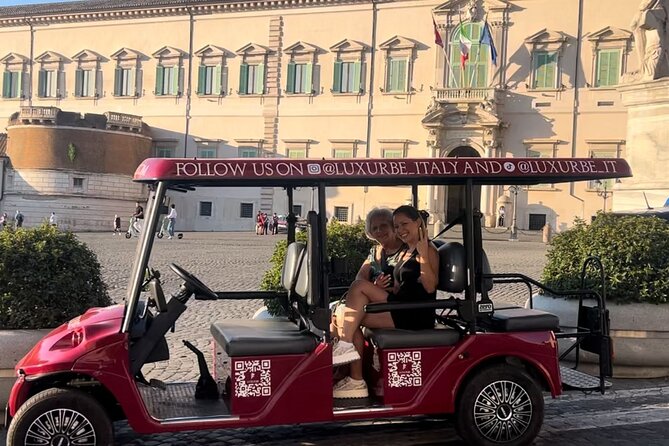
The route continues to Palazzo del Quirinale on Quirinal Hill. Even if you do not enter, the point is the setting: this is the official residence of Italy’s President, surrounded by historic architecture and gardens. For visitors, it is mainly about panoramic views and the sense of Rome as a city of power and ceremony, not only ruins and churches.
If your timing is tight, this is still worth it. The hilltop angle helps you “read” the city later when you spot domes and bell towers from street level.
Palatine Hill and Via dei Fori Imperiali: stepping into the ancient core
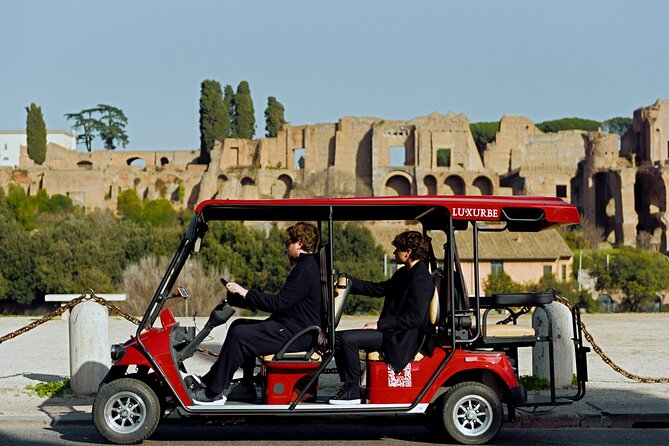
Two stops here do a lot of work: Palatine Hill and the area around Via dei Fori Imperiali.
Palatine Hill, imperial ruins and big sightlines
At Palatine Hill, you get ancient Roman palaces and the kind of view that makes the Forum area feel like a real stage. The ruins are not only “old rocks.” They show how elite life sat above the city, with gardens and viewpoints built into the landscape.
Even if you do not go deep into every ruin area, the cart route helps you angle your attention. You can see how the Forum and Circus Maximus sit in the same general geography, so your mental map improves fast.
Via dei Fori Imperiali, monumental emperor-era planning
Then you move onto Via dei Fori Imperiali, the broad, dramatic approach alongside the Imperial Fora. This is where the city’s scale changes from “one church at a time” to “entire blocks planned to impress.” The Imperial Fora include the Forum of Trajan, Augustus, Nerva, and Julius Caesar, plus temples and arches that show off Roman political ambition.
This stop is also a lesson in how Rome uses architecture as messaging. Even from the outside, you can grasp why emperors wanted these spaces to dominate the urban center.
Acquario Romano to Bocca della Verita: oddball Rome, in a good way
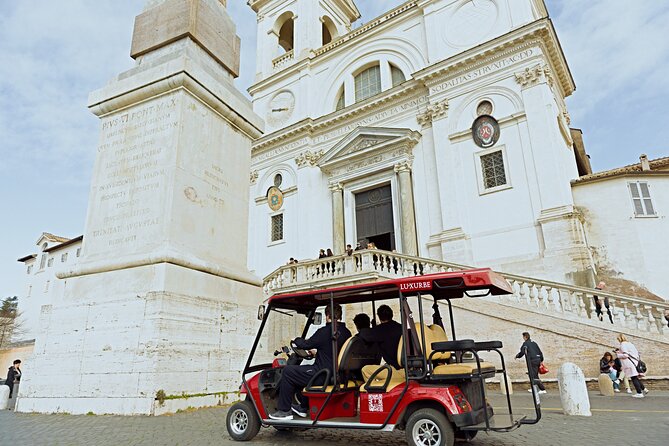
This part of the route mixes “what is that?” energy with fun legend. It breaks up the heavier ancient sites.
Acquario Romano, city center water-and-culture stop
Acquario Romano is listed as a stop in the Esquilino area. The key value here is not the building itself, but the way it interrupts the typical ancient-route rhythm. You get a glimpse of Rome as a living city where attractions and modern uses sit near older layers.
If you want a short photo break and a breather between major monuments, this is a logical place to pause.
Bocca della Verita, the hand-in-the-mouth ritual
Then comes Bocca della Verita, the Mouth of Truth, a marble mask housed at the portico of Basilica of Santa Maria in Cosmedin. The folklore says you put your hand in the open mouth to test honesty. You can treat it as a playful tradition while also taking in the sculpture’s age and the Roman Republic connection that the legend ties to.
This stop tends to be popular because it gives you a quick, memorable photo moment that is not just another wide plaza shot.
Colosseum stop: see it, then decide on your ticket
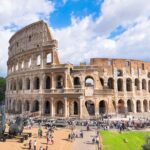
The itinerary includes a Colosseum stop with a note that Colosseum admission is not included. That means you will likely get time for views and photos, but it is not the same as a ticketed visit inside the arena.
How to handle this if you care about the interior
If you want the Colosseum floor and the full storytelling of the site, plan to add a separate visit before or after your cart tour. If you only want the exterior and the vibe, this stop still works because you are doing it right at the moment you’ve already built your ancient context with Palatine Hill and Via dei Fori Imperiali.
Either way, keep your expectations aligned: this is coverage and orientation, not a deep Colosseum dig.
Caelian Hill and the Roman Houses: daily life, not only emperors
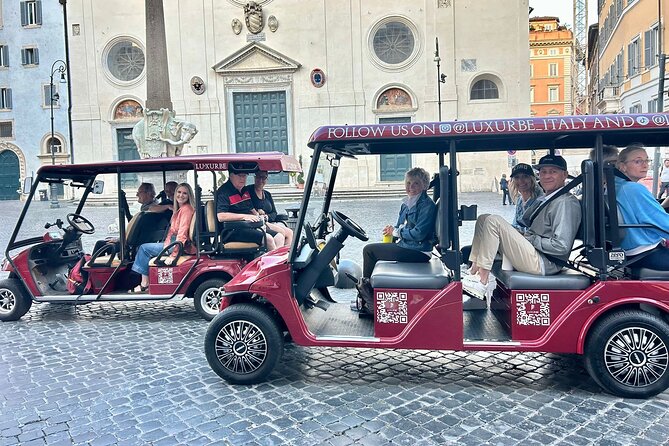
Two stops focus on Caelian Hill: the church area around San Gregorio Magno and the ancient dwellings known as Case Romane del Celio.
Church of San Gregorio Magno, quiet cloister energy
The tour lists Celio as the Church of San Gregorio Magno, where you can find frescoes and a peaceful cloister garden. Even if your time on site is short, the point is atmosphere. This is a break from high-traffic viewpoints, and it helps you feel Rome as a place of worship and everyday ritual, not only public monuments.
Case Romane del Celio, Roman domestic art
Next is Case Romane del Celio, ancient houses with preserved frescoes and mosaics. This is one of the more special stops on the route because it shifts the scale down. Instead of thinking about civic plans and emperor power, you look at elite domestic life.
If you like archaeology that feels like real rooms and real decoration, this stop will stick with you longer than another quick exterior photo.
Aventine Hill finale: Roseto, keyhole view, and the Orange Garden
The Aventine stops are the payoff section. They are calmer, scenic, and they give you the kind of photo that feels earned.
Roseto Comunale, seasonal rose gardens with city views
You’ll visit the Roseto Comunale, the municipal rose garden on the Aventine Hill. It’s described as open seasonally and has over a thousand rose varieties, plus pathways, fountains, and panoramic views.
Even if roses are not blooming when you go, the hilltop vantage and garden design are still the point. This is a place to slow down for a bit, because it feels different from Rome’s high-traffic streets.
Buco della Serratura, the Knights of Malta keyhole view
Then it is Buco della Serratura dell’Ordine di Malta, the keyhole viewpoint at the Priory of the Knights of Malta. Peering through the keyhole frames St. Peter’s Basilica in a carefully aligned view, and that framing is the magic.
This is one of those experiences that is simple, but it only works because the viewpoint is specific. You get the short moment and the composition, then it is gone. So if you want photos, position yourself quickly and be ready.
Giardino degli Aranci, orange trees and St. Peter’s panorama
Finally comes the Giardino degli Aranci. The Orange Garden offers orange trees, benches, and wide views including the dome of St. Peter’s Basilica. It is a peaceful ending because the setting lets you absorb the city after all the monuments.
In many itineraries, the best part is the last part. Here, it often is.
What makes the tour shine, and what can go wrong
This type of tour is only as good as its pace and its guiding. When it runs well, the cart ride is fun and the explanations help you connect stops fast.
Some of the most praised guides in this route include names like Ernesto, Fabrizio, Johnny, Daniel, Luca, Claudio, Robin, Edwin, and Matt. Across those experiences, the common thread is that the guide shapes the tour based on what you want, shares practical Rome tips for later evenings, and makes the ride itself feel like part of the sightseeing.
Still, there are recurring pitfalls you should watch for:
- Stop timing can shorten if traffic or safety changes the plan.
- Colosseum time may be limited since entry is not included.
- Audio may not be automatically obvious, since audio guides are listed as provided on request if available. If you care about narration, ask early so you are not stuck craning your neck to catch the guide’s words.
A golf cart tour is also a shared experience, so expect a bit of variability. The upside is flexibility and access. The downside is you should not treat it like a rigid, minute-by-minute script.
Who this tour suits best
I would point you to this tour if:
- You have limited time and want a fast orientation loop across Rome’s major districts and hills.
- You prefer seats over long walks, especially on a first day or after travel.
- You want the Aventine area stops, including the Orange Garden and keyhole view, without building a separate transport plan.
I would think twice if:
- You want long, ticketed immersion at every major site, especially the Colosseum.
- You are the type who needs every stop with a guaranteed length, regardless of traffic.
Should you book Seven Hills of Rome by Golf Cart?
Yes, with a smart plan.
Book it if you want the practical Rome overview, you like scenic viewpoint stops, and you are happy to treat paid monument visits as extras you schedule around this tour. The best part is how the route helps you understand Rome as a set of hills and sightlines, not as a random list of attractions.
Skip or pair it carefully if you expect a full Colosseum visit or if you need strict stop times at every listed location. In that case, plan your most important paid interior visits for another day.
If you do book, do two things: bring patience for pacing shifts, and ask about audio early so you do not miss narration while you’re moving between hills.
More Tours in Rome
More Tour Reviews in Rome
Not for you? Here's more nearby things to do in Rome we have reviewed





Rome Golf Cart Tours, compared.
 ★ 4.8Imperial City Tour by Golf Cart with Optional TransferFrom $1241,024 reviews
 ★ 5.0Golf Cart Small-Group Guided Tour: Rome City HighlightsFrom $104907 reviews
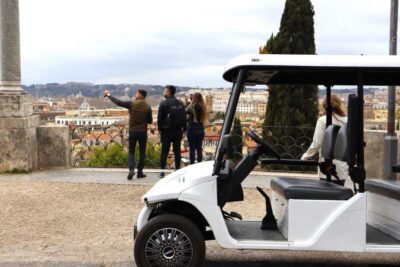 ★ 4.8City Highlights Golf Cart TourFrom $45857 reviews
 ★ 5.0Private/Group 4 Hours Golf Cart SightseeingTourFrom $168780 reviews
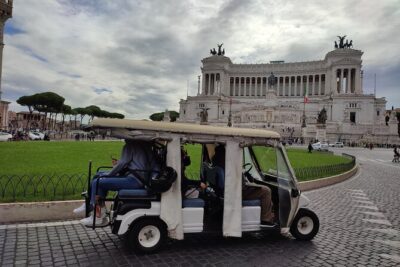 ★ 5.0Explore Rome on a Golf Cart: Private TourFrom $83757 reviews
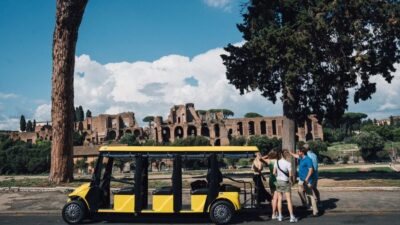 ★ 4.8City Highlights Golf Cart Tour with Local GuideFrom $71752 reviews
 ★ 4.5Rome by Night: Golf Cart TourFrom $108688 reviews
 ★ 5.0Rome Catacomb & Appian Way Small-Group Tour by Golf CartFrom $107681 reviews
Browse the lists this tour appears in