

Reviewed · ROME GOLF CART TOURS
Rome in Golf Car a Private Trip between History and Beauty
Rome goes by in fast, comfy style. This private Rome in Golf Car trip links big sights with hotel pickup and photo-friendly pacing, so you spend less time navigating and more time looking up. I also like the way guides such as Max and Mauricio can adjust the route when your interests shift. One possible drawback: the booking page can sometimes misprice certain party setups, so double-check the final total before you confirm.
What makes this work is the balance of must-see icons and manageable walking. You get time to pause at landmarks, snap photos, and orient yourself for the rest of your trip, which is a lifesaver if Rome time is tight (like one day plus a half day). You should also plan for crowds near the headline sites, because the city does not quiet down just because you arrive by golf cart.
Finally, it is a private outing, so you are not fighting for position on a coach. Still, you are traveling through the center, where traffic and pedestrian crossings can be slow, even on a good day. If you want a calm, highly structured experience, this is a strong fit. If you want a long, museum-style day, you may find 3 hours feels short for Rome’s deeper rabbit holes.
Key highlights you’ll feel right away
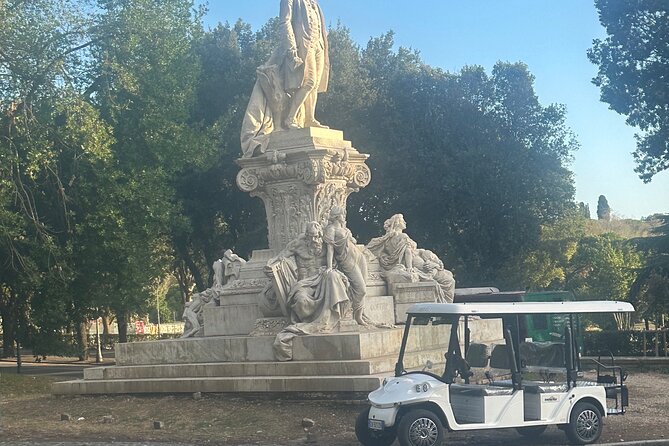
- Hotel pickup plus easy start: you begin without dragging bags to a distant meeting point
- Photo stops built into the route: you get time to park, frame shots, and move on
- Guide flexibility: guides like Max and Mauricio are praised for tailoring the flow
- Pantheon visit with included entry time: you see the dome and oculus area as part of the plan
- Icon chain in one outing: Trevi, Spanish Steps area, Piazza del Popolo, and more in one circuit
How a private golf cart tour actually helps in Rome
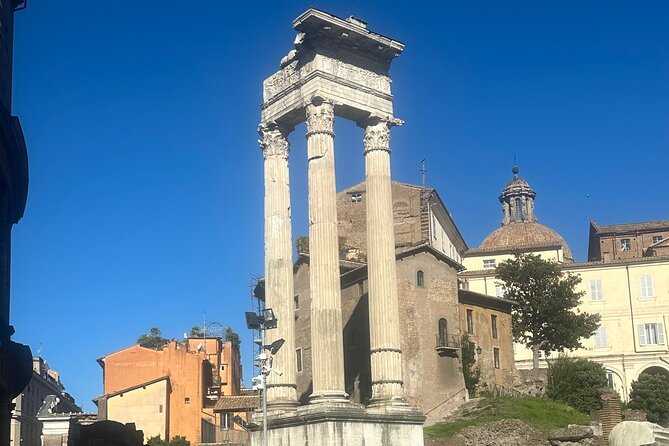
Rome is stunning, but it can be exhausting. The streets are narrow, the sidewalks get crowded, and the “where is the bus stop again?” feeling can steal energy. A golf cart private tour keeps you close to the action while reducing the long, stop-and-start marches between monuments.
This trip is about getting your bearings fast. You cover major spots that are spread across central Rome, including the Trevi Fountain area, Spanish Steps neighborhood, and the Pantheon zone. After a 3-hour spin like this, you usually understand where things sit relative to each other, so your next walk, taxi ride, or museum booking makes more sense.
I also appreciate the practical mindset you can feel in the way the day runs. The best experiences here are not just speed, they are pacing: short time at each stop, clear explanations while you are looking at the view, and enough room for photos. If you are traveling with kids, older adults, or anyone who wants less walking, that matters.
And yes, Rome crowds still exist. You will be near busy piazzas and popular viewpoints, especially around Piazza di Spagna and the central monuments. The difference is that you are not stuck transferring between faraway points on foot.
You can also read our reviews of more private tours in Rome

Trevi Fountain: that baroque moment and a smooth first wow
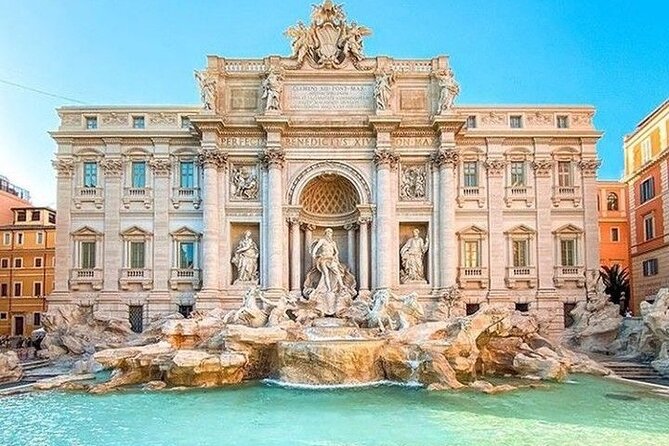
Trevi Fountain is one of those places where your brain says I have seen this before, but your eyes still can’t believe it when you are actually there. You get an intentional stop that focuses on the fountain’s dramatic scale and the storytelling details of its design. The time is built for photos, so you can get your framing without rushing into the next rush.
A small practical tip: plan for the crowd rhythm. Even with a golf cart, the most photogenic angles can be busy, so it helps to be ready to shift position as your guide suggests. If you care about a clean photo, go for a moment when the crowd thins just slightly, then take your shot and move with the group.
Also, this is the kind of stop where a quick coin toss moment becomes more meaningful when you understand what you are looking at. The fountain’s symbolism and baroque elements are part of the experience, not just the postcard picture.
Piazza Venezia and the Colosseum area: orientation plus big-city context
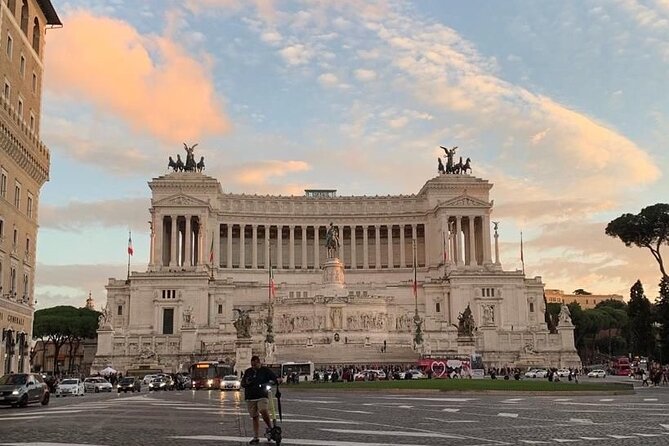
Even if you do not go into the Colosseum itself during this outing, the Colosseum zone makes sense as a foundation stop. Piazza Venezia sits right in the thick of central Rome, and it helps you orient to how the city is laid out around monuments and major roads.
This is a good segment if you want to connect the dots between what you have read and what you see with your own eyes. You get a snapshot of the area, plus nearby historic landmarks that give you context for what is coming next. It also helps if you plan to return later for a more detailed visit, because you will feel how close (or far) things really are.
One thing to consider: your time here is short. It is not trying to be a deep-dive into ancient engineering or politics. Think of it as a navigational anchor, a way to lock in where the landmarks sit before you spend more time elsewhere.
Spanish Steps, Trinità dei Monti area, and the shopping street connection
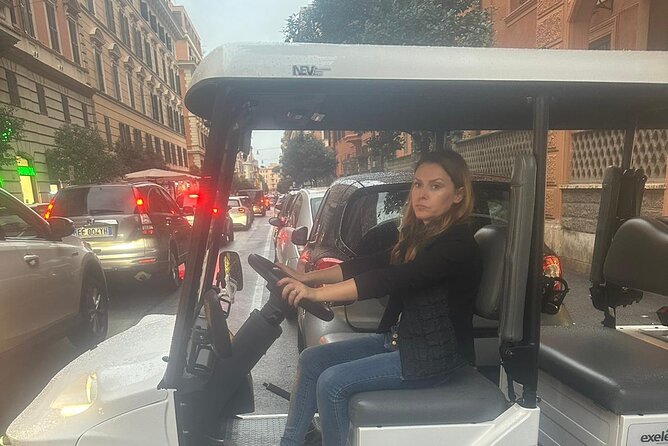
The Spanish Steps area is basically Rome’s outdoor social hub. You get the classic viewpoint from Piazza di Spagna, with the steps rising up toward Trinità dei Monti. It is one of the most photographed places in the city for a reason: the composition is built to pull your eye upward.
This stop works well on a golf cart because you can get close to the action, then step in to take your photos and get the feel of the piazza. The church viewpoint area matters too, because it changes how you see the steps and the flow of people around them.
From there, Via del Corso and the nearby streets bring you into Rome’s everyday energy. Via del Corso is a major artery that connects big piazzas, lined with shops and cafes. It is a practical reminder that Rome is not just monuments, it is also neighborhoods, street life, and day-to-day movement.
If you like fashion window browsing, Via dei Condotti also fits the bill as a luxury shopping stretch, lined with designer names. Even if shopping is not your priority, walking past flagship storefronts is a fast way to understand another side of Rome’s identity.
Piazza del Popolo: the Obelisk view and three-church framing
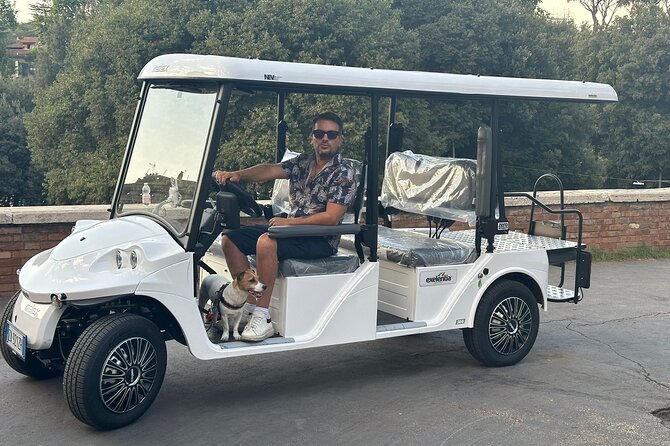
Piazza del Popolo feels like Rome’s northern gateway. It has an elliptical shape, and the center point is the Flaminian Obelisk, an ancient Egyptian obelisk dating to 10 BC. The fact that it is anchored in an open square gives you a clean sightline that is easy to photograph and easy to understand.
What I like about stopping here is how the space frames historic buildings. You have the churches Santa Maria in Montesanto and Santa Maria dei Miracoli on either side, plus Santa Maria del Popolo at the far end. This makes the square feel like a designed set, not just a traffic circle where you wait for a light.
If you are tired of being surrounded by scaffolding and crowds at the most famous sites, this can feel like a welcome reset. It still has energy, but it also gives you a better sense of scale and layout. And since Piazza del Popolo connects to Via del Corso, it pairs well with the rest of the shopping and architecture stops.
You can also read our reviews of more historical tours in Rome

Bocca della Verità: a quick culture moment with Roman personality
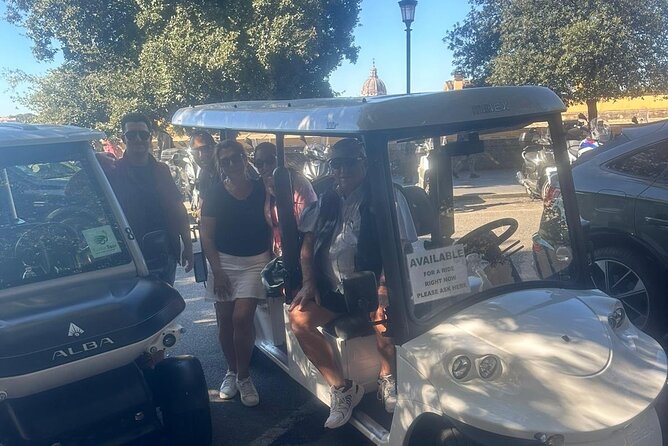
Bocca della Verità is one of those places that blends fun with history. You stop near it in the same general area as the Trinità dei Monti and Spanish Steps zone, so it fits naturally into the day without adding major travel time.
This stop is shorter, so it is not about lingering for hours. Instead, it is a quick chance to see a distinctive Roman artifact and add a little pop-culture flavor to your ancient itinerary.
If you are traveling with people who like hands-on, quirky stops, this is the kind of moment that tends to land well. If your group prefers strict museum pacing, you may want to balance it with extra time at the Pantheon later.
Pantheon: why included entry time matters
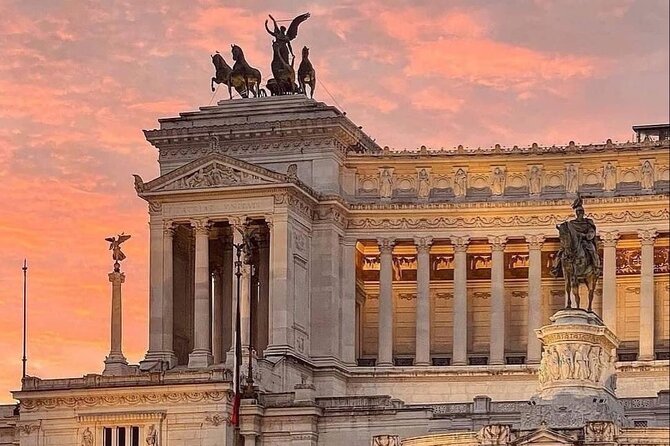
The Pantheon is the stop that usually makes people slow down, even if they think they are “not the dome type.” It is one of the best-preserved monuments in Rome, built in the 2nd century AD, later adapted as a church. The engineering is impressive, but what hits hardest is the light.
Inside, the dome has a central oculus. Light pours in from above, and that changing brightness makes the space feel alive in a way photos cannot fully capture. You also get the classical symmetry and columns in the entrance area, which helps you appreciate why the building influenced later architecture for centuries.
This tour includes an admission ticket for the Pantheon stop, which is a real value. In a 3-hour day, skipping that kind of hassle matters. It also helps you avoid losing time to ticket lines or entry uncertainty when you are trying to fit a lot into limited time.
Practical note: the Pantheon interior can feel cool and calmer than the street outside, but it is still a popular site. Go with the flow, stand where your guide tells you, and give yourself a second to look upward after you enter.
Imperial Forums and Roman ruins: power, politics, and “oh wow” scale
In the central Rome area, the Imperial Forums connect you to the political and civic heart of ancient Rome. This is where you feel how massive Rome was, not just how beautiful.
You see the idea of multiple forums commissioned by emperors across time, with temples, basilicas, columns, and triumphal arches. It is less about one perfect angle and more about reading the space as a whole. The ruins are not intact like a preserved museum, but that is the point. You are looking at the remains of systems that shaped public life.
This segment is also a time saver. If you tried to stitch the same sights together on your own, you would likely spend extra time deciding transport, walking routes, and entry windows. Here, you get a guided flow that keeps you moving efficiently.
If you like photography, the Forum areas can be tricky because the best shots depend on crowd patterns and angles. You may not get the empty-square version you imagine, but you should still get plenty of clear views with patience.
Teatro di Marcello and Giardino degli Aranci: ancient theater meets a calm pause
Roman theaters feel different from modern venues. You are not just looking at seating, you are seeing how public entertainment shaped city life. Teatro di Marcello, built at the request of Emperor Augustus and dedicated to his nephew Marcellus, is a good example. Even in partial form, you can sense the scale. The idea of around 20,000 spectators gives you a sense of how big ancient events really were.
Then you get an escape from noise and crowds at Giardino degli Aranci, also known as Orange Garden, on the Aventine Hill. This is a far better use of time than staring at maps. You stroll among orange trees and get that classic Rome panoramic view over the city and toward the Tiber River.
I love adding one calmer viewpoint into a tour like this, because it changes your body’s rhythm. After monuments, it feels good to slow down, breathe, and look across Rome instead of only up close.
Price and value: when $131.81 per person makes sense
$131.81 per person can sound steep if you compare it to a few tickets and a Metro ride. But for Rome, this price often makes sense because you are paying for four things you cannot buy easily one by one.
First, private time. You are not stuck with the “stand here, move there” pace of a larger group. Second, you get hotel pickup (direct pickup from hotels is offered), which can save you from wasted travel time and confusion.
Third, you are buying fewer transportation headaches. Central Rome is walkable, but the distances between the most famous points can feel longer than you expect. A golf cart keeps you close while reducing the time you spend weaving through traffic or backtracking.
Finally, you get guides who are praised for being flexible and for taking great photos of you. Even if you think you can handle photos yourself, a good guide helps you avoid the most awkward angles and timing issues, which is worth real money when you only have a few days.
This tour is also easier to justify when you are short on time. People with 1.5 days in Rome often use this kind of routing to pick the rest of their itinerary with confidence.
Who should book this Rome in Golf Car trip
This is a strong fit if you:
- want to see many top sites in about 3 hours without turning your trip into a leg workout
- value a guide who adjusts based on what you want to prioritize
- care about photos, especially at the iconic squares and viewpoints
- arrive in Rome and want quick orientation for the rest of your stay
It may be less ideal if you:
- want long museum time at a single site
- prefer wandering at your own pace all day with zero structure
- are hoping for a quiet, crowd-free Rome day, because these landmarks are popular
Quick practical prep before you go
Wear comfortable shoes anyway, because you will step out at viewpoints and inside places like the Pantheon. Dress for the weather, and be ready for sudden sun or shade changes in open piazzas.
If you want your photos to look great, think about timing. Popular squares can be packed, so if your guide suggests a new angle, take it. Also, if you have hearing needs, it can help to tell your guide your preferences, and then follow their cues for where to stand for the best explanations.
Should you book this Rome in Golf Car tour?
If you have limited time in Rome and you want an efficient, good-looking “Rome highlight chain” day, I think this tour is a smart booking. The value comes from hotel pickup, private pacing, short stops that still feel meaningful, and a guide style that supports photos and flexibility. For many visitors, it becomes the day that sets up the rest of the trip.
If you have a full week and love slow, deep museum days, you might spend your money differently. But for a first or second day in town, this is a reliable way to hit the key landmarks without wearing everyone out.
FAQ
How long is the Rome in Golf Car private trip?
It runs about 3 hours.
What is the price per person?
The price listed is $131.81 per person.
Is this a private tour?
Yes. Only your group participates.
Does the tour include hotel pickup?
Yes. Direct pickup from hotels is offered, and the tour also has a meeting point at Fontana dell’Adriatico/Piazza Venezia.
Are tickets included for any attractions?
Yes. Trevi Fountain and the Pantheon are listed with admission ticket included. Other stops are listed as free.
What languages are offered for the guide?
The guide is offered in English, Spanish, Italian, Russian, Ukrainian, and Polish.
Will I receive a mobile ticket?
Yes, a mobile ticket is provided.
What if weather is bad?
This experience requires good weather. If it is canceled due to poor weather, you will be offered a different date or a full refund.
Is there free cancellation?
Yes. You can cancel up to 24 hours in advance for a full refund.
More Historical Tours in Rome

More Private Tours in Rome
More Tour Reviews in Rome






Not for you? Here's more nearby things to do in Rome we have reviewed












Rome Golf Cart Tours, compared.
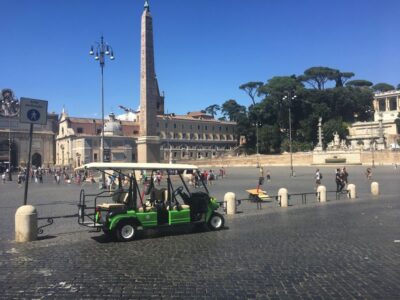 ★ 4.8Imperial City Tour by Golf Cart with Optional TransferFrom $1241,024 reviews
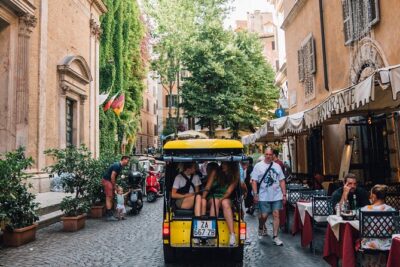 ★ 5.0Golf Cart Small-Group Guided Tour: Rome City HighlightsFrom $104907 reviews
 ★ 4.8City Highlights Golf Cart TourFrom $45857 reviews
 ★ 5.0Private/Group 4 Hours Golf Cart SightseeingTourFrom $168780 reviews
 ★ 5.0Explore Rome on a Golf Cart: Private TourFrom $83757 reviews
 ★ 4.8City Highlights Golf Cart Tour with Local GuideFrom $71752 reviews
 ★ 4.5Rome by Night: Golf Cart TourFrom $108688 reviews
 ★ 5.0Rome Catacomb & Appian Way Small-Group Tour by Golf CartFrom $107681 reviews
Browse the lists this tour appears in