
Reviewed · HISTORICAL TOURS
Rome Highlights Tour Squares and Fountains Stroll Through History
Rome’s biggest hits roll by on foot. This highlights tour strings together iconic piazzas and fountains fast, with a real art historian guide and clear headsets so the stories land as you walk. One thing to plan for: it’s a walking route with stairs and uneven cobblestones, and it is not recommended for people with motor difficulties or using walkers.
I like that the tour is built for first-time Rome. In about 2 to 2.5 hours, you’re looking at the Spanish Steps, Trevi Fountain, Pantheon (outside), Piazza Navona, Castel Sant’Angelo area, and a scenic St. Peter’s Basilica view in the Vatican. If you want a smooth intro plus big-name sights without spending your day figuring out logistics, this fits.
Key Highlights You’ll Actually Feel on This Tour
- Headsets make the guide easy to hear (especially with group size over 8 people)
- You cover major landmarks in a tight route: Spanish Steps, Trevi, Pantheon, Navona, and more
- Trevi Fountain admission is included during the stop
- Pantheon is an outside visit, so you get the must-see exterior without extra waits
- The end point is right near Ponte Sant’Angelo for an easy next walk along the Tiber
- English-speaking, with an art-focused approach, and named guides Sabrina, Andrada, and Alfredo have stood out in feedback for their explanations
Why This Rome Highlights Walk Works in 2.5 Hours
Rome can overwhelm you. This tour doesn’t try to do everything, it just hits the highest-impact sights and connects them with the kind of context that makes photos feel less random.
You’re paying $69.84 per person for a guided, timed loop. For that price, the big value is not just the famous stops, it’s the structure: a guide for about 2.5 to 3 hours, plus headsets, plus a route that keeps you moving between areas that you’d otherwise need to stitch together yourself. If you’re here for a short stay, that efficiency matters.
Group size is capped at 50, and the tour notes say you’ll be using headsets to hear clearly for groups over 8. That’s a practical touch. It’s also why this tour works well if you care about the why behind the art and architecture, not just the what.
Timing also helps. Most stops are around 10 to 15 minutes. That’s long enough to orient yourself, spot key details, and take a few photos, but short enough that you’re not stuck for an hour wondering what to do next.
You can also read our reviews of more historical tours in Rome



Meet at Piazza della Trinità dei Monti, Then Make Sense of the Spanish Steps
The tour starts at Piazza della Trinità dei Monti, a smart place to begin because everything here is about elevation and view. The first stop is Santissima Trinità dei Monti (Trinità dei Monti), the church above the Spanish Steps. The setting is part of the story: the church sits over the long stairway down toward Piazza di Spagna, and the surrounding area including Villa Medici is tied to French state property.
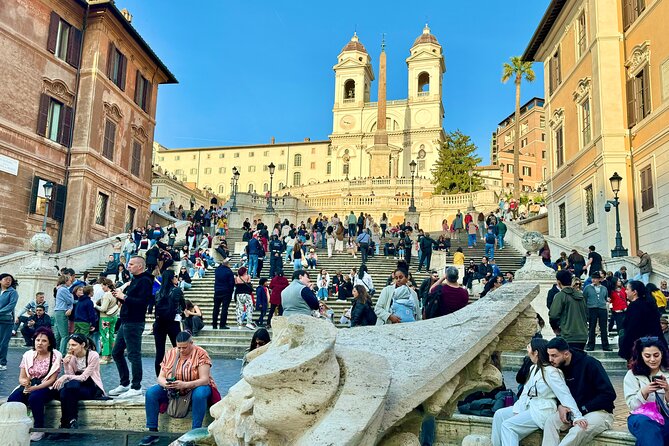
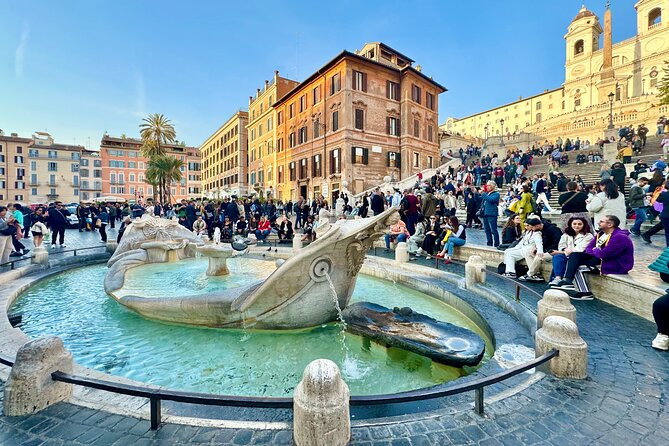
From there, you climb to the Spanish Steps viewpoint. The famous stairway is 135 steps, designed by Francesco de Sanctis and Alessandro Specchi, linking the church at the top with Piazza di Spagna at the bottom. This is one of those Rome scenes where you can feel the planning, even if you don’t know the dates. The Bourbon kings of France and the Spanish Embassy connection are part of why the steps were built with such symbolic weight.
Practical tip: wear shoes you’re happy to walk in for stairs. Even if you’re fit, this is classic Rome terrain, and the tour also warns it’s not ideal for walker users or people with motor difficulties. If you have knee or mobility issues, plan to move slower and consider asking the guide what the smoothest pace can be. In feedback, at least one guide adjusted walking pace and used easier routes for someone with knee problems.
Trevi Fountain Stop: What You See, What You Learn, and What to Budget
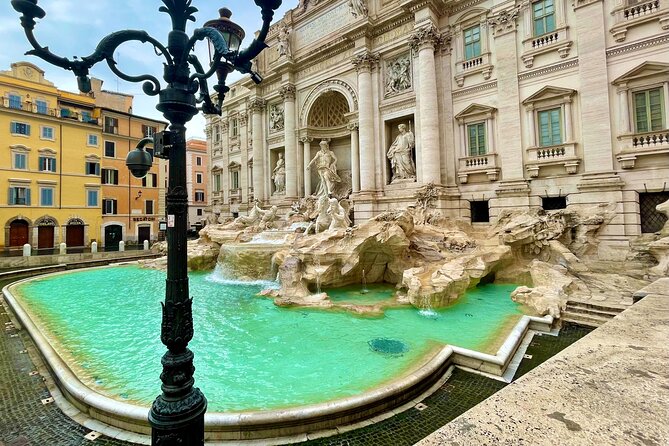
Trevi Fountain is the kind of stop that can either feel magical or chaotic, depending on how you approach it. This tour gives you a timed window, and it includes admission for this fountain stop.
Fontana di Trevi is an 18th-century Baroque fountain designed by Nicola Salvi and completed by Giuseppe Pannini in 1762, with additional work by others. Scale is a big part of why it hits hard: it is 26.3 meters high and 49.15 meters wide. Even if you’ve seen pictures, standing close is different. You notice the depth of the sculptural groups and how the design pulls your eye across the whole façade.
Here’s the value of having a guide at Trevi. Without context, it’s easy to treat Trevi like a photo background. With history and art talk, you start to see how the fountain fits into Rome’s Baroque approach to drama, movement, and power.
Two quick cautions:
- Don’t count on time for a long detour. This stop is listed at about 10 minutes.
- If you plan to spend money nearby, build it into your day since food and drinks are not included on the tour.
Pantheon Outside: The Exterior That Makes the Inside Worth It Later
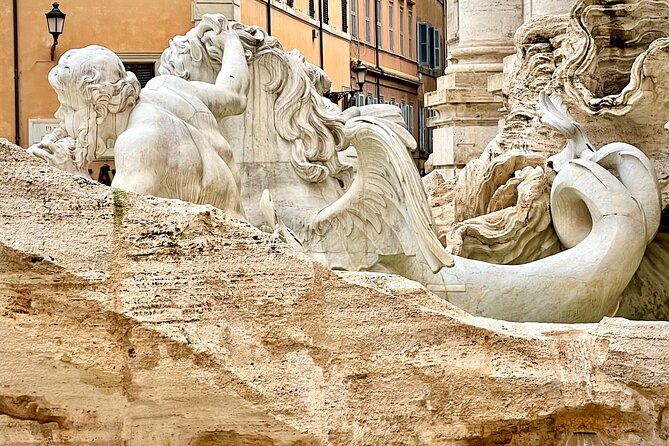
The Pantheon is one of those buildings you can’t really fake. You might only see it outside on this tour, but that’s still worth it.
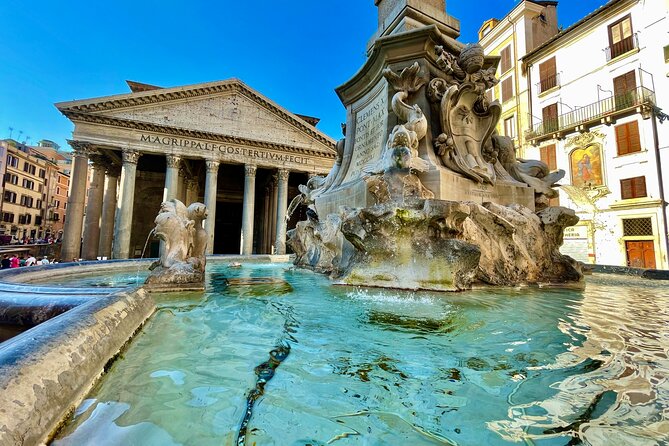
You’ll spend about 15 minutes, and the tour lists it as outside visit, with admission not included. That means you should treat this stop as orientation and appreciation, not a full-entry experience. The Pantheon’s story is massive: it started as a Roman temple commissioned by Marcus Agrippa during Augustus’ reign, then burned, then the current building was ordered by Emperor Hadrian, likely dedicated around AD 126. Since AD 609, it has been a Catholic church, known as Basilica Santa Maria ad Martyres.
Even if you don’t enter, you can still do a lot here if you focus your attention. Look at the scale of the front and the overall geometry. The guide’s art history angle helps you connect why the structure is so influential long after the Roman era ended.
What I like about an outside-only stop: it reduces your time wasted behind lines and it keeps the tour moving. If you want to go inside later, you’ll be more prepared, because you already understand what you’re looking at.
Piazza Navona and the Four Rivers Fountain, Built on Ancient Stadium Lines
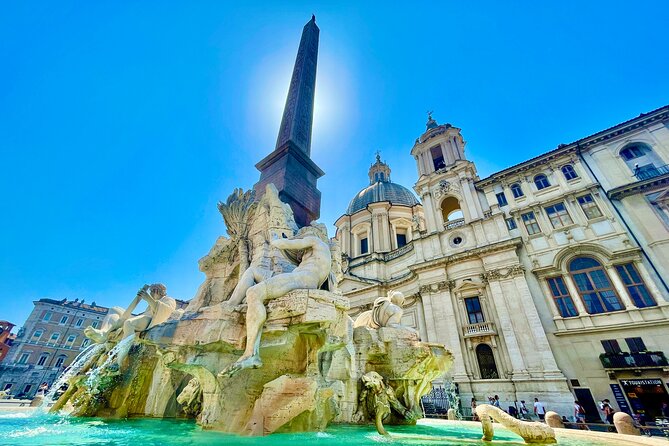
Piazza Navona is a great payoff after the temples and fountains. Instead of one building dominating the scene, you get an open space with layers.
This tour gives you about 15 minutes in Piazza Navona, and it also includes Fontana dei Quattro Fiumi, the Fountain of the Four Rivers. Fontana dei Quattro Fiumi is in Piazza Navona, designed in 1651 by Gian Lorenzo Bernini for Pope Innocent X. The pope’s family palace faced onto the piazza, and the church of Sant’Agnese in Agone is nearby.
Here’s the extra context that helps you understand why the piazza looks the way it does. Piazza Navona is built on the site of the 1st-century AD Stadium of Domitian. The shape follows the old stadium footprint, an elongated oval. Over time, the name changed from Circus Agonalis to something like in avone to navone, then eventually to Navona.
That stadium-to-piazza transformation is exactly the kind of Rome continuity your guide can make clear in simple terms. Instead of thinking, I’m in a scenic square, you realize you’re standing on a place that has hosted crowds for nearly two thousand years.
Practical tip: budget a moment to slow down. The fountain and surrounding church fronts are where the details live. This stop is not long, so it helps to decide what you want to notice in advance.






Castel Sant’Angelo and Ponte Sant’Angelo: Rome’s Tiber Crossing With Big Views
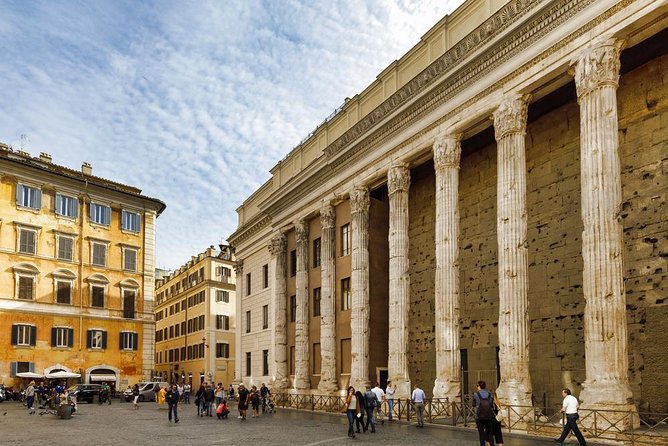
After Navona, the route shifts toward the Tiber. You’ll stop at the Mausoleum of Hadrian, known as Castel Sant’Angelo. The structure began as a mausoleum commissioned by Emperor Hadrian, later used by popes as a fortress, and today it’s a museum. The tour notes also say it was once the tallest building in Rome, which is a wild fact to consider while you’re looking at it.
Then comes Ponte Sant’Angelo, or St. Angelo Bridge. This bridge spans the Tiber and was completed in 134 AD under Hadrian. It has five arches and was faced with travertine marble. Originally known as the Aelian Bridge, it was designed to connect the city center to Hadrian’s mausoleum.
The best part for many people is the bridge now being pedestrian only. It’s a scenic view route that links the rioni of Ponte and Borgo. On the tour, it’s about 10 minutes, and the admission ticket is listed as free.
If you like walking with payoff views, this is your moment. Even if you don’t plan to go into Castel Sant’Angelo museum space, the exterior and the river angle help you understand why the area mattered so much for centuries.
St. Peter’s Basilica Scenic View: A Short Vatican Hit Done Right
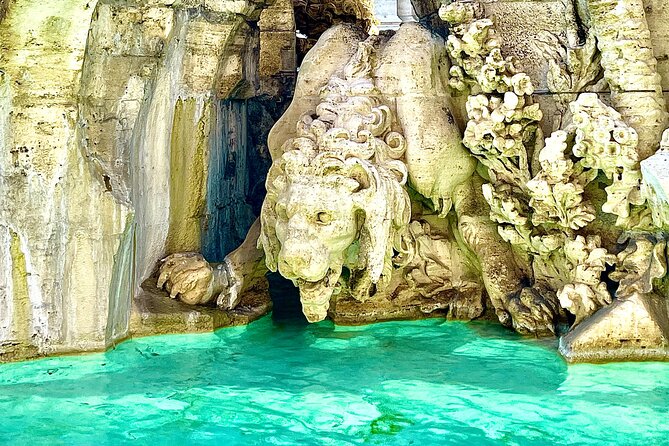
The final major sight is St. Peter’s Basilica, with a scenic view stop. It’s listed at about 1 minute, and the admission ticket is free.
This basilica is a High Renaissance landmark in Vatican City. Construction of the present basilica began in 1506 and was completed in 1626. The tour also notes the old basilica started with Constantine the Great in the 4th century, and the current one replaced it as plans developed in the 15th century under popes Nicholas V and Julius II.
Because this is a quick scenic stop, I’d treat it like a visual stamp on your day, not your full Vatican plan. If St. Peter’s is a priority for you, you’ll likely want separate time later. Still, this moment can make your whole day feel complete, since you started up in Trinità dei Monti and finished near the Vatican perimeter.
Price and Value: What $69.84 Buys You, and What It Doesn’t
At $69.84 per person, this tour is priced in the sweet spot for a highlights walk that includes real guidance and headsets. Here’s the value breakdown based on the tour details:
What’s included:
- Headsets to hear the guide clearly
- A professional art historian guide for about 2.5 to 3 hours
- Trevi Fountain admission is included (listed for that stop)
What’s not included:
- Food and drinks
- Transportation
- Hotel pickup and drop-off
- Admission tickets for Pantheon (outside visit) and the other stops are listed as not included
That last point matters. Outside visit means you might not need tickets for the time you’re there, but if you want to go inside certain sights, you should expect separate ticket planning.
Also keep in mind the tour order can vary. That’s normal in Rome, and it doesn’t usually affect the overall experience. It’s more about keeping you moving efficiently in the city environment.
Who Should Book This Tour, and Who Should Skip It
This is a great match if you want:
- A fast intro to Rome’s top piazzas and fountains
- An art-and-history explanation while you’re walking
- A manageable half-day plan, about 2 to 2.5 hours
- A guided route that helps you connect landmarks into a bigger picture
It may be less ideal if:
- You need a low-stairs route, because you’ll handle elevation and uneven surfaces
- You use a walker or have motor difficulties, since the tour specifically says it is not recommended for walker users
- You want lots of museum time, because the Pantheon is outside and St. Peter’s is a brief scenic view
One more fit question: are you okay with smart casual dress? The tour calls for smart casual. Rome is flexible, but you’ll feel better if you’re dressed for standing and quick movement.
The Guides Matter: What High Praise Tells You About the Experience
The strongest praise across the feedback is about the guides themselves. People repeatedly highlight that the guide explains history in a way that adds emotion, not just dates.
Named guides in the feedback include Sabrina, Andrada, and Alfredo. The common thread is strong English and a serious art history focus, especially around Baroque style. One review also talks about the guide making it personal and adjusting walking pace for knee issues, using short cuts when needed. That’s exactly what you want from an expert in the field and also from a real person managing a group.
So even though the itinerary lists the stops, the experience is really about how the guide ties them together. You come away with a sense of the city’s logic, not just a checklist.
Should You Book This Rome Highlights Tour?
Yes, if you’re a first-timer who wants the headline sights with context and you’d rather walk with a plan than build one yourself. The biggest reason to book is the combination of art historian guidance plus headsets, plus Trevi Fountain admission included, all within a manageable 2 to 2.5 hour window.
Skip it if your main goal is long, slow sightseeing inside monuments and museums. This tour is designed for outside views, quick stops, and smart pacing, not for deep interior time.
My decision checklist for you:
- If you want Spanish Steps, Trevi, Pantheon exterior, Piazza Navona, and Castel Sant’Angelo area in one go, this is a solid choice.
- If you have mobility limits, treat the warning seriously and consider a less stair-heavy alternative.
- If you care about Baroque and how Rome layers centuries on top of each other, the guide-driven format will feel worth every minute.
If that sounds like your pace, book it and use the rest of your day to go back to the one or two places that stay with you.
FAQ
How long is the Rome Highlights Tour?
It runs about 2 hours to 2 hours 30 minutes, depending on the flow of the walk and conditions.
What is the tour language?
The tour is offered in English.
Where do I meet and where does the tour end?
You meet at Piazza della Trinità dei Monti, 380, 00187 Roma RM, Italy, and the tour ends at Piazza di Ponte S. Angelo in front of Castel Sant’Angelo Bridge.
What is included in the ticket price?
Headsets are included, and you get a professional art historian guide for about 2.5 to 3 hours. Trevi Fountain admission is included.
Are tickets included for the Pantheon?
The Pantheon stop is listed as an outside visit, and admission ticket is not included for that stop.
Is St. Peter’s Basilica included, or just viewed?
It is listed as a scenic view stop, and admission ticket is free. The tour duration there is about 1 minute.
What about food and drinks?
Food and drinks are not included unless specified.
Is there a dress code?
The dress code is smart casual.
Is it refundable if plans change?
Free cancellation is available up to 24 hours in advance for a full refund.
More Historical Tours in Rome

More Tours in Rome



More Tour Reviews in Rome
Not for you? Here's more nearby things to do in Rome we have reviewed












Historical Tours, compared.
 ★ 4.9Forbidden History Walking Tour & Pub Crawl with DrinksFrom $61688 reviews
 ★ 4.5Twilight Treasures: An Evening Tour Through Rome’s Rich HistoryFrom $4263 reviews
 ★ 4.7Colosseum, Vatican Museums & Historic Center in a Day228 reviews
 ★ 4.5Heritage Site: Villa d’Este and Hadrian’s Villa in Tivoli Tour from RomeFrom $159157 reviews
 ★ 5.0Piazza del Popolo and Historical Sights Walking Tour in RomeFrom $4143 reviews
 ★ 5.0Private Rome Food Tour in the Historic Centre with 8+TastingsFrom $405135 reviews
 ★ 5.0Vespa Tour with Historic City HighlightsFrom $79113 reviews
 ★ 5.0Colosseum & Ancient Rome Private: Women History Guided TourFrom $29690 reviews
Browse the lists this tour appears in