
Reviewed · ROME GOLF CART TOURS
Rome Golf Cart Tour: Discover the Pinnacle Experience
Rome moves fast, and this ride helps you keep up. A 3-hour golf cart tour lets you cover major Rome landmarks and hilltop viewpoints without the constant stop, start, and shoulder-to-shoulder crowds. I especially like the hotel pickup in central Rome and the tight route planning that gets you from big names like the Pantheon to classics like Trevi Fountain. The main thing to consider is timing: many stops are short, and only Pantheon lists admission as not included.
In the driver’s hands, this is a practical way to get your bearings, then choose what to revisit on your own. Guides such as Francesco and Ivana have been praised for making the history feel easy to follow and for adapting the route when you already know what you want to prioritize. One caution, though, is that you will be moving through a lot in a single afternoon, so it works best if you’re happy with brief photo pauses over long museum-style breaks.
Key Highlights You Can Actually Use
- Central pickup plus a true sightseeing pace, so you spend less time hopping buses and more time looking at Rome
- Timed stops at icons and viewpoints, including Pantheon, Piazza Navona, Trevi Fountain, and the Aventine Orange Garden
- Free exterior stops add real value, since many stops list admission as free and only Pantheon flags ticket access as not included
- Route flexibility can happen, with some guides adjusting based on what you request, within the overall tour flow
- Open-air cruising helps mobility, since it is easier on tired legs than constant walking
- Orange Garden panoramas and Bocca della Verità, two stops that feel fun and memorable even with limited time
Why a Golf Cart Route Works So Well in Rome
Rome has a funny way of making you feel like you are always late. Even when you have a plan, cobblestones, winding streets, and long waits for taxis can slow you down. A golf cart tour is a smart fix because it keeps you moving while still letting you see the skyline change from one neighborhood to the next.
In a short window like this, the big win is focus. You do not need to “beat the city” on foot. Instead, you get a guided sweep that hits recognizable places and Roman power points like the hills and forums, plus a few fun detours like the Orange Garden panorama.
It is also a good match for mixed groups. If you have older folks, kids, or anyone who wants to sit down every so often, the open-air ride can make the day feel lighter. In multiple experiences like this, the best part was simply resting while still getting the views.
You can also read our reviews of more tours and experiences in Rome.



Price and Pickup: What $396.48 Per Person Really Covers
At $396.48 per person for about 3 hours, you are paying for transportation, an English-speaking driver, and the structure that keeps everything efficient. You are not paying for attraction entry. In the stop details, Pantheon specifically says admission ticket not included, while several other stops list admission free.
You also get complimentary hotel pickup in central Rome for the private experience. If your hotel is outside the center, the info says you should contact them, and they might arrange a private car. The tour ends back at the meeting point, so you are not being dropped far away without a plan.
A practical tip: because the tour is tight and pickup can depend on where you stay, I’d treat the meeting point as your safety net. The start location is Piazzale delle Canestre, SNC, 00197 Roma RM. If you do not land at the exact pickup spot, it helps to know where the tour base is.
Choosing Your Start Time: Morning, Afternoon, or Evening
The tour offers morning, afternoon, or evening start times. That matters more than it sounds, because your best choice depends on what you want to feel while you ride.
- If you want the day to feel calmer, a morning start often helps you beat the densest foot traffic when you’re heading to big-picture stops like the Pantheon and Piazza Navona.
- If you want the light for photos, an afternoon or evening start can be easier on your group’s energy, especially once you’re climbing in and around the hills such as the Aventine.
One more angle: the itinerary includes several “quick-view” stops. A late start can work fine, but only if you are okay with shorter windows for each location and you do not need long time inside buildings.
Stop-by-Stop: From the Pantheon to Piazza Navona, Trevi, and the Spanish Steps
This is where the tour earns its name as a fast introduction to Rome. You get classic landmarks in a logical loop, which helps if it is your first time in the city.
1) Pantheon (15 minutes)
The Pantheon is both a former Roman temple and, since 609 AD, a Catholic church. It sits on the site of an earlier temple commissioned by Marcus Agrippa during Augustus’s reign. That mix is the whole point: Roman engineering meets later religious use.
Admission is not included for this stop. So if your plan is to go inside, you’ll want to budget extra and treat the 15 minutes as a quick visit window. For most people, this stop is the “big wow” because it is instantly recognizable and historically layered.





2) Piazza Navona (10 minutes, admission free)
Piazza Navona is one of Baroque Rome’s standout squares, built on remains of the Stadium of Domitian. Even if you are only there briefly, the setting makes the city feel theatrical in a good way.
Since admission is listed as free, you are mainly paying attention to the square itself and the flow of the neighborhood around it.
3) Trevi Fountain (10 minutes, admission free)
Trevi is an 18th-century fountain in the Trevi district. It was designed by Italian architect Nicola Salvi and completed by Giuseppe Pannini and several others.
This is one of those stops where your biggest job is planning around crowds and timing. The short stop is still worth it because the guide route keeps you from spending an hour trying to simply reach the fountain area.
4) Spanish Steps (5 minutes, admission free)
The Spanish Steps climb a steep slope between Piazza di Spagna and Piazza Trinità dei Monti. The church at the top dominates the view, which gives you a natural “level change” to photograph.
Five minutes sounds tight, but it usually gives you time to see the steps and get a sense of the layout. If you want a longer linger, you can always come back later, but the cart tour gives you the first hit quickly.
Campo dè Fiori, Villa Borghese, and the Seven Hills Perspective
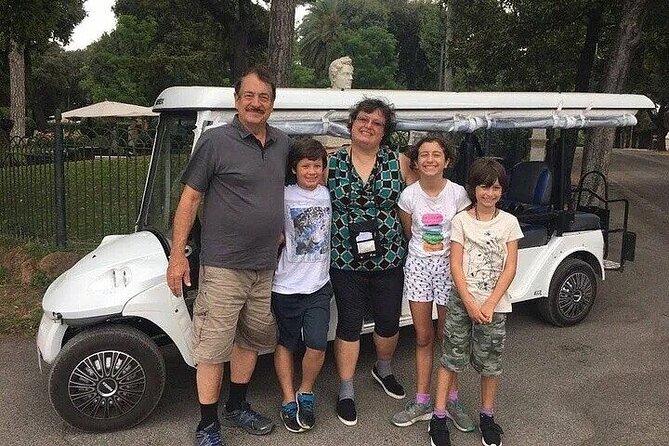
After the top-picture stops, the route shifts into Rome’s “structure.” The places here help you understand why the city feels like it has different personalities depending on the hill you’re on.
Piazza Campo dè Fiori
This piazza is described as rich in colors and sounds, one of the souls of Rome. It overlooks the statue of philosopher Giordano Bruno, burned alive in the center of the piazza.
Even on a short pause, this is the kind of stop that gives Rome a little edge. It’s not just pretty buildings. It hints at real stories tied to specific ground.
Villa Borghese
Villa Borghese is a landscape garden in Rome that includes buildings, museums, and attractions. It is also listed as the third largest public park in Rome.
This stop works well as a reset. You can look out over the space, then mentally switch from “icon sightseeing” to “how locals experience the city.”
Palatine Hill and Aventine Hill
Palatine Hill is described as the center most of the seven hills, and as one of the most ancient parts of the city, called the first nucleus of the Roman Empire. Aventine Hill is another of the seven hills, belonging to Ripa, the modern twelfth rione.
The value here is perspective. Seeing these hills quickly helps you connect the dots between ancient Rome and the modern city shape. It also sets you up for viewpoints like the Orange Garden later.
Circus Maximus
Circus Maximus is an ancient Roman chariot-racing stadium and mass entertainment venue. It’s described as the first and largest stadium in ancient Rome.
If you like big-scale history, this stop lands. Even if you are not standing in the original arena, you get the feeling of scale that buildings like this used to command.
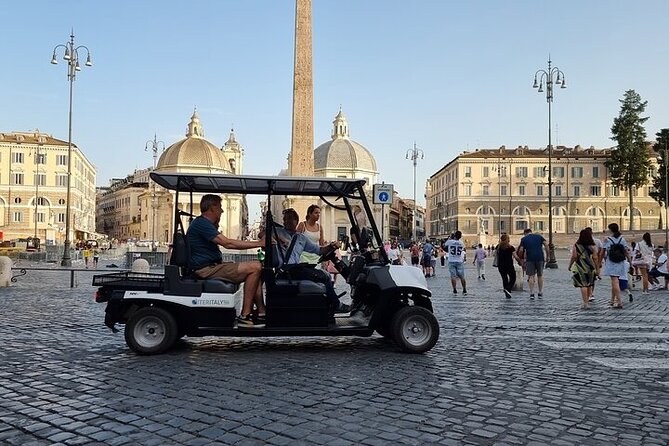
Piazza del Popolo
Piazza del Popolo is located inside the northern gate of the city, once called Porta Flaminia.
This is a helpful stop if you want to understand how city gates shaped movement and views.
Church Facades and Imperial Power: Sant’Ignazio, Augustus, and Piazza Venezia
Rome is not only temples and fountains. A big part of its feel is church architecture and the way empires re-used space over time. This segment leans into that.
Chiesa di Sant’Ignazio di Loyola (10 minutes, free)
This church was built on a design by Jesuit mathematician Orazio Grassi, based on plans by Carlo Maderno and others. It was funded by Cardinal Ludovico Ludovisi, nephew of Gregorio XV. The facade is inspired by the nearby church of Gesù, with two orders of pilasters and Corinthian columns, and enriched by windows and niches.
If you love details, this stop can feel like a mini lesson in how faith and design worked together. The time is short, but the focus is clear: you’re learning what you are looking at.
Mausoleum of Augustus
The Mausoleum of Augustus is described as a large circular tomb. It’s also framed as a key monument for exploring how antiquities get reused, reinterpreted, and rediscovered over time.
This is one of those stops where the most valuable thing is context, not length. Even a quick view helps you connect to the empire theme running through the rest of the route.
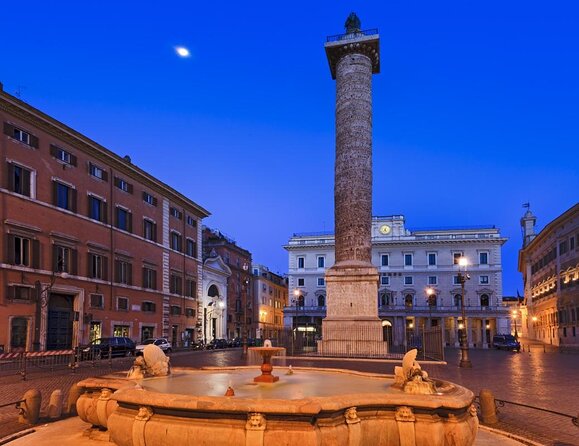
Column of Marcus Aurelius and Faustina
This column stands in Piazza Colonna. It is thought to have been erected by Commodus in memory of his father and mother around 180 CE.
Short stop, clear story. You get a tangible reminder that Roman monuments were often political and commemorative.
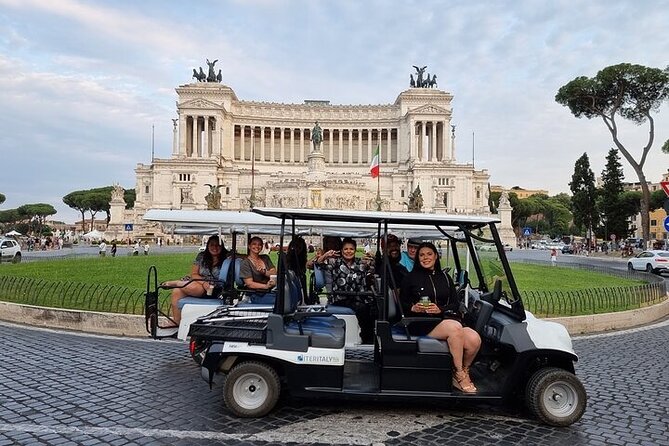
Piazza Venezia
Piazza Venezia’s shape comes from the remaking of the area around the turn of the 19th and 20th centuries, for the construction of the Monumento a Vittorio Emanuele II.
This stop is great if you want Rome to feel continuous across centuries. It’s not just ancient Rome, it’s what later Italy chose to build and how it reshaped space.
Trajan’s Markets and the Imperial Forums: Tech, Panels, and Quick Context
One stop in the route is described as a striking museum that showcases Mercati di Traiano, the 2nd-century complex of emperor Trajan, with multimedia displays and explanatory panels, plus archaeological artifacts.
This segment is valuable for two reasons:
1) It gives you a guided framework for what the Imperial Forums were, not just where they are.
2) It helps your later self-guided walking make sense, because the big relationships are explained.
Because attraction access is not included (and the stop describes a museum experience), plan to treat this as a “see and understand” stop, with possible entry decisions based on what you want to spend time and money on.
Giardino degli Aranci, Bocca della Verità, and the Fun Side of Rome
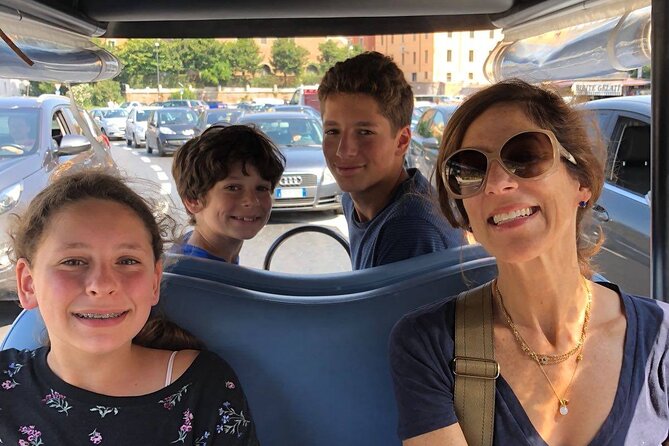
This part of the tour mixes payoff views with playful legend. It is one of the more memorable sections, even if your day is packed.
Giardino degli Aranci (15 minutes, free)
The Orange Garden covers almost 8,000 square meters and offers a panorama over Rome. The route description also notes that if there is time, you might stop at the Keyhole of Rome.
This is a solid reason to take the tour. After you’ve been through squares and architecture, you get a wide breath of Rome, literally from a hilltop garden.
Piazza della Bocca della Verità (5 minutes, free)
Bocca della Verità is an ancient carving said to bite the hands off of liars. The wording here makes the superstition feel like theater.
The best way to do this stop is with a sense of humor and zero seriousness. It’s brief, but it creates a shared moment that breaks up the history grind.
Temple of Hercules and Portunus and the Theatre of Marcellus
These stops shift you into Roman architecture as a kind of “design language.” They are not the loudest famous names, but they help you see Rome as built, planned, and engineered.
Temple of Hercules and Portunus
The Temple of Hercules and Portunus is described as a well-preserved example of ancient Roman architecture. It overlooked the fluvial port of Rome, watching over goods entering the city.
Even with limited time, the idea matters. This was not just a standalone temple, it was connected to commerce and the movement of goods.
Theatre of Marcellus
The theatre of Marcellus is described as Rome’s largest and most important theatre, completed in the late 1st century BCE during Augustus’s reign. The architecture influenced theatres across the empire and is said to have influenced facades of iconic buildings such as the Colosseum.
This stop gives you a “look how designs travel” feeling. You can start spotting how one era’s style becomes another era’s signature.
What the Best Guides Do With Only 3 Hours
Your experience depends heavily on the driver and how they manage the route. The good news is the guides tied to this kind of tour tend to be strong at turning quick stops into something you can actually remember.
Names that came up strongly include Francesco, Sabrina, Claudio, Marco, Ivana, Nadia, Valerie, and Peter. Across these experiences, the recurring strengths were:
- Making the history easy to follow, without making the day feel like a lecture
- Keeping energy up for families and mixed-age groups
- Adjusting timing and route when you already saw certain areas or when you want to go off-script
There is also a theme of customization. In some cases, people asked for spots outside the tight central route, and the guide worked that in. If you want something specific, I’d tell the driver early, with a realistic request that fits inside the tour length.
Should You Book This Rome Golf Cart Tour?
I’d book it if you want a high-signal Rome overview in about 3 hours, with hotel pickup options and an English-speaking driver. It’s especially worth it for first-time visitors, anyone with limited mobility, and groups that do not want to spend the day navigating public transport.
Skip it or rethink it if you want long, slow time at a single attraction, or if you are hoping for fully included museum entry. The tour is built around short stops, and only Pantheon explicitly lists admission as not included, so you’ll still need to plan for any entry fees you decide to add.
If you can arrive on time and you like seeing a lot without exhausting yourself, this is one of the smarter ways to get Rome’s highlights and then choose what to explore next.
FAQ
Is admission included for the attractions on this tour?
Pantheon lists admission ticket not included. Other stops on the route list admission as free, but access to attractions in general is not included.
How long is the tour, and what’s the pace like?
The tour is approximately 3 hours. Many stops are brief, ranging from about 5 to 15 minutes depending on the location.
Does the tour include hotel pickup?
Yes, complimentary hotel pickup in central Rome is included for the private experience. If you are not in central Rome, you should contact the operator to ask about arranging a private car.
What language is the tour guide?
The driver is listed as English speaking, and the tour is offered in English.
Where does the tour start and end?
The tour starts at Piazzale delle Canestre, SNC, 00197 Roma RM, Italy. It ends back at the meeting point.
Can I choose when to start the tour?
Yes. The tour offers morning, afternoon, or evening start times so you can match it to your itinerary.
Is this a shared tour or private?
The experience is described as a private tour or activity, meaning only your group will participate.
Are there any group discounts?
Group discounts are listed as a feature.
Is the tour ticket sent to my phone?
Yes, the tour includes a mobile ticket.
Is the tour suitable for most travelers?
The information says most travelers can participate, and service animals are allowed.
More Tours in Rome
More Tour Reviews in Rome
Not for you? Here's more nearby things to do in Rome we have reviewed












Rome Golf Cart Tours, compared.
 ★ 4.8Imperial City Tour by Golf Cart with Optional TransferFrom $1241,024 reviews
 ★ 5.0Golf Cart Small-Group Guided Tour: Rome City HighlightsFrom $104907 reviews
 ★ 4.8City Highlights Golf Cart TourFrom $45857 reviews
 ★ 5.0Private/Group 4 Hours Golf Cart SightseeingTourFrom $168780 reviews
 ★ 5.0Explore Rome on a Golf Cart: Private TourFrom $83757 reviews
 ★ 4.8City Highlights Golf Cart Tour with Local GuideFrom $71752 reviews
 ★ 4.5Rome by Night: Golf Cart TourFrom $108688 reviews
 ★ 5.0Rome Catacomb & Appian Way Small-Group Tour by Golf CartFrom $107681 reviews
Browse the lists this tour appears in