
Reviewed · ROME GOLF CART TOURS
Private Piazza’s, Fountains, Monuments & Basilicas Rome Golf Cart
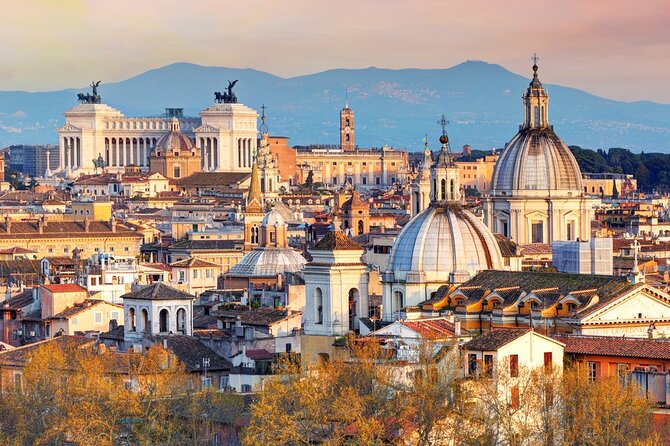
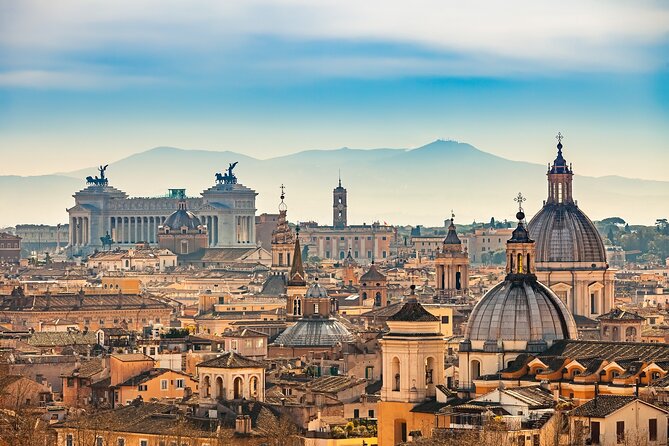
Rome is easier from a golf cart. This private golf cart tour threads Rome’s big sights and side streets with live English commentary, so you get oriented fast without constantly craning over a bus window. I like that the viewpoint feels open and personal, and I also like how the route stitches together plazas, fountains, monuments, and basilicas in a way that makes your first days in Rome less guesswork.
One thing to plan for: you won’t be going inside most monuments. The tour includes transportation and commentary, but entry inside attractions is not included, and sights that require tickets are visited from the outside.
Key highlights to know before you go
- Unobstructed views instead of the usual bus-window angles
- First-timer friendly orientation across Rome’s most famous neighborhoods and monuments
- Live commentary in English that links places to stories across many centuries
- A route built for panoramas, including the Belvedere del Gianicolo viewpoint
- Outside-only sighting style, especially for ticketed stops
- You still walk, so comfortable shoes matter even with the cart
Start at Maya Tours, then roll into Rome’s key sights
The experience starts at the Maya Tours office in Rome. You head inside, check in at the front desk, then your driver brings you into the city by golf cart. The end point is Piazza del Popolo, and your driver will leave you there or nearby if you request it.
This matters more than you’d think. Rome is a patchwork of tight streets, sudden stairs, and viewpoints that feel hidden until you’re right there. A golf cart route helps you cover a lot of ground while keeping your camera line of sight. And because it is private, your group sets the pace, instead of everyone getting swept along at the speed of the largest group.
Duration is about 3 to 4 hours. That time window is ideal for a first visit, or for a day when your feet need a break, but your brain still wants the essentials.
You can also read our reviews of more private tours in Rome

Why the golf cart feels better than a bus window
On standard tours, you often spend time staring at glass, not stone. Here, the cart gives you the kind of angles you usually only get when you’re walking. You’ll see the city rather than watching it glide by.
I also like the “bundle” effect. In a few hours, you can connect Rome’s main threads: the grand public spaces (piazzas), the big sculptural moments (fountains), and the religious anchors (basilicas). If your goal is getting oriented quickly, this kind of tour works because it gives you landmarks you can later revisit on your own.
That said, do not mistake this for a sit-and-glide ride. Even when you stay mostly on the cart, the tour includes stops where you will need to stand, look, and in some cases walk a bit. One family noted over 4 miles of walking during their experience, so bring shoes you can trust.
Belvedere del Gianicolo: Rome’s hilltop panorama stop
One of the first “wow” moments is the Belvedere del Gianicolo viewpoint. It sits on the right bank of the Tiber and climbs up the hill dotted with plane trees. If you want a fast mental map of the city, this is the kind of stop that makes future navigation easier.
From up here, you start to understand how Rome’s hills and river bends shaped where people built, gathered, and traveled. You’re not just looking at monuments, you’re seeing why they ended up where they did.
If your tour timing matches late morning or afternoon light, the city tones usually look especially good. This is also one of the stops where I’d prioritize paying attention to the guide’s context, because the view makes those explanations click.
Fontana dell’Acqua Paola, also called Il Fontanone
Next comes Fontana dell’Acqua Paola, the monumental fountain on Janiculum Hill. It was built in 1612 to mark the end of the Acqua Paola aqueduct, restored by Pope Paul V. The nickname Il Fontanone and the connection to the aqueduct are part of the reason this stop feels bigger than a pretty photo.
The practical angle: when your guide explains how water systems worked and why leaders invested in them, you start seeing fountains as engineering plus politics, not just decoration. It also helps you notice details you might otherwise overlook when you later pass fountains on your own.
Trastevere atmosphere and the legend that starts with the Tiber
Then you head into Trastevere, a working-class neighborhood known for its trattorias, craft beer pubs, artisan shops, and small places to stay. The tour doesn’t promise a deep neighborhood crawl, but it gives you a sense of the vibe you’ll want to revisit.
Around here, you also get pulled into Rome’s origin story near the river. According to legend, Romulus and Remus were set in a basket along the Tiber, and the river protected them until the she-wolf appeared. In 753 BC, Romulus is said to found Rome. That kind of storytelling is why this style of tour works well on a first day, or early in your trip, when you want the city’s “who started what” narrative.





Mouth of Truth and Santa Maria in Cosmedin area
One of the most famous quick stops is the Mouth of Truth at the Piazza della Bocca della Verità, in the portico of the Santa Maria in Cosmedin church. It is an ancient Roman marble mask that anchors a spot tied to the ancient Forum Boarium.
You are mostly looking from outside on this kind of tour approach. But even without going deep into ticketed sights, this stop gives you a recognizable landmark you can later connect to the broader ancient Rome map. It also helps you understand how medieval and later Rome reuse ancient pieces in everyday public spaces.
Parco Savello on the Aventine Hill and the keyhole view
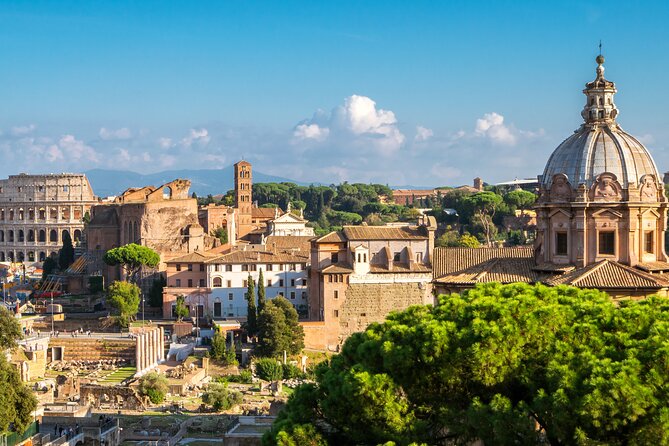
Next is the Orange Trees Garden, the Roman name for Parco Savello on the Aventine Hill. It is about 7,800 square meters and known for an excellent city view. This is a more restful break in the pacing, and it’s the kind of spot where the guide’s commentary helps you look at the city like a layout, not a list of attractions.
The stop also includes Il Buco Della Serratura, the small keyhole associated with the Villa setting. Through it, you can view the copper-green dome of Saint Peter’s Basilica at the end of a garden allée framed by clipped cypresses.
This is a smart inclusion for first-timers. It trains your eye on a specific alignment and turns a simple view into a little “spot-the-frame” moment. It’s also a reminder that Rome’s most iconic angles often come from carefully planned sightlines.
Pyramid of Cestius, the Aurelian Walls, and ancient Rome’s durable borders
From the Aventine area, the tour moves into ancient Rome markers that feel less crowded than the Colosseum zone. The Pyramid of Cestius is a standout: an ancient Roman pyramid near Porta San Paolo and the Protestant Cemetery. It was built as a tomb for Gaius Cestius, in a style inspired by Nubian pyramids, and it adds a surprising shape to Rome’s skyline.
Then you pass by the Aurelian Walls, built between 271 and 275 AD under Emperor Aurelian. These walls superseded the earlier Servian Wall. Seeing fortification lines like this helps you understand the city’s long-term mindset: Rome did not just build monuments, it built boundaries.
Baths of Caracalla and Palatine Hill: the empire’s everyday grandeur
The Baths of Caracalla are next. This site was the city’s second largest public bath complex after Diocletian’s baths and was likely built between AD 212 and 216 or 217. The point here is scale. Even from outside, you can grasp that Roman “spa time” was public life, social life, and civic power all rolled into one.
After that, you reach the Palatine Hill. It’s one of the oldest parts of the city, often described as the first nucleus of the Roman Empire. If you like origins and “where it all began” feelings, Palatine Hill is one of Rome’s best places to feel the early weight of the empire.
Arch of Constantine and Basilica di Santa Maria Maggiore area
The Arch of Constantine commemorates Constantine the Great’s victory over Maxentius at the Battle of the Milvian Bridge in AD 312. A triumphal arch is a very Roman kind of storytelling, meant to freeze a moment and broadcast power for anyone walking past.
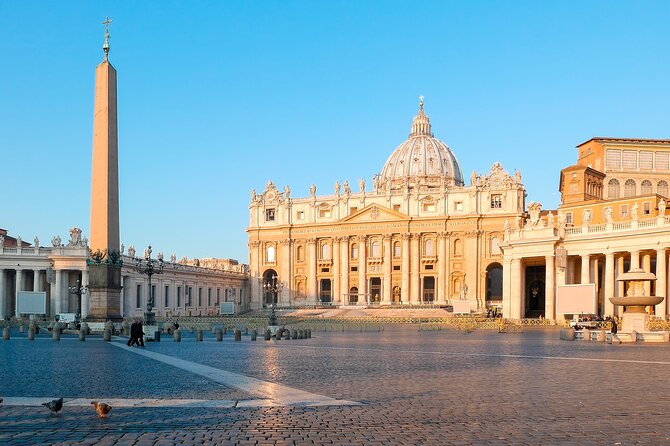
Then the tour heads toward Basilica of Saint Mary Major, also known as Santa Maria Maggiore, one of the four major papal basilicas and one of the Seven Pilgrim Churches of Rome. Even if you do not enter, the exterior context helps you place Rome’s layers: ancient empire, then Christian Rome, each reusing public space and architectural language in new ways.
Colosseum, Roman Forum, Circus Maximus: the core trio from the outside
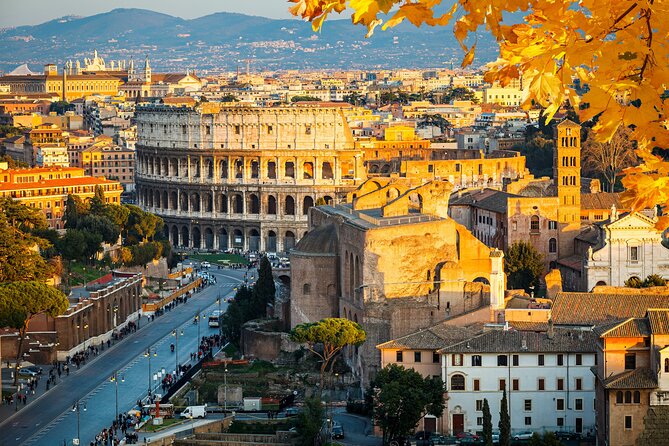
No golf cart Rome highlights list is complete without the Colosseum and the surrounding ancient zone. Here, you see the Colosseum, the Roman Forum (Forum Romanum), and the Circus Maximus. Each one plays a different role.
- The Colosseum is the huge, iconic amphitheater, still standing in part despite centuries of wear.
- The Roman Forum was the center for government buildings and public life, a rectangular space that citizens once treated as a marketplace.
- The Circus Maximus was a massive chariot-racing stadium and entertainment venue, first and largest of its kind in ancient Rome.
Even when ticketed interior access is not included, the guide’s explanations make these stops click together. You start to see how entertainment, politics, and public spectacle lived side by side.
Quick practical note: for these big names, Rome can feel like a crowd magnet. A cart can reduce time lost to transfers, but you still want to manage expectations and plan for some standing time and walking between viewpoints.
Roman Ghetto, Piazza Navona, and Castel Sant’Angelo
The tour includes the Roman Ghetto area, established in 1555 in what is today Rione Sant’Angelo around the Tiber. This is a heavier stop in tone, and it helps balance the more “photo easy” moments.
Then it heads to Piazza Navona, built on the site of Domitian’s stadium and shaped in an elongated oval, where ancient Romans once went for games. It’s one of those places that always feels alive because the layout is ancient even when the street life is modern.
Castel Sant’Angelo, the Mausoleum of Hadrian, is also part of the route. Originally commissioned by Emperor Hadrian, later used as a fortress by popes, and now a museum. Even without museum entry here, the building itself explains so much. It’s a landmark you can spot from multiple angles and it changes how you interpret the river area.
Pantheon, Trevi Fountain, and the Spanish Steps without the worst lines
The Pantheon is on the list, a former Roman temple later turned Catholic church. It is built on the site of an earlier temple ordered by Marcus Agrippa, then rebuilt after a fire under Emperor Hadrian and likely dedicated around AD 126.
Even if your tour style stays outside, the Pantheon stop is valuable because the guide can point out what makes the building historically specific. And because it sits in an urban pocket rather than a remote ruin field, it helps you understand Rome’s ability to keep older structures alive in daily life.
Then you get Trevi Fountain, designed by Nicola Salvi and completed in 1762. It is one of Rome’s most recognizable fountain designs, and it’s also a place where crowd management becomes part of the travel plan. A golf cart approach can help you arrive with less friction and keep the experience moving.
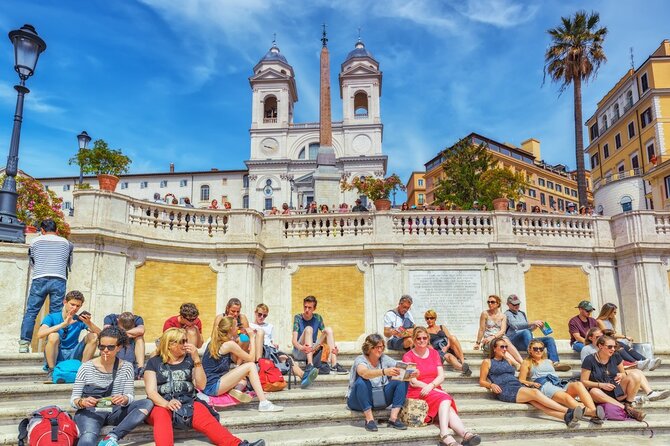
After Trevi, the route includes the Spanish Steps area, with the steep slope between Piazza di Spagna and Piazza Trinità dei Monti, dominated by the church at the top. That incline is a defining Rome feature. You may not want to climb every day, but seeing it from the right vantage points helps you decide whether it’s worth it later on your own.
Villa Medici and Piazza del Popolo, a fitting finish
Towards the end, the tour goes by Villa Medici, a Mannerist villa complex on the Pincian Hill next to the Borghese garden area and near Trinità dei Monti. Finally, you reach Piazza del Popolo, a large urban square. The name comes from poplars once tied to the church of Santa Maria del Popolo in the northeast corner.
This ending spot is practical because it is a convenient hub for getting around. If you want dinner or a later walk, Piazza del Popolo gives you options without forcing you into a maze of narrow lanes.
Price and timing: is $150.18 per person worth it?
At $150.18 per person for roughly 3 to 4 hours, the value depends on what you want out of Rome that day.
If you are trying to see a lot without spending half your trip in transport, this is the kind of ticket that can make sense. You get private transportation by golf cart and live English commentary, plus a route packed with famous names and a few less obvious ancient markers like Aurelian Walls and the Pyramid of Cestius.
Where it may not fit is if you mainly want ticketed entry and you hate outside-only viewing. Since entry inside monuments and attractions is not included, and ticketed sites are viewed from the outside, you will likely want to add separate visits for the interiors that matter most to you.
Booking timing matters too. This tour gets booked a lot, often around 75 days in advance on average. If your trip has limited days, grab your preferred timing early.
What kind of traveler this fits best
This tour is a strong choice if you:
- Want quick orientation across major Rome landmarks
- Prefer open views over being stuck behind bus glass
- Like stories that connect monuments to legend, religion, and power
- Need to reduce time walking while still seeing a wide mix of sites
It also fits multi-generation groups. One family highlighted that their guide paid attention to safety for young kids. Another set of families praised guides who balanced facts with lively explanations, making the tour feel fun rather than forced.
Plan to work with the reality of walking. Even with the cart, wear comfortable shoes. One participant called it not a leisurely stroll, so treat it as active sightseeing rather than a rest day.
How the guide’s style changes the whole experience
Live commentary is included, and the guide can make or break a fast-moving tour like this. The guides noted in past experiences include Ahmed, Claudio, Alfredo Noye, Alfonso Noye, and Mido.
The patterns that stand out are consistent:
- Guides often connect fountains and sculptures to the people and decisions behind them.
- Many guides keep the route organized and help you focus on what matters at each stop.
- Some guides also help with logistics at the right moment, like giving direction about where to go next for food near key piazzas.
If you care about understanding what you’re seeing, this tour style rewards you.
Quick trip tips for a smoother day
- Bring comfortable walking shoes. You will likely get more steps than you expect.
- Plan one day as your “orientation day,” so you can return later to the parts you love most.
- If your trip overlaps the Jubilee period, some monuments or areas may be under restoration. Watch for any messages that suggest changes.
- If you have children, make sure an adult is with them, since children must be accompanied.
Should you book this Rome golf cart tour?
Book it if your priority is a fast, guided “greatest hits with context” day, where golf-cart access gives you better sightlines than a bus and the live commentary helps you connect the places.
Skip it or pair it with ticketed add-ons if you mainly want to go inside. Since most entrances are not included and ticketed sites are viewed from the outside, you will need separate plans for interior experiences.
If you want one smart move for a first or second day in Rome, this is a solid way to get oriented, learn the city’s key stories, and still keep your feet from taking over your schedule.
FAQ
How long is the Private Piazza’s, Fountains, Monuments & Basilicas Rome Golf Cart tour?
It runs about 3 to 4 hours.
Where does the tour start?
The meeting point is Via Germanico, 16, 00192 Roma RM, Italy. You check in at the Maya Tours office front desk.
Where does the tour end?
The tour ends at Piazza del Popolo, Roma RM. Your driver will leave you there or close by upon request.
What is the price per person?
The price is $150.18 per person.
Is this tour private?
Yes. It is a private tour/activity, and only your group participates.
What is included in the tour?
Included items are private transportation and live commentary. The tour is offered in English.
Are entry tickets included for the monuments and attractions?
No. Entry inside monuments and attractions is not included, and sights that require a ticket are visited from the outside.
Is lunch included?
No, lunch is not included.
Can I cancel for a full refund?
Yes, you can cancel for a full refund if you cancel at least 24 hours in advance of the experience start time.
Is the tour suitable for children or families?
Most people can participate, and children must be accompanied by an adult. Service animals are allowed.
More Private Tours in Rome
More Tour Reviews in Rome



Not for you? Here's more nearby things to do in Rome we have reviewed












Rome Golf Cart Tours, compared.
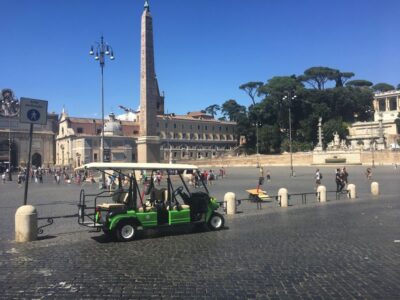 ★ 4.8Imperial City Tour by Golf Cart with Optional TransferFrom $1241,024 reviews
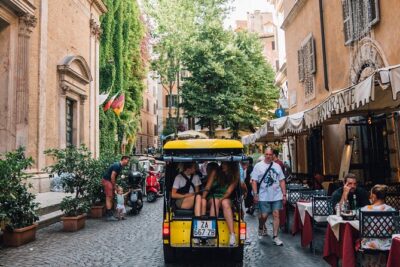 ★ 5.0Golf Cart Small-Group Guided Tour: Rome City HighlightsFrom $104907 reviews
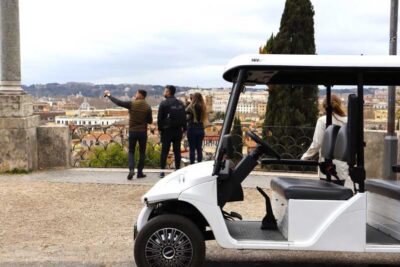 ★ 4.8City Highlights Golf Cart TourFrom $45857 reviews
 ★ 5.0Private/Group 4 Hours Golf Cart SightseeingTourFrom $168780 reviews
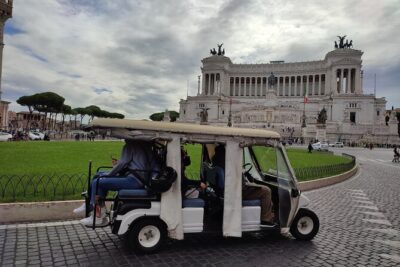 ★ 5.0Explore Rome on a Golf Cart: Private TourFrom $83757 reviews
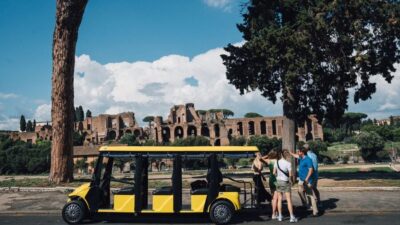 ★ 4.8City Highlights Golf Cart Tour with Local GuideFrom $71752 reviews
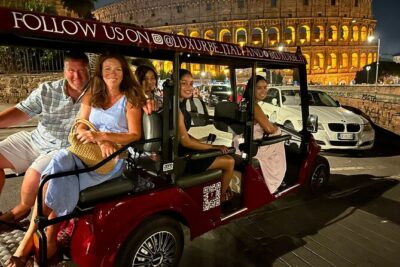 ★ 4.5Rome by Night: Golf Cart TourFrom $108688 reviews
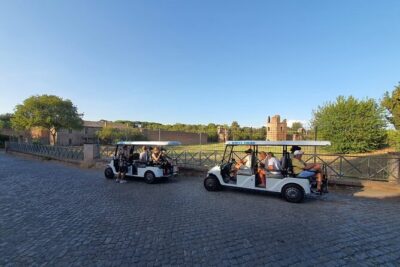 ★ 5.0Rome Catacomb & Appian Way Small-Group Tour by Golf CartFrom $107681 reviews
Browse the lists this tour appears in