
Reviewed · PRIVATE DRIVERS
Hidden Rome – Private Tour with Driver
A private Rome day starts in quiet pockets. This Hidden Rome tour uses a private vehicle and hotel pickup to take you beyond the crowded center and into places most visitors miss.
I love the easy pickup and drop-off that saves you time and stress, and I also like the way the route strings together Roman icons you can actually enjoy, from the Appian Way to Parco degli Acquedotti. One possible drawback: the depth of guiding can vary by driver, so if you want more explanation at every stop, make that clear early.
Key things to know before you go
- Hotel pickup and drop-off means you skip street-hunting in Rome traffic
- A private vehicle lets you cover far-flung sites in one smooth 6-hour block
- Catacombe San Sebastiano admission included, so you avoid one extra ticket line
- Aqueduct park time at Parco degli Acquedotti is unusually calm for being so close to Rome
- Flexible guide energy based on who you get, with some groups adding extra churches during Jubilee
A private driver route that actually changes your Rome day
Rome has a way of compressing everything into the same few streets. This tour breaks that pattern. You start at 9:00 am with hotel pickup, then spend the day moving between sites that are spread out around Rome, not clustered in the most jammed zones. That is a big deal for a half-day format.
For a private tour, you are also buying time. You are not spending chunks of your day on transfers, or trying to coordinate meeting points while buses and crowds do their thing. You just ride, stop, walk a bit, and move on again. In a city where getting from Point A to Point B can be the whole adventure, that simplicity matters.
The other value is the mix. You get roads, underground burial sites, giant engineering leftovers, thermal baths, neighborhood life in Trastevere, and one of the best skyline views on the Janiculum Hill. If you have already seen the big-ticket stuff, this tour gives you Rome’s side streets, older corridors, and quieter corners.
The tour is offered in English, and it is for your group only, so you are not squeezed into a giant headcount. Service animals are allowed, and the day is listed as suitable for moderate physical fitness.
You can also read our reviews of more private tours in Rome


Appian Way (Via Appia Antica): the Queen of Roads, still wearing its armor
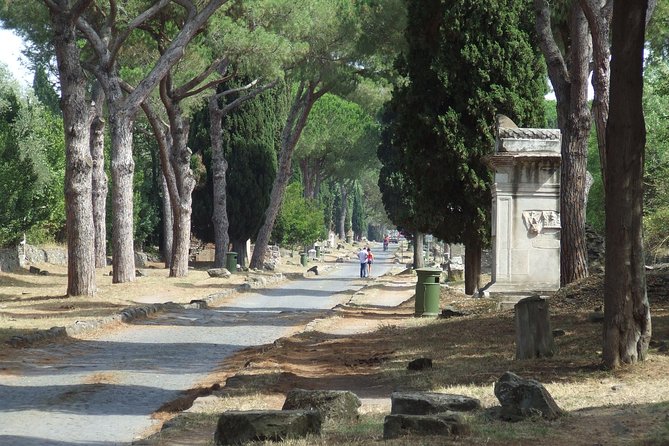
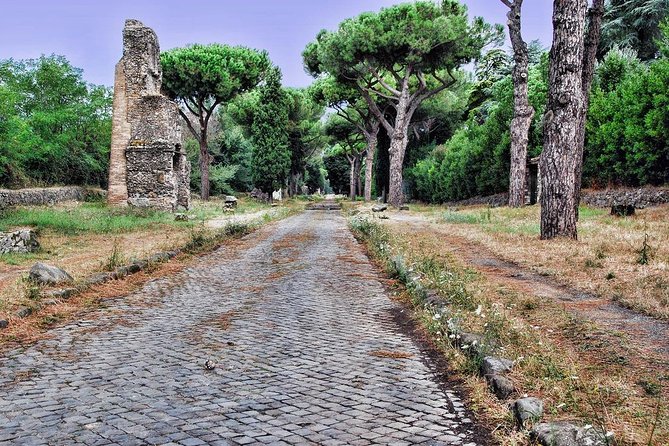
The Appian Way is the kind of place where the ground feels like it has a résumé. This road mattered to the Roman Empire because it tied Rome to faraway settlements, first stretching toward Capua, and later continuing all the way toward Brindisi in Puglia. Even if you do not memorize dates, you can feel why Romans were proud of it.
What you are seeing here is unusually well-preserved. The surface is made of large flat stones laid firmly in place, worn smooth over centuries by rain, wheels, and feet. That is the whole point of visiting in person: you get a physical sense of how travel worked when roads were power.
This stop is about an hour, and the best way to get the most is to slow down. Walk at a comfortable pace and let the driver’s context guide you. If your guide is energetic, you will likely hear connections to how the Romans controlled movement, supply, and administration across distances. If you want more narrative, ask for it before you step out.
One practical note: you should be ready for uneven ancient paving. Wear shoes with good grip.
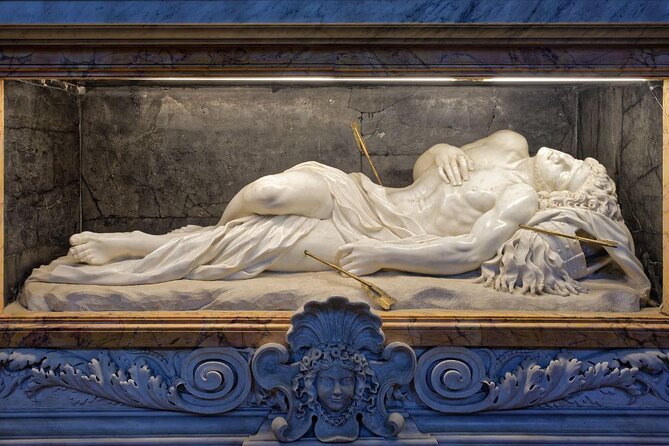
Catacombe San Sebastiano: underground burial city near where St. Sebastian was honored
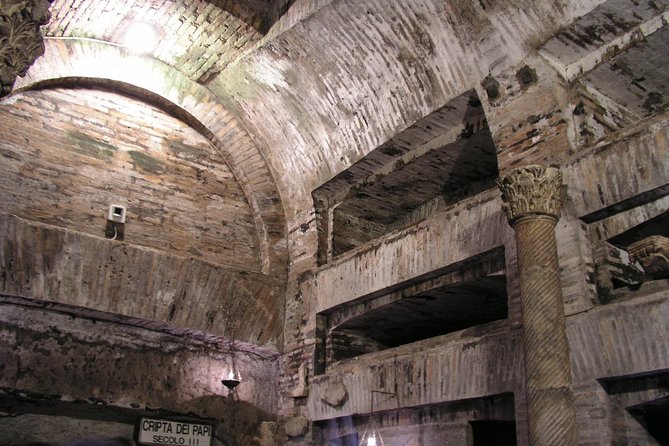
Next comes Catacombe San Sebastiano. The name points to location language, and it also ties into the story of St. Sebastian, whose connection to the site gives it its familiar name today. The area has long been used for underground Christian burial, and it also reflects layers of earlier pagan and later Christian use.
This is not just a tunnel walk. The cemetery used mines of tuff, with caves and passages repurposed for tombs. You can find rectangular wall tombs (loculi) and urn storage areas (colombari). Over time, there were also above-ground residential buildings, some with interior wall painting decorations.
The stop runs about an hour, and admission is included. That matters. You avoid the awkward moment of trying to fit a separate ticket into a tight schedule.
What I like about including the catacombs in a private format is that you get the chance to ask questions without competing for space. In small groups, you can usually hear the details about what you are looking at instead of rushing past them.
If you are sensitive to enclosed spaces or dim lighting, treat this as a moment to go at your own pace. The value is in understanding what you see, not in forcing it.
Parco degli Acquedotti: aqueduct ruins, open skies, and a surprisingly local feel
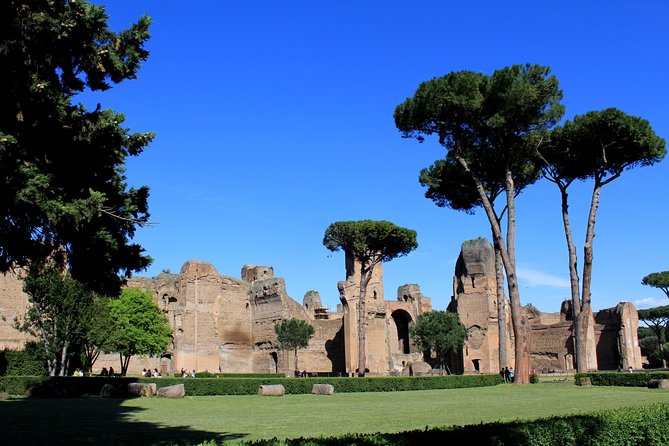
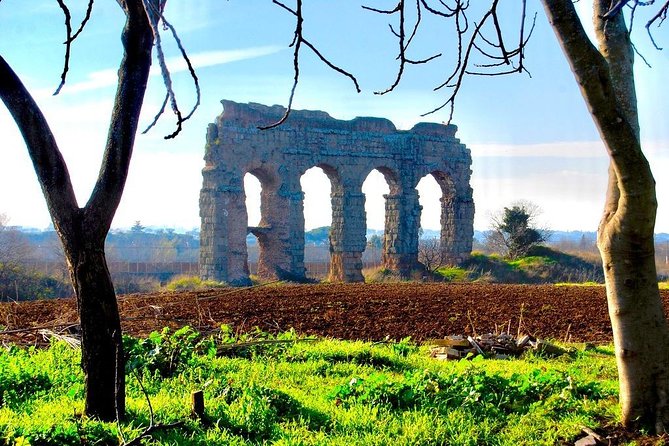
After underground history, the tour turns to open air at Parco degli Acquedotti, part of Parco Archeologico dell’Appia Antica. This is one of those Rome parks that feels like it belongs to the city’s residents more than to tour brochures. Even though it is only a few miles from the center, it tends to stay calm.
Here you can experience what the Romans built to solve a daily problem: water. The aqueducts were engineered to bring fresh water from mountains and countryside into the city. Some sections still stand, including stretches of Aqua Felix and parts of the Aqua Claudia. Standing near ruins of that scale makes the idea of Roman engineering feel real, not abstract.
The park is mostly about walking and taking in the geometry of the surviving structures. There are wide grassy spaces under the aqueducts, and on weekends you may see picnicking families. You can also rent a bike if you want to cover more ground, though the tour itself gives you a one-hour stop with admission free.
My advice: use this hour to slow down and look up. The aqueducts are dramatic in a vertical way. If your guide gives you context, you will also start noticing how the lines and arches controlled the flow of water.
If you prefer to avoid crowds, this is the part of the day that tends to deliver. You get Rome without constant shoulder checks.
Baths of Caracalla: what’s left of the splendor, and why it still works
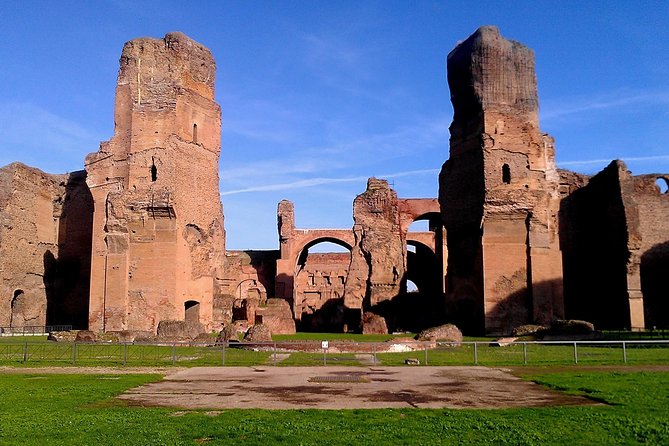
Terme di Caracalla is a half-an-hour stop, and that timing is realistic. Even though the site today preserves mostly brick walls and collapsed vaults, the scale still hits you. These baths were built between 212 and 216 under Emperor Caracalla, ordered under Marcus Aurelius Antoninus Augustus. That’s the kind of detail that makes you realize how serious Roman thermal complexes were.
The value of stopping here on this route is that you are not just ticking a box. You are moving from the Appian Way’s transportation logic to catacombs’ burial purpose, then to aqueduct water infrastructure. Caracalla fits into the water story of Rome, but on the leisure and public comfort side.
Because the listed duration is only 30 minutes and admission is not included, you should plan to use this stop for orientation. Look at the main surviving elements, take in the footprint, and read the cues your guide gives you. If you want deeper exploration, you might need extra time beyond the tour.
Also, because this stop is short, it is worth having your expectations set. This is a quick hit, not a full museum visit.
A few more Rome tours and experiences worth a look


A Tiber moment: learning Rome’s geography at the speed of a half-day
Between Caracalla and Trastevere, there is a simple geographic lesson built into the route. The Tiber River runs about 250 miles, flows from the Apennines through Rome, and reaches the Tyrrhenian Sea at Ostia. Most of Rome is east of the Tiber, while areas to the west include the island in the river, Insula Tiberina.
This might sound like a trivia detour, but it helps you understand why neighborhoods feel the way they do. Trastevere, for example, sits just down the Tiber from the Vatican. Knowing the river as a divider and connector gives you a clearer mental map when you are walking later on your own.
If you like learning while you move, ask your driver to point out where you are relative to the river. In Rome, those little orientation moments make your next stroll easier.
Trastevere and Santa Maria in Trastevere: neighborhood energy with church art you can’t unsee
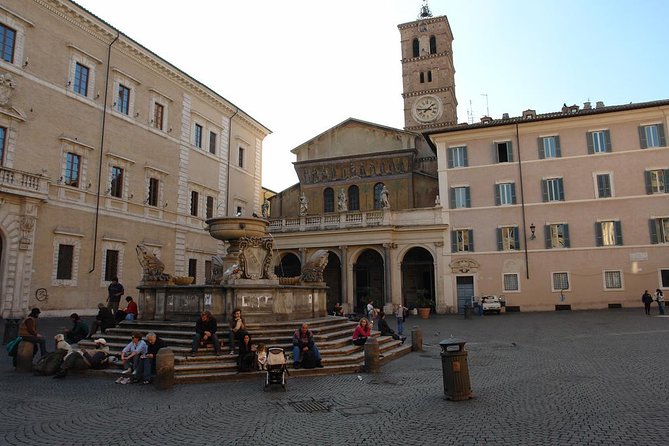
Trastevere is one of those places where locals treat the neighborhood identity as non-negotiable. You get a maze of piazzas and cobbled vicoli, and the area has a habit of pushing back against heavy commercialization. That attitude shows up in how people live there, not just how it looks.
This stop is about 30 minutes. During that time, you can do two useful things. First, you can take in the street-life rhythm and decide what you want to revisit later for a longer coffee break. Second, you can orient yourself around Piazza Trilussa, a common starting point in the area.
Then comes Basilica di Santa Maria in Trastevere. This church has mosaics and artworks that reflect multiple centuries. Restoration work has brought attention back to 12th-century Pietro Cavallini mosaics, including Vita della Vergine, along with frescoes and marbles from later periods. There is also Domenichino’s Baroque octagonal gold ceiling, plus L’Assunzione della Vergine from 1616-1617.
What I like here is that this stop is short but rewarding. Even if you only have 10 minutes, the church can deliver a strong visual payoff if you focus on one or two standout elements instead of trying to see everything.
If you are traveling during the Jubilee period, some guides have been able to add extra church visits like St. Paul, St. John, and St. Mary’s, with access that can include entering through main doors. That is not guaranteed, but it is worth asking about if your dates overlap with Jubilee events.
Colle del Gianicolo: one of Rome’s best skyline views, no ticket required
To finish, you head to Colle del Gianicolo, the Janiculum Hill. This is a classic for a reason: you get a scenic view of central Rome with domes and bell towers. On a clear day, it is the kind of panorama that helps everything you saw earlier snap into place.
The Janiculum also connects to religious and memorial points of interest. You can find San Pietro in Montorio, a Tempietto designed by Donato Bramante marking the supposed site associated with St. Peter, and the Fontana dell’Acqua Paola, a Baroque fountain built by Pope Paul V. There are also research institutions and academies in the area, including the American Academy in Rome and the Spanish Academy in Rome.
This stop is listed for about 10 minutes, and that is tight. Some guides may take you to the top and help you place the view. Others might keep it brief. If the skyline moment is a major priority for you, say so at the start of the day and ask for a clear plan.
What you are really paying for: hotel pickup, private pacing, and included access
At $330.40 per person for an approximately 6-hour private experience, this is not a budget stroll. You are paying for two big things: a private vehicle and private pacing.
Hotel pickup and drop-off is a major part of that value. Rome’s center can be chaotic, and the chance to avoid walking to a pickup point is real convenience. One review highlighted that this alone made the experience feel worth it.
You also get included catacombs admission fee. Most other stops have admission tickets listed as free or not included, but catacombs admission is explicitly included. In a tight schedule, that inclusion is the kind of detail that saves time and friction.
And then there is the route itself. You are not just hopping between famous ruins. You are mixing far-flung Roman features into one day, which means you see more while spending less time doing logistics.
If you are a solo traveler, this cost can feel steep. If you are traveling with another person or a small group, the private setup often starts to make more financial sense, and group discounts are listed as a feature.
Jubilee-year timing and site changes you should expect
Rome during Jubilee can mean extra attention to churches and visitor management, and it can also mean some monuments are under restoration. The tour notes that some sites may be affected by restoration work and that you should pay attention to messages sent about potential changes.
This matters because a private driver guide can sometimes adjust the plan on the fly. If your dates overlap with Jubilee events, ask whether your guide can prioritize access moments, like main-door entries in major churches. Some groups have had that experience, and it can add a meaningful layer to the day.
Also, restoration work can affect what you see or how much time you get at a specific spot. That is one reason to keep your expectations flexible and treat the day as a route built around Rome’s living present, not only its preserved past.
Who this tour fits best, and who should choose something else
This is a great fit if you:
- Want to escape the busiest historic core without sacrificing major Roman themes
- Prefer private pacing over crowded group tours
- Like a mix of outdoors and indoor stops, from aqueduct parks to catacombs
- Have already seen big highlights and want a more personal Rome route
It is less ideal if you:
- Need a very long stop at each site. The day is built for quick, high-impact moments.
- Expect the same level of guidance from every guide. Some groups felt the guiding could be lighter, especially later in the day, and one group noted they were not taken to the top of Janiculum as expected.
If you care deeply about interpretation, start the day by asking your driver-guide to focus on the parts you care about most.
Should you book Hidden Rome with a private driver?
I would book it if your goal is a low-stress, high-variety Rome day that stays away from the worst crowd pockets. The combo of Appian Way, catacombs, aqueduct parkland, and Trastevere gives you Roman scale and everyday neighborhood flavor, without forcing you to fight for time slots or public transit.
I would think twice if you hate short stops. This tour is designed for movement and selection, not for lingering for hours in one place. Also, guidance quality can vary, so if you want heavy narration throughout, communicate your preference early.
Bottom line: if you want a private driver day that feels like Rome beyond the postcard path, this is a strong choice.
FAQ
How long is the Hidden Rome private tour?
The tour lasts about 6 hours.
What time does the tour start?
The start time is 9:00 am.
Is hotel pickup and drop-off included?
Yes. Hotel pickup and drop-off are included.
Is the catacombs admission included in the price?
Yes. Catacombs admission fee is included.
What is included, and what is not included?
Included items include a driver/guide, a local guide, hotel pickup and drop-off, private tour, transport by private vehicle, and catacombs admission fee. Food and drinks are not included.
Is this tour private?
Yes. It is a private tour/activity, and only your group participates.
Can I cancel for a full refund?
You can cancel up to 24 hours in advance of the experience for a full refund.
More Private Tours in Rome

More Tours in Rome






More Tour Reviews in Rome

Not for you? Here's more nearby things to do in Rome we have reviewed












Private Drivers, compared.
 ★ 4.2Catacombs Guided Tour with TransferFrom $541,808 reviews
 ★ 4.6Catacombs and Capuchin Crypt Guided Tour with TransferFrom $411,606 reviews
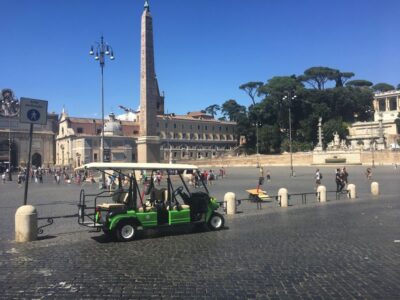 ★ 4.8Imperial City Tour by Golf Cart with Optional TransferFrom $1241,024 reviews
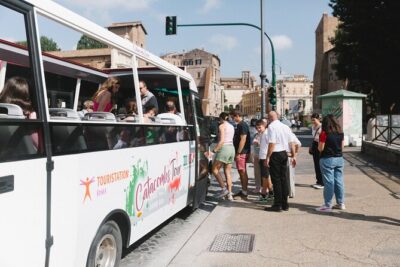 ★ 4.5Catacombs Tour with Transfer – Optional Capuchin Crypt or TreviFrom $54694 reviews
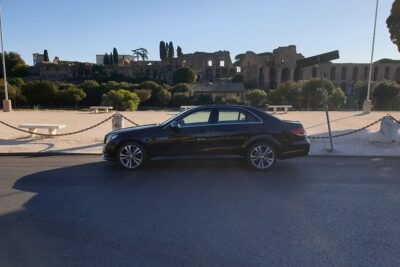 ★ 5.0Civitavecchia Private Transfer: Rome to Civitavecchia Cruise PortFrom $141669 reviews
 ★ 4.0Transfer Rome center – Fiumicino airportFrom $8530 reviews
 ★ 4.5Shared Transfer from Civitavecchia Pier to Rome Hotel or AirportFrom $82455 reviews
 ★ 4.5Civitavecchia Private Transfer: Civitavecchia Port to RomeFrom $141430 reviews
Browse the lists this tour appears in