
Reviewed · WALKING TOURS
Rome walking tour: Churches, Squares and Fountains
Rome feels huge until you walk it. This Rome walking tour links churches, squares, and fountains into one 2.5 hour route that helps you understand the city fast. I love the small group size (capped at 15) because you get calmer explanations and more freedom to look around. One catch: you mainly see the sites from the outside, so if you want to go inside big-name buildings, this plan is not for that.
The pace works for getting a lot done without sprinting. The tour includes radio headsets, which means you can actually hear the guide even in busy plazas, plus the guidance on hot days tends to include more shade stops. One practical consideration is that it is still a walking tour through central Rome, so bring comfy shoes and plan for steady time on your feet.
The route runs in English and starts at Foro Traiano in the morning, ending at Trevi Fountain square. Monuments are explained from outside only, and tickets for certain sights are not included. If you like a clear, structured city overview where the guide does the heavy lifting, this is a smart way to spend your day.
Quick points to know before you go
- 15-person cap keeps the tour feeling personal, not like a human traffic jam
- Radio headsets help you follow the story in loud squares
- Outside-only viewing means quick stops for photos and perspective, not inside entrances
- Trajan to Trevi route stitches together ancient Rome, Jewish Ghetto area, and baroque landmarks
- Hot-day friendly pacing with shade-focused guidance, guided by people like Brian, Alessandra, and Suzanna
A 2.5 hour Rome walking primer built around churches, squares, and fountains
This tour is basically a “get your bearings fast” plan, but with real substance. You cover major Rome areas in a compact timeframe, then you finish at Trevi so you can keep exploring on your own. With a price of $42.17 per person for about 2 hours 30 minutes, it is not cheap, but it is also not trying to sell you extra add-ons. You are paying for a guide, radio headsets, and a tight route that would be harder to assemble on your own in the same amount of time.
What makes the experience feel efficient is the way the stops are grouped. You move from ancient Rome landmarks into famous civic squares, then into church-related sights, and finally end at a world-famous fountain. That order matters. It trains your eyes to notice how different eras are layered in the same neighborhood.
You should also know the boundaries up front. The tour includes explanations from the outside, and there is no entry into the buildings on the schedule. If your dream list includes going inside the Pantheon or other major interiors, you will need a separate plan for that. Still, outside viewing can be surprisingly rewarding in Rome, especially when the guide points out what to look for.
Logistics are straightforward. The meeting point is Foro Traiano, 84, and the tour starts at 10:00 am. You need to arrive about 20 minutes early to get a smooth departure. It ends at Trevi Fountain square, Piazza di Trevi, so you can finish your route with maximum “walk-off momentum” toward dinner or gelato.
You can also read our reviews of more walking tours in Rome


From Foro Traiano to Trajan’s Column: the first spiral story
Your first stop centers on Trajan’s Column, a Roman triumphal column completed in AD 113. The main visual payoff is the spiral bas-relief, famous for depicting wars between the Romans and Dacians. Even without going inside anything, you get a strong anchor for ancient Rome here. You are not just seeing a monument, you are learning how Romans used art to broadcast victory and power in public space.
This is also a great mental warm-up for the day. Once you understand why a victory column got built, other “show of authority” spaces in Rome start to make more sense. You also get a quick format that fits a walking tour: the stop is short, about 5 minutes, and the value is in what the guide helps you notice.
Next comes Trajan’s Market, Mercati di Traiano – Museo dei Fori Imperiali. This is a large ruin complex, and the tour frames it with one of the most interesting claims about the site: it has been thought of as the world’s oldest shopping mall, with arcades that many believe were administrative offices for Emperor Trajan. You get the feeling of stepping into an engine of city life rather than an isolated temple or single building.
Important practical note: admission for Trajan’s Market is not included. The tour format here is also about outside explanation, so you are not committing to an entry ticket as part of the main price. If you later want to go deeper, you can decide on your own time, but you are not forced into it mid-tour.
Then you swing to Piazza Venezia, one of Rome’s most famous squares. Here the guide connects the square to major landmarks around it, including the Victor Emmanuel II Monument and Palazzo Venezia. Piazza Venezia works well in this kind of route for a simple reason: it is a crossroads. You can look around and start mapping the city in your head, which makes every later stop easier to place.
The Jewish Ghetto area, Campo de’ Fiori, and Piazza Navona in one flow
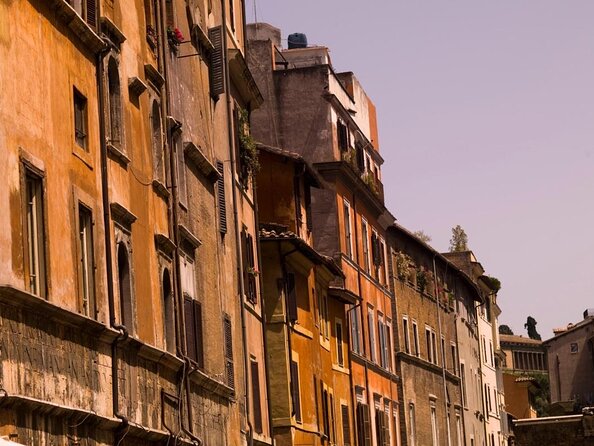
After ancient Rome, the tour turns toward a part of the city that is both historical and lived-in: the Jewish Ghetto area. This is one of the less obvious attractions in many first-time plans, and it sits between the Tiber and Piazza Venezia. The tour emphasizes that the Jewish community in Rome is the oldest in Europe, and it highlights how the area has grown into a neighborhood with restaurants, churches, and synagogues blending Jewish culture with Roman architectural grandeur.
That matters because it changes your mindset. Instead of treating the ghetto as only a museum-like stop, you are encouraged to see it as a neighborhood with layers. Even if you only spend about 20 minutes here, it is enough time to get the street pattern and feel of the area, and then keep your eyes open for how religious and cultural buildings sit close together in Rome.
Next up is Campo de’ Fiori. This is where Rome gets more everyday. The tour frames it as a lively street market where you can browse stalls and pick up souvenirs. Even if you do not plan to buy anything, this is a useful pause because it breaks the heavy monument rhythm with something more human-paced. It also gives you an easy opportunity to refuel, grab a drink, and adjust your plan for the next square.
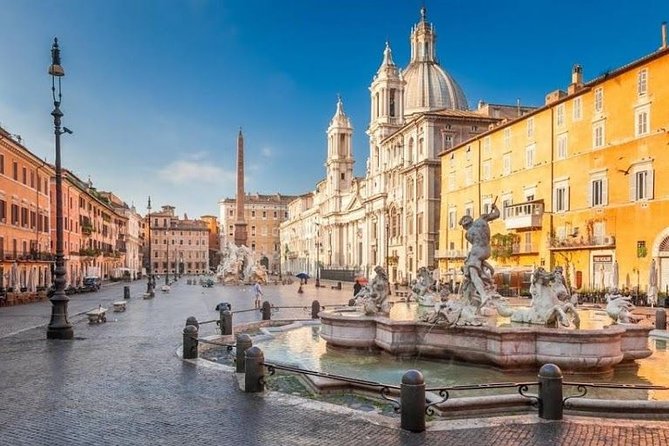
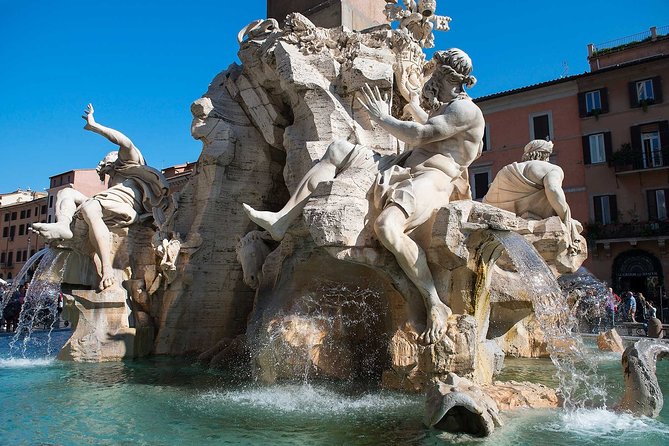
Then the tour lands at Piazza Navona, a baroque square tied to ancient times when the area hosted a stadium. The guide also points you toward two specific highlights: the Fontana dei Quattro Fiumi by Bernini and the Church of Santa Agnese in Agone. Piazza Navona is a classic “look up and look around” stop. You feel the drama of the architecture from multiple angles, and the fountain gives you something that is instantly recognizable even if you are not a Rome expert.
Time-wise, you get about 15 minutes here, which means you should choose your moment. If you want photos, pick one good viewing spot and let the square unfold around you rather than trying to see everything at once.
Pantheon outside views and the Temple of Hadrian stop
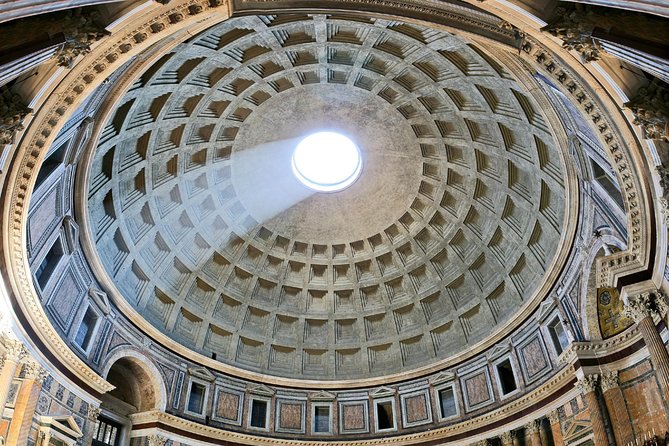
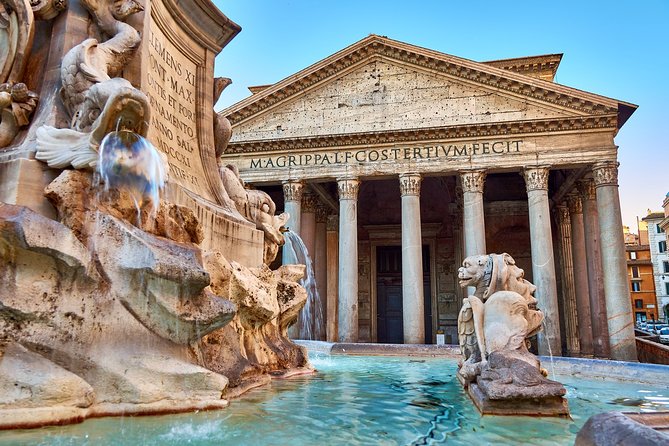
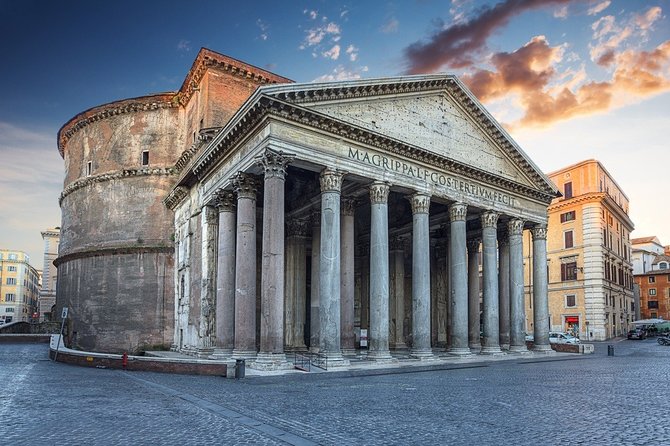
The Pantheon is one of those Rome sites that almost everyone recognizes. Here, you get it in the tour’s outside-only style, with the guide focusing on why the building looks so remarkably preserved. The tour also spells out the big concept that makes it feel special: it was originally a temple dedicated to all the gods, and then it was converted into a church already in the 7th century. Because of that conversion, the tour highlights that it looks basically identical to how it looked in ancient times.
That explanation is a big reason this stop works even without entry. You are not trapped outside with nothing to do. You are learning the story behind the facade and the overall impression. It helps you see the Pantheon as an evolving structure rather than a frozen relic.
Admission for the Pantheon is not included, so you should treat it as a viewing stop. If you want to go inside, you will need to plan that separately. But as part of a 2.5 hour overview tour, it is still a strong inclusion, because the Pantheon is a reference point for almost every “Rome architecture conversation” that comes after.
Then the tour brings you to Piazza di Pietra to see the Temple of Hadrian. The guide identifies it clearly as an ancient Roman structure dedicated to Emperor Hadrian. Again, this stop is about outside interpretation, but it fits the day’s pattern well. You move from the Pantheon’s ancient-to-church transformation into another ancient reference point, and your eyes start to pick up recurring design logic across centuries.
Trevi Fountain finale: closing with Rome’s best photo magnet
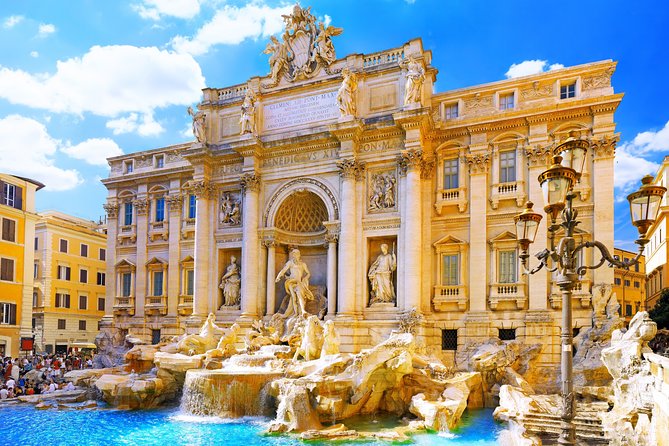
At the end of the tour, you arrive at Trevi Fountain in Piazza di Trevi. This is described as the largest Baroque fountain of Rome and arguably the most famous fountain in the world. You get about 15 minutes at the end, which is enough time for a few photos and to take in the scale.
Because the tour ends here, it is the perfect place to decide what you want next. You are already in one of the most central zones, so you can either wander for more time or head toward dinner nearby. If you want the most flexibility, plan to stay in the area after the tour rather than rushing away immediately.
Also, keep your expectations realistic for any Trevi visit. It is famous, so it tends to attract a lot of attention. Your best move is to treat the finale as a finish line, not a quick snapshot. Use the time to stand back and understand the whole fountain first, then go for tighter shots if you still feel like it.






Value check: $42.17, 15 people, and radio headsets that actually help
Let’s talk value in a way that matters. At $42.17 per person, you are paying for five key things:
- A guided route through central Rome
- Radio headsets so you can hear the explanation
- A small group cap at 15 people for a more personal feel
- A structure that covers major monuments and squares in about 2 hours 30 minutes
- Outside-only storytelling across ancient, Jewish Ghetto area, and baroque highlights
You also are not paying for private transportation. There is no private transport included, which is fine if you are comfortable walking and if you want the sights to do the work. Rome is built for walking anyway, and this tour leans into that.
Where the value gets especially good is in how much ground you cover. Instead of choosing one museum or one famous church, you are getting a “map-making” experience. By the time you finish at Trevi, you can understand how the city’s major areas link together, and you know which places you might want to return to later.
If you are comparing this against a self-guided plan, the guide is the difference. The tour’s stops are not random. They are chosen because each one adds a clear piece of Rome’s story, from Trajan’s military victory art to the way religious and civic spaces sit side by side in the Jewish Ghetto area, to how Piazza Navona and Trevi represent the baroque side of Rome.
One more practical point: this is best for moderate physical fitness. It is not framed as extreme, but you should expect consistent walking across central Rome streets and plazas.
Should you book this Rome Churches, Squares and Fountains walking tour?
Book it if you want a fast, organized overview that hits major Rome names in a single morning or late-day block. It is also a strong choice if you like learning while walking, and you appreciate outside viewing when the guide gives you context. The small group and radio headsets help make that kind of learning feel comfortable.
Skip it or pair it with something else if your top priority is interior access. Since the tour includes explanations from the outside only and does not include entries into buildings, you might find it limiting if you were hoping for fully inside experiences at sites like the Pantheon.
I also think it is a good fit for first-timers and for return visitors who want a guided refresher without committing to a long day. Ending at Trevi is a smart finish if you want an easy landing point for dinner plans.
If you do decide to go, do yourself a favor and show up about 20 minutes early at Foro Traiano. That head start keeps the tour smooth and gives you time to get oriented before walking begins.
FAQ
How long is the Rome Churches, Squares and Fountains walking tour?
It runs for approximately 2 hours 30 minutes.
What is the price per person?
The price is $42.17 per person.
Where does the tour start and end?
It starts at Foro Traiano, 84, 00187 Roma RM, Italy and ends at Trevi Fountain, Piazza di Trevi, 00187 Roma RM, Italy.
Is the tour offered in English?
Yes, it is offered in English.
What is included in the tour price?
The tour includes a tour guide and radio headsets.
Are tickets included for the Pantheon and other monuments?
No. The tour notes that admission tickets are not included for some places such as the Pantheon. Other stops are free to see, but you should plan that not every stop includes an admission ticket.
Do we enter the churches and monuments during the tour?
The tour includes various monuments which are explained from the outside, and there is no entry into any of the buildings.
More Walking Tours in Rome



More Tours in Rome



More Tour Reviews in Rome
Not for you? Here's more nearby things to do in Rome we have reviewed












Walking Tours, compared.
 ★ 4.9Trastevere & Campo de Fiori Street Food Walking TourFrom $512,768 reviews
 ★ 4.9Paranormal Night Walking Tour & Secret BackstreetsFrom $341,921 reviews
 ★ 4.4Guided City Center Evening Sightseeing Walking TourFrom $46953 reviews
 ★ 4.5Best of Rome Walking Tour including Trevi FountainFrom $4923 reviews
 ★ 4.8Under the Moonlight Evening Walking TourFrom $28852 reviews
 ★ 4.9Forbidden History Walking Tour & Pub Crawl with DrinksFrom $61688 reviews
 ★ 5.0Guided Small Group Walking Tour of City HighlightsFrom $30682 reviews
 ★ 4.5Rome Walking Tour with Piazza Navona, Trevi Fountain and PantheonFrom $35676 reviews
Browse the lists this tour appears in