
Rome has a secret level. This small-group walking tour leads you through Basilica of St. Clement underground layers and into the churches where early Christianity is explained with tangible relics and place-based history. I also like the pacing, because the tour stays intimate with a maximum of 10 people and includes headsets so you do not miss the key details.
One thing to think about first, this route is not for claustrophobic people. You also need to dress for church spaces, with no shorts and no short skirts, and you should wear comfy shoes for uneven, historic steps.
Key highlights worth planning around
- Three archaeological layers at St. Clement, including the pagan temple underneath
- A Mithraic Temple setting and an underground river you can actually picture
- Frescoes and mosaics across multiple basilica phases, with explanations of symbolism
- Scala Sancta (Holy Stairs) and the story of Helena’s recovery mission to Jerusalem
- Crucifixion relics tied to Holy Land locations, presented in the Basilica of the Holy Cross in Jerusalem
- Optional extension to Santa Maria Maggiore, if you want extra mosaic time
A short walk that takes you from pagan Rome to relics
This is a 2.5 to 3.5 hour Rome tour built for people who have limited time but still want meaning, not just photo stops. You begin at Basilica of San Clemente al Laterano and you go down, literally, through centuries stacked under the same ground.
I like that the group stays small, max 10 travelers. That matters underground, where space can feel tight and it helps the guide keep the story clear while you move from site to site with minimal waiting.
You should also know what you are signing up for: this is a walking tour with church interiors and underground areas. You will need comfortable shoes, and the route is subject to closures, with the guide adapting the stops so you still finish within the same time window.
You can also read our reviews of more walking tours in Rome

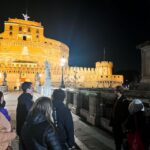

Basilica of St. Clement underground: three layers, one surprising timeline
Your tour starts at St. Clement, a church that teaches history by literally putting it under your feet. The key move here is that you enter the basilica’s underground spaces and walk through multiple archaeological layers, where each level reflects a different era.
The first big takeaway is the pagan layer. Beneath the later Christian buildings, you stand in the setting of a Mithraic cult, and you learn how that pagan world forms the backdrop for later Christian persecutions. It is a reminder that early Christianity did not appear in a vacuum, and Rome’s religious life was already complex when the new faith spread.
Then there is the underground river element. The tour highlights an ancient underground water source that still runs beneath the area, including below the Colosseum. That is the kind of detail that makes the site feel real, because it connects places you may already know above ground to the hidden infrastructure beneath Rome.
What to expect underground
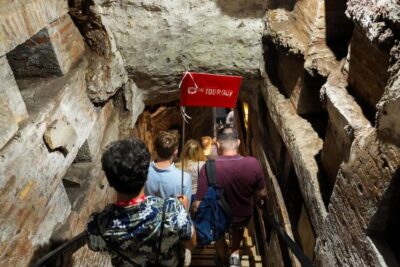
You’ll move through St. Clement’s underground area while the guide connects what you see to what came next above. The stairs and passages can feel cramped in places, so go at a steady pace and do not try to race ahead. This is also where headsets earn their keep, because the guide’s explanations stay audible even when you are surrounded by stone walls and changing acoustics.
A possible drawback is that the underground portions can feel enclosed. If you have claustrophobia, this is the type of tour that can quickly become uncomfortable.
From St. Clement’s house to proto-Christian art in layers above
After the underground pagan temple setting, the story moves upward through Christian space. You see how the area changed as new basilicas were built over older structures, rather than replacing everything from scratch. That stacking is the point: you watch Christianity grow in the same footprint as earlier life.
The tour takes you to the 4th-century basilica built on top of St. Clement’s house. This is where you get a sense of the early church’s physical scale, because the spaces are described as well preserved. You’ll also look at frescoes tied to the lives of martyrs, and the guide explains the scenes and why they mattered to believers.
Then you go into the 12th-century basilica that sits above the earlier levels. This is where the visuals become more dramatic, especially with the golden mosaics. You do not just see them, you learn how the church used imagery to communicate faith to people who might not have had access to texts.
If you care about how art functions as storytelling, this is a strong stop. Many Rome tours rush from building to building, but St. Clement gives you a controlled lesson in how belief and architecture can evolve together.
St. John Lateran: why it is called the Mother and head of all churches
Next, you head to Basilica of St. John Lateran, often described as the Mother and head of all churches on Earth. This matters because it places you in the heart of Roman church identity, not just in one side chapel or one street corner.
You’ll spend about 30 minutes with a guided visit here. That time is enough to appreciate the interior beauty and to understand the political shift that affected Christianity’s status in the Roman world. The tour connects Emperor Constantine and the legalization of Christianity in 313, explaining why that date is a turning point.
You might also run into lines here. On busy days, St. John Lateran can be slow to enter, and the tour’s format relies on the guide managing pacing across multiple stops. Even when there is waiting, the point is that you keep the itinerary moving without feeling like you lost the day.






Scala Sancta (Holy Stairs): a pilgrimage moment in Rome
From St. John Lateran, you move to the Scala Sancta, also called the Holy Stairs. This stop is short, around 15 minutes, but it has an outsized emotional pull because the story connects the steps to Jesus’ judgment scene.
The guide explains what the Holy Stairs represent, framing them as part of a larger theme of Jerusalem traditions coming to Rome. This matters because the tour is not just about Catholic landmarks. It is about how devotion, relics, and geography traveled, physically and spiritually.
In practical terms, arrive ready to move carefully. Stairs and foot traffic create bottlenecks, so keep your timing calm. If you have mobility issues or you are tired from the underground portion, this is where you want to slow your pace.
Helena, Jerusalem soil, and the relic logic
Then comes the tour’s most specific theme: relics, recovered and safeguarded, with ties to the Holy Land. You visit the Basilica of the Holy Cross in Jerusalem, where the narrative centers on St. Helena and her pilgrimage to Jerusalem to recover Christian artifacts.
The key idea is that the early underground church helped safeguard these sacred materials in the Holy Land, and later devotion preserved those connections. The tour highlights soil from the Holy Land as part of that sense of physical proximity, not just symbolic meaning.
This stop is also your bridge from story to objects. You learn why relics mattered to early faith communities, because they connected believers to events they could not visit in person. Rome becomes a kind of memory map, with places acting like anchors.
Basilica of the Holy Cross in Jerusalem: the relics you came for
This is the capstone for people who want to see what is actually described as Crucifixion relics. The tour gives you around 30 minutes here, with guided attention to items associated with the Crucifixion and the Passion.
You may see relics described as:
- A nail from the Crucifixion
- The walnut board attributed to Pontius Pilate above the cross
- The wood of the Cross Jesus was crucified on
- Fragments of the wall from the cave of the Nativity in Bethlehem
- Two thorns of the crown of the Passion of Christ
The tour also highlights the basilica’s connection to the Holy Land through earth brought from Jerusalem. When you pair that with the relic items, the church starts to feel like more than a museum. It becomes a place built to keep a specific chain of memory intact.
A helpful approach here is to listen first, then look. The guide’s explanations help you understand what you are seeing and why it has been protected and venerated.
Optional extension to Santa Maria Maggiore for extra mosaics
If you extend your tour, you add Basilica Papale di Santa Maria Maggiore for about 1 hour. This is a strong add-on if you want more mosaic artistry and more sacred material tied into Christian history.
The stop fits nicely after the relic and Holy Land theme because it returns you to a broader idea of how the church communicated faith through visuals. If you are the type who likes to compare how different churches use art for teaching, this extension will feel worthwhile rather than repetitive.
Timing, group size, and what makes the $88 value feel real
At $88 per person, this is not the cheapest way to see Rome. But it is also not trying to be. You are paying for guided interpretation at multiple high-impact sites plus the included admission to St. Clement’s Undergrounds and the practical comfort of headsets.
You should think about value in three parts:
- Access and instruction where it matters most: St. Clement’s underground layers are the heart of the tour, and guided pacing helps you connect what you see across eras.
- Time efficiency: You cover St. Clement, St. John Lateran, Scala Sancta, and the Holy Cross in Jerusalem within a single route instead of piecing together multiple tickets and explanations on your own.
- Intimacy: The maximum group size of 10 people keeps the experience manageable, especially in tighter spaces underground.
Duration is listed as 2.5 to 3.5 hours. In real life, you might find the pacing flexing slightly at the major anchor stops, because the guide keeps the story tight and then adjusts when lines or on-site conditions slow things down.
What you should bring and wear
Bring comfortable shoes. The tour also has strict clothing rules for church interiors. Shorts are not allowed, short skirts are not allowed, and you should avoid sleeveless shirts.
Large bags, luggage, and pets are not allowed inside the monuments. Also, no weapons or sharp objects, which is standard but still worth noting.
Who this tour suits best
This tour is a great fit if you:
- Want Roman underground history tied directly to early Christianity
- Like walking between sites with one clear narrative thread
- Have limited time and want a guide to connect art, politics, and devotion
- Prefer a small group format
It is less suitable if you:
- Have claustrophobia
- Need wheelchair access (the tour is not wheelchair-accessible)
Final decision: should you book?
Book it if you want more than surface-level Rome. The strongest reason is the structure: St. Clement’s underground layers plus the Holy Land relic story is a rare combo. You get pagan Rome, early Christian growth, major basilicas, the Holy Stairs, and then specific relics connected to Jerusalem in one focused route.
Skip or reconsider if you dislike enclosed spaces. This is not a stroll through open-air squares. You are moving through churches and underground passages where your comfort level matters.
If you do book, plan to go in curious and patient. The guide names and stories can vary by group, and I have seen guides like Mario and Daniel make the pacing work by staying calm when timing gets tricky and by keeping the explanations clear as you move across multiple sites.
FAQ
How long is the Rome Underground Temples and Crucifixion Relics tour?
It runs about 2.5 to 3.5 hours.
What is the maximum group size?
The tour has a maximum of 10 travellers.
Where does the tour start?
The meeting point may vary depending on the option booked, with starting locations listed as Piazza di San Clemente (Piazza di San Clemente).
What is included in the price?
You get a live professional guide, entrance fees to St. Clement’s Undergrounds, headsets to hear the guide clearly, and full on-site assistance.
What should I wear or bring?
Wear comfortable shoes. Shorts, short skirts, and sleeveless shirts are not allowed.
Is the tour wheelchair accessible?
No, the tour is not wheelchair-accessible.
Is this tour suitable for people with claustrophobia?
No, it is not suitable for people with claustrophobia.
Can I get a refund if my plans change?
Yes, there is free cancellation up to 24 hours in advance for a full refund.
More Walking Tours in Rome



More Tours in Rome



More Tour Reviews in Rome
Not for you? Here's more nearby things to do in Rome we have reviewed












Catacombs & Underground Tours, compared.
 ★ 4.7Colosseum: Underground and Ancient Rome TourFrom $16012,691 reviews
 ★ 4.6Crypts and Catacombs Underground Tour with TransfersFrom $745,341 reviews
 ★ 4.7Colosseum Underground Small Group Guided TourFrom $1054,844 reviews
 ★ 4.8St. Peter’s Basilica, Dome Climb, and Underground TourFrom $383,404 reviews
 ★ 4.7Colosseum Underground, Arena & Forum TourFrom $1573,272 reviews
 ★ 4.3Trevi Fountain and Underground Guided TourFrom $411,664 reviews
 ★ 4.6Catacombs and Capuchin Crypt Guided Tour with TransferFrom $411,606 reviews
 ★ 4.7St. Peter’s Basilica Priority Access Tour with Dome & CryptFrom $831,476 reviews
Browse the lists this tour appears in