
Reviewed · WALKING TOURS
Rome Jubilee Walking Tour of Churches, Bridges & Legends
Rome changes after sunset. This 2 hour walking tour turns the Vatican area into a living map, with pilgrimage context and holy-site stories that make the streets feel purposeful, not random. You get a smooth evening route that focuses on churches, bridges, and the legends people carried with them on the way to Saint Peter.
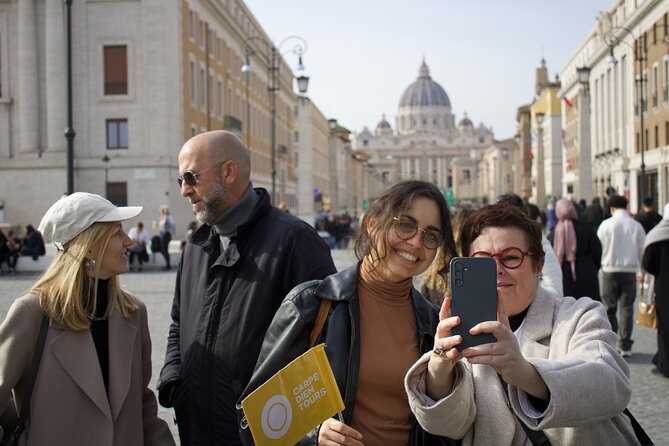
I especially like the small-group feel (max 15). When guides such as Alina, Kasia, Domenica, and Dominica lead, they keep the walk moving and the history readable, with lots of meaning behind what you see, not just names on a sign.
One possible drawback: key interiors are not part of the ticket. You see places like the Pantheon and Saint Peter’s Basilica from outside, so if you want to go in, you will need separate entry plans and modest dress if you are visiting nearby religious sites.
Key moments that make this tour worth your time
- Vatican context, explained on your feet so Saint Peter’s area makes sense fast
- Baroque church stops with artwork and ceiling details you can actually understand
- Pilgrim-route storytelling on Via dei Coronari plus the less-holy side of the street’s past
- Ponte Sant’Angelo and Castel Sant’Angelo viewpoints tied to Hadrian and later papal life
- Small-group pacing that keeps the experience personal without feeling rushed
Why this Jubilee walk works so well at 5 pm
The start time matters in Rome, and this tour begins at 5:00 pm. In practical terms, that’s often the sweet spot after the hottest daytime crowds, so your feet get a calmer, more comfortable tour pace. You still cover a lot of ground in about 2 hours, and because it is a guided walk, you are not spending your energy figuring out what to look at.
This is also a smart “first night” style activity. You end near Castel Sant’Angelo and Piazza Pia, which means you finish where you can keep wandering if you want. The whole loop is built around the holy-sight corridor near the Vatican, but it is not just a checklist of big landmarks. The guide weaves in what pilgrims believed, where they met, and what the route meant.
Lastly, this is English-guided and sized for up to 15 people. That scale makes a real difference: you can ask quick questions, and the guide can keep control of the pace without losing people.
You can also read our reviews of more walking tours in Rome

Price and what you really get for $120.14
At $120.14 per person, this is not the cheapest way to see Rome. But you are not paying for entry tickets to major sites, either. You are paying for an organized evening walk with a local guide who connects each stop to the larger pilgrimage story, plus “hidden gems” and city highlights.
Here is what is included:
- guided walking tour and a local guide
- city highlights and hidden gems
- a mobile ticket
And here is what is not included:
- entry to the Pantheon and Saint Peter’s Basilica (you view them from outside)
So the value pitch is simple. If you want the history and meaning, guided and in context, this price can feel fair. If your top priority is ticking off interiors, you will likely feel the gap because big interiors are not included.
Getting oriented: Piazza di Pietra to Piazza Pia
The tour starts at P.za di Pietra, 45, 00186 Roma RM and ends at Piazza Pia, 00193 Roma RM, next to Castel Sant’Angelo. That matters because it shapes your evening plan.
Before you go, I’d set up your day so you have at least a short buffer after the tour. Since you finish near Castel Sant’Angelo, it is easy to continue with photos over the Tiber, a relaxed wander through nearby streets, or a quick stop to grab a bite nearby. If you have plans earlier in the day, this evening slot can work nicely as a bridge between daytime sightseeing and your deeper Vatican-area time.
Also, Rome is strict about dress for many religious interiors. If you plan to visit Saint Peter’s Basilica or the Sistine Chapel before or after the tour, plan on knees and shoulders covered. Even if you do not enter during the walk, this tip helps you avoid a frustrating last-minute outfit problem.
Stop 1: Piazza di Pietra and the Temple of Hadrian’s columns
You begin in Piazza di Pietra, a quieter start that immediately gives you ancient Rome in plain sight. The standout is the Temple of Hadrian, with its columns still holding up the sense of scale. It is the kind of scene where your brain starts connecting dates: this is not just “the church part of Rome,” it is the same city, over centuries.
What I like about starting here is that it resets your eye. Before you jump into baroque churches and pilgrimage stories, you get a clear ancient anchor. The guide’s job at this stop is key: you should walk away understanding what you are looking at, and why it feels like Rome built layers on layers rather than replacing everything.
Stop 2: Chiesa di Sant’Ignazio di Loyola and the Baroque ceiling
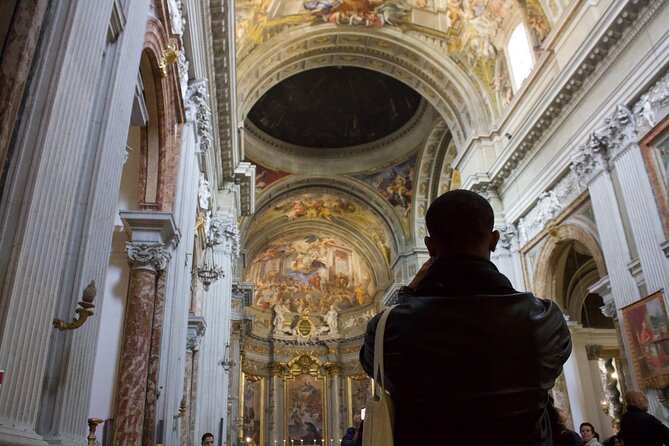
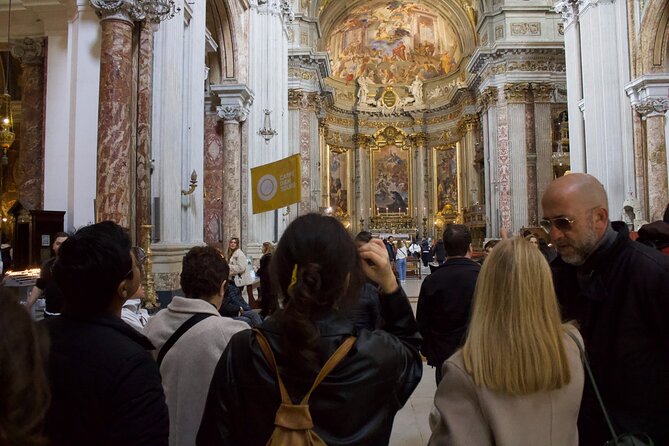
From ancient columns to one of Rome’s best-known Baroque church interiors. Chiesa di Sant’Ignazio di Loyola is famous for its ceiling, and the guide helps you read it as more than decoration.
This stop is about religious art with a purpose. You should expect commentary on what the 17th-century artwork was trying to communicate, plus why the church became a standout for people who cared about faith, spectacle, and storytelling. If you enjoy places where art carries meaning, this is one of the most rewarding moments.
One practical note: because you are looking up and inside this kind of space, wear comfortable shoes and go in with a slower gaze. Even if you only get a short look, the guide’s explanation can turn that quick glance into real understanding.






Stop 3: Basilica of Saint Mary of Minerva and art with strong ties
Next up is the area around the Basilica di Santa Maria Sopra Minerva in a peaceful square. This is a great “pause stop” after the energy of earlier sights.
Inside, you are set up to notice major artworks and burial history. The highlight is Michaelangelo’s Christ the Redeemer plus the tomb of Saint Catherine of Siena. Even when you are not spending a long stretch in a museum-like way, the guide’s framing helps you realize you are seeing theology, devotion, and artistic choices all at once.
If you are the type who gets a little overwhelmed by too many big Roman churches, this stop can be a relief. The story is focused: art and saints connected in a way that feels intentional, not random.
The Pantheon viewpoint stop: why looking from outside still pays off
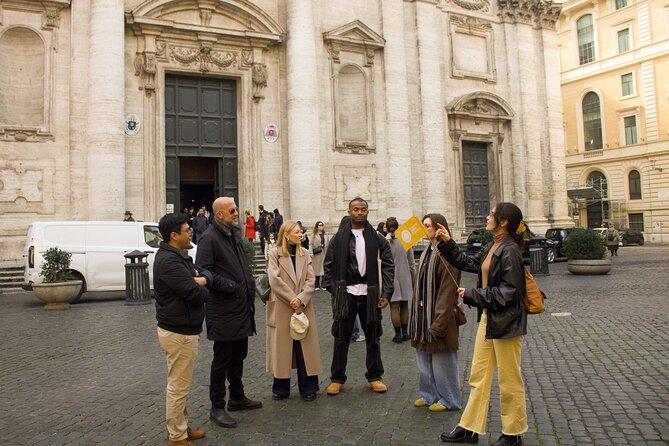
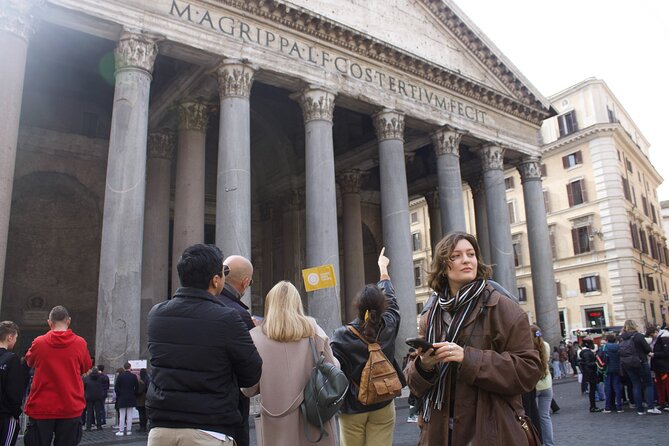
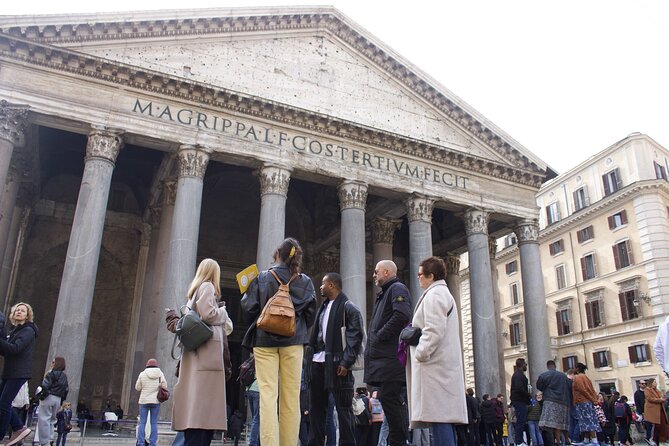
At some point you will pass the Pantheon, including its iconic dome and portico. You do not get interior time here, and the listing keeps things clear that entry is not included. But viewing it from outside can still be worthwhile if the guide points out the architectural logic and the reason the Pantheon still feels startling.
This is one of those Rome moves where you think, I already know what it looks like. Then you hear what makes it different, how it held up, and why people still use it as a reference point. If you later choose to enter on your own, you will be better prepared for what to look for, because you already have the context.
If you are tightly scheduled and want to keep costs down, the outside view works. If you dream of interior exploration, treat the Pantheon stop here as a warm-up.
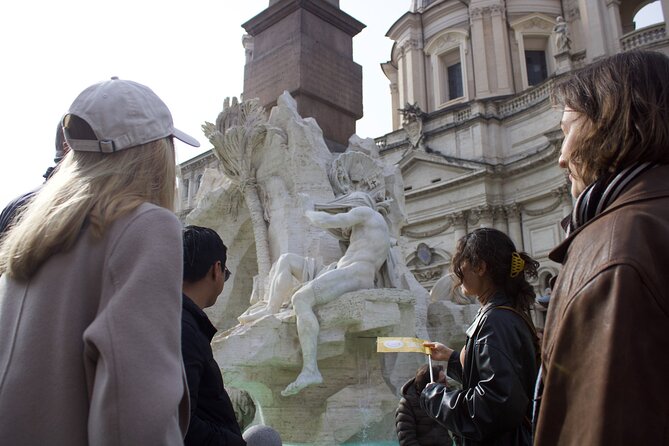
Piazza Navona: from Roman stadium energy to Baroque fountains
Piazza Navona is the kind of place where Rome does not whisper. It talks loud. This site started as an ancient Roman stadium, and the square still carries that open rhythm.
You will stroll through the space and hear about how it connects to the present-day visual vibe: Baroque fountains and the major church Sant’Agnese in Agone, designed by Borromini and Bernini. Even if you have seen pictures, the guide’s job is to make the layers click, stadium to square to spectacle.
I like this stop because it balances sacred and civic. You get the religious architecture, but you also understand the way public space shaped city life. It also sets you up for the next street walk, because Piazza Navona feels like the center of gravity in this area.
Via dei Coronari: pilgrims on cobblestones, and a darker side of the street
Then you shift to a narrower street: Via dei Coronari. The cobblestones and Renaissance-era buildings make it feel like a storybook corridor, but the guide keeps it grounded.
This street is tied to the movement of pilgrims headed toward Saint Peter’s Basilica. You will also hear about how the street was lined with more than just holy travelers and worship. Some parts of the street’s past are described as less-than-holy, which helps you understand that pilgrimage was not a bubble. Real people, real needs, real temptations all existed in the same walking route.
If you like atmospheric walks where a guide explains the human side of history, this is a standout. And for photos, this is a better lane than the bigger squares because the angle is naturally tight, so your images look more “Rome up close.”
Ponte Sant’Angelo and the pilgrim shortcut idea
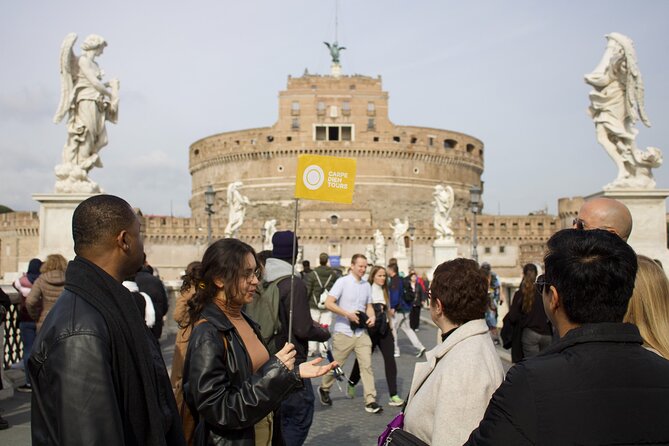
You cross St. Angelo Bridge, also known as Ponte Sant’Angelo. The bridge is decorated with statues of angels, and you also get views toward the Tiber River and Castel Sant’Angelo.
This is a big moment in the narrative because it was part of the route people used to travel toward Saint Peter’s Basilica. One review also highlights that the tour covers only one bridge crossing, which makes sense because the focus is not on bridge-hopping. It is about the meaning and the viewpoint you gain from this specific passage.
If you like bridges in travel, enjoy this one for the combination: religious symbolism (angels), empire context (it connects to Hadrian’s mausoleum), and practical city orientation (how the route channels people).
Castel Sant’Angelo: mausoleum, papal residence, prison, now a museum
Right after the bridge, you take in Castel Sant’Angelo. The building’s story is one of Rome’s best “one structure, many lives” examples.
You’ll hear how it began as Emperor Hadrian’s mausoleum, later became a papal residence, and even served as a prison. Today it is a museum, but the exterior and the setting still communicate all those roles. The guide helps you connect that timeline to the pilgrimage route feeling: this is where power, faith, and politics overlap.
This is also a viewpoint stop. Even if you do not go inside, you should be able to enjoy the perspective over Rome and understand why this location mattered for centuries.
Piazza Pia and the almost-finished feeling
Next is Piazza Pia, a meeting point for visitors heading toward Saint Peter’s Basilica. It is the part of the walk where the pilgrimage story starts to feel complete, like the final approach.
I like this stop because it gives your brain a “checkpoint” moment. Instead of treating the Vatican area like one giant attraction, you understand it as an arrival sequence: meet here, look up, and then move forward.
You might find this especially helpful if you are building your own independent Vatican plan later. A guided sense of the flow helps you navigate with less stress and fewer detours.
Saint Peter’s Square: Bernini colonnades and the tomb-under-the-façade idea
The tour ends at Saint Peter’s Square, with Bernini’s colonnades guiding you toward the basilica façade. Even if you have been to Rome before, this area can still hit differently when a guide ties it directly to the pilgrimage route and the symbolism.
You should get the essential context: Saint Peter’s Basilica is considered the heart of Catholicism and built over the tomb of Saint Peter. The guide’s explanation helps you see the square not as a photo backdrop, but as a designed stage for spiritual arrival.
When the tour finishes, you can decide how much time to spend at your own pace. If you enter Saint Peter’s Basilica, remember the dress rule about covered knees and shoulders.
Who this tour is best for
This tour is an excellent fit if you:
- want your Vatican-area visit to feel organized and meaningful, not random
- enjoy church art, ceilings, tombs, and religious symbolism explained in plain language
- prefer a small group with room for questions
- like walking city routes and learning why people used to move this way
It may be less ideal if you:
- want guaranteed interior entry at the Pantheon or Saint Peter’s Basilica
- want more than one bridge stop, because this route centers on Ponte Sant’Angelo specifically
Final verdict: should you book?
I think you should book this tour if you want an evening that feels efficient and story-driven, with strong guide-led context and a route that connects ancient, baroque, and pilgrimage Rome in a way that stays understandable.
Skip it only if your main goal is interior ticket time at the Pantheon and Saint Peter’s Basilica. In that case, you will likely want a different option that includes those entries.
If you are aiming for a great first look at this side of Rome, with less guesswork and more meaning per step, this one is a very solid choice.
FAQ
How long is the Rome Jubilee Walking Tour of Churches, Bridges & Legends?
The tour lasts about 2 hours.
What time does the tour start?
The start time is 5:00 pm.
Where does the tour start and end?
It starts at P.za di Pietra, 45, 00186 Roma RM and ends at Piazza Pia, 00193 Roma RM, next to Castel Sant’Angelo.
Is the tour guided and in English?
Yes. It is a guided walking tour with a local guide, and it is offered in English.
How big is the group?
The tour has a maximum of 15 travelers.
What is included in the tour price?
Included are the guided walking tour, a local tour guide, city highlights, and hidden gems, plus a mobile ticket.
Are entry tickets included for the Pantheon and Saint Peter’s Basilica?
No. You view both the Pantheon and Saint Peter’s Basilica from outside, and entry is not included.
What should I wear if I plan to visit Saint Peter’s Basilica or the Sistine Chapel?
Bring clothing that covers knees and shoulders.
Is free cancellation available?
Yes, free cancellation is available. You must cancel at least 24 hours in advance for a full refund.
More Walking Tours in Rome



More Tours in Rome



More Tour Reviews in Rome
Not for you? Here's more nearby things to do in Rome we have reviewed












Walking Tours, compared.
 ★ 4.9Trastevere & Campo de Fiori Street Food Walking TourFrom $512,768 reviews
 ★ 4.9Paranormal Night Walking Tour & Secret BackstreetsFrom $341,921 reviews
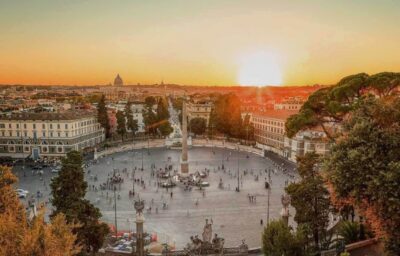 ★ 4.4Guided City Center Evening Sightseeing Walking TourFrom $46953 reviews
 ★ 4.5Best of Rome Walking Tour including Trevi FountainFrom $4923 reviews
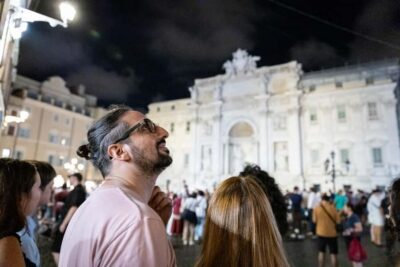 ★ 4.8Under the Moonlight Evening Walking TourFrom $28852 reviews
 ★ 4.9Forbidden History Walking Tour & Pub Crawl with DrinksFrom $61688 reviews
 ★ 5.0Guided Small Group Walking Tour of City HighlightsFrom $30682 reviews
 ★ 4.5Rome Walking Tour with Piazza Navona, Trevi Fountain and PantheonFrom $35676 reviews
Browse the lists this tour appears in