
Reviewed · WALKING TOURS
Ghosts Legends and Mysteries of Rome Walking Tour
Rome has a dark bedtime story. This 90-minute night walk threads from Castel Sant’Angelo to Campo de’ Fiori, with English storytelling and a licensed guide keeping the pace moving.
I love the fact that it is short, so you can fit it into a busy trip without sacrificing Rome time. I also like how the route focuses on places tied to power, punishment, and rumor, ending in the famously complicated Campo de’ Fiori square.
One key consideration: this is storytelling, not a paranormal show, and the material includes graphic topics, so it is not recommended for children under 12.
Key things to know before you go
- 90 minutes at night: made for time-pressed travelers who still want the darker side of Rome
- Licensed guide, small group: up to 24 people, which helps you stay together
- Mobile ticket: convenient for a quick evening plan
- Iconic stops close together: Castel Sant’Angelo, Ponte Sant’Angelo, and Via Giulia are built into one walk
- Not a ghost hunt: you get legends and historical mysteries, not jump scares
- Some heavy content: plan for graphic themes, especially if traveling with kids
Ghosts, Legends, and Mysteries of Rome, what you get for the $3.63 price
First, the price looks almost too good on paper: $3.63 per person. But the real value math is in how the tour is structured. You are paying a small amount to reserve your spot, and then the experience runs on tips at the end, so the guide’s performance is the main lever.
For me, the sweet spot is the format. You are not stuck in a long sit-down tour. Instead, you move from stop to stop while the guide folds history, folklore, and true-crime era details into a single night narrative. That format is ideal when you want something memorable after a full day of museums and churches.
And because the tour ends in Campo de’ Fiori, you also get an easy transition back into real Roman life. After the stories, you are right where the city likes to gather, snack, and talk.
You can also read our reviews of more walking tours in Rome


Tip-based tours: how this one “really” works
The price you pay upfront is only part of the story. This is a tip-based tour, and the tour info makes it clear that guides work for tips alone. That changes how the whole thing feels: good guides push harder, and you will notice it in the energy and pacing.
So here is the practical takeaway for you. If you book this, treat the guide like part of the experience, not like a background audio track. Arrive on time, keep your attention on the front of the group, and you’ll get much more out of the storytelling.
Also, you can expect the tour to be honest about its style. This is not marketed like a Hollywood haunted house. It is built around legends and mysteries you can picture as you walk past the original settings.
The 8:00 pm start: timing, meeting point, and end at Campo de’ Fiori
This tour starts at 8:00 pm at Lungotevere Castello, 50, 00193 Roma RM. It ends in Piazza Campo de’ Fiori (P.za Campo de’ Fiori, 00186). That end point matters. Campo de’ Fiori is well placed with transit options, and it gives you an instant “what now?” choice after the walk.
The duration is listed as about 1 hour 30 minutes, and it tends to feel like a fast-moving circuit because the stops are short. Most stops are just minutes long, which means you get variety without getting dragged across town for hours.
The group size is capped at 24 travelers, which is a nice middle ground. Large enough to keep the vibe lively, small enough to hear the guide without playing musical chairs.
Castel Sant’Angelo after dark: the anchor stop of the whole route
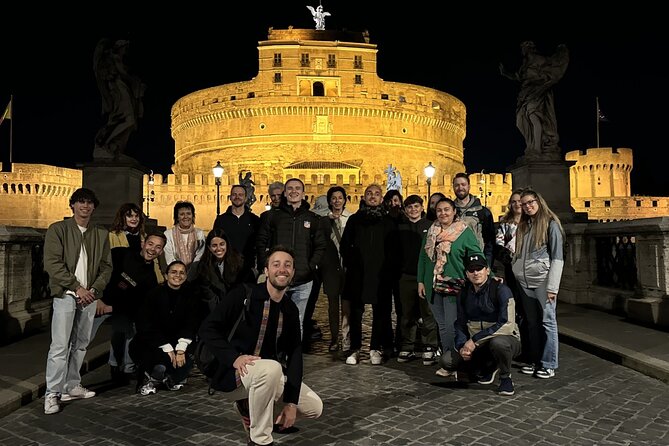
The tour’s first big landmark is Castel Sant’Angelo, a structure that basically grew up with Rome’s power shifts. It began as Emperor Hadrian’s mausoleum, then became a fortress, papal residence, and prison. So even before the legends start, the building already feels like a time machine.
You also get one of the classic visual beats: the cylindrical shape you recognize instantly from the Tiber River area. Atop it, the Archangel Michael statue gives you that “guarding the line” feeling, which fits perfectly with the tour’s theme.
The value here is more than sightseeing. This stop gives you a mental frame. Once you understand the building moved from tomb to fortress to prison, the later stories about executions and church secrecy feel less like random horror trivia and more like a map of how Rome’s institutions worked.
Ponte Sant’Angelo’s angel statues and the idea of crossing over
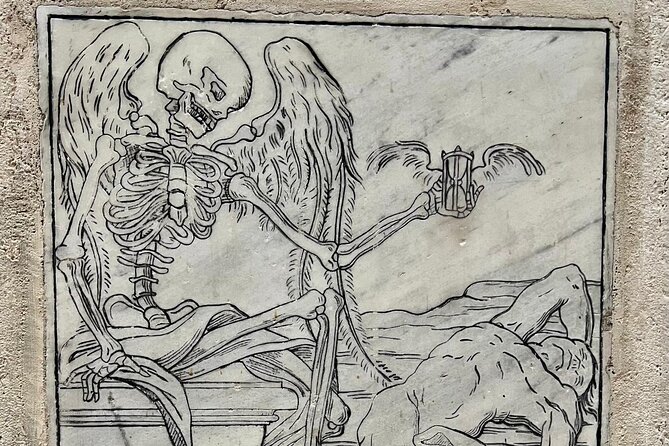
Right after Castel Sant’Angelo, you head to Ponte Sant’Angelo. This bridge is loaded with meaning, and the tour leans into it. The bridge’s ten angelic statues, carved by Bernini and his students, are tied to symbols connected to Christ’s suffering.
At night, the mood shifts. Shadows make the angels’ faces feel harsher and more guarded, and the guide uses that effect to set up the idea of a bridge between worlds. In a tour like this, that matters, because it is the first time you move from “this is a place” to “this is a story people attached to places.”
If you are the type who likes atmosphere, this is where you start feeling the theme.



Via Paola and the legend of the kindest executioner
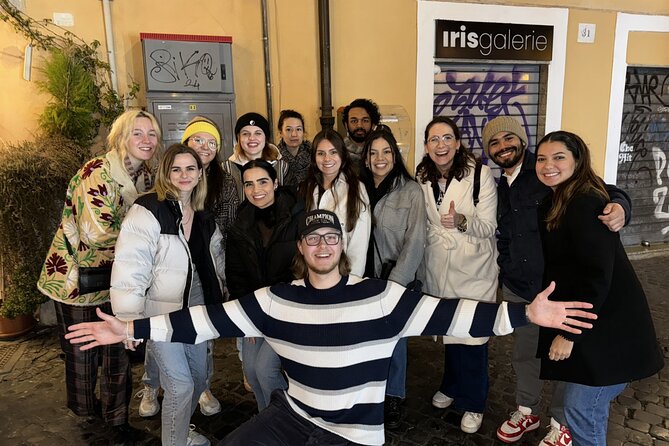
Next comes Via Paola, linked to the story of the house of the kindest executioner in Rome. That line is exactly the kind of moral twist this tour enjoys: Rome is full of roles that sound monstrous, yet the folklore sometimes humanizes the people inside them.
This stop is short, so you will not get a lecture. You get a snapshot, usually delivered in a way that connects the neighborhood to a larger system of punishment.
Practical note: because the stops are brief, your best strategy is to keep walking and listen for the guide’s linking phrases. The payoff comes when the guide ties one dark detail to the next one.
Arco dei Banchi: haunted arch energy plus exorcist controversy
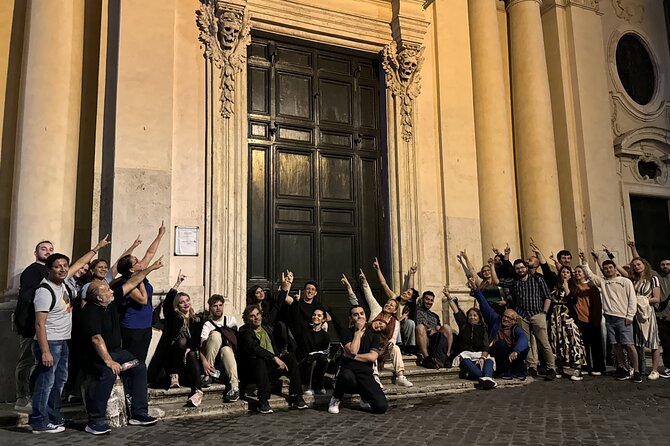
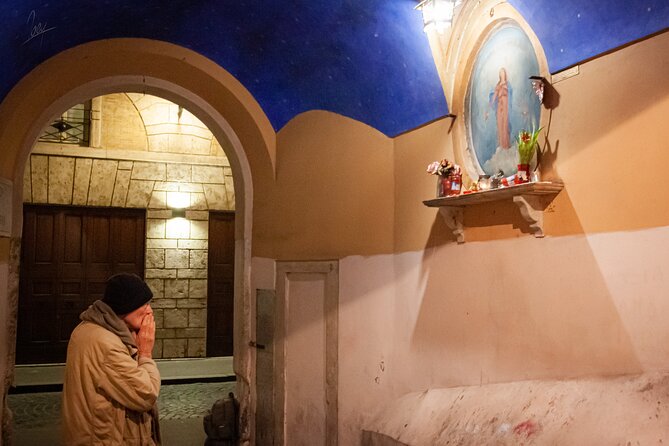
The route then hits Arco Dei Banchi, the Haunted Arch. It is also described as a place of prayer connected to one of Rome’s most controversial exorcists.
This stop works well if you like legends that live in religious spaces. Instead of treating “haunting” as ghosts and monsters, the tour treats it as belief, fear, and people trying to control what they cannot explain.
It is a quick stop, but it gives you another perspective on the tour’s big idea: in Rome, the supernatural often sits next to official institutions, whether that is church ritual, scandal, or both.
The stories behind Cellini’s house: art, violence, and gossip
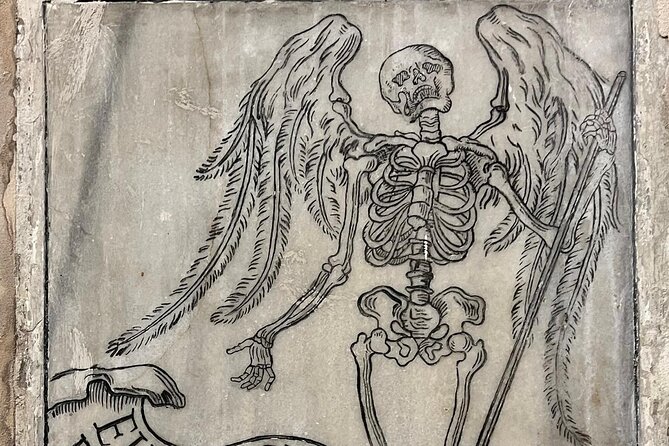
At Largo Ottavio Tassoni, 319, the tour points you toward the house connected with Benvenuto Cellini, a 16th-century artistic genius. The darker turn is that the stories attached to him are not just about art. They include accusations and tales of serious violence.
This is one of those stops where you can feel the tour balancing two gears at once: great city names and reputations, and the messy rumors that cling to them. If you like your Rome complicated, you’ll probably enjoy this.
If you prefer purely historical tourism without the heavy rumor framing, this is the moment to keep expectations flexible. The tour’s brand is not “museum facts only.”
Vicolo della Moretta and Giulia Tofana’s witch legend
In Vicolo della Moretta, the tour brings you to the haunted house story of the witch Giulia Tofana. It also layers in tales tied to the holy inquisition.
This stop leans into fear and folklore. It is not just about one person. The guide uses it to explain how legends can spread when communities are scared, hungry for answers, and ready to assign blame.
Because the tour includes graphic topics, this is the kind of stop where the theme can feel darker. You will want to decide ahead of time that you are okay with that side of Rome history.
Corte Savella prison walls and Beatrice Cenci’s torture
Then the walk shifts toward Via di Monserrato, where Corte Savella is described as the only prison in Rome authorized to execute convicts inside its walls. The stop connects this place to the story of Beatrice Cenci, who was tortured before execution.
Even though it is a short stop, it lands. It is where the tour stops being “spooky” and becomes “this is the reality behind the legend.” The guide’s job is to connect the physical site to the human cost, not just the macabre plot points.
If you are someone who likes your horror grounded in real places, this is a highlight.
Via Giulia: the nice street that hides nasty stories
The tour then touches Via Giulia, a picturesque historic street designed by Bramante for Pope Julius II. It is lined with Renaissance palaces and ivy-covered facades, with a sense of quiet elegance.
This is important for your experience because it prevents the tour from feeling like a single note. You get beauty, symmetry, and street texture, then the guide points out how those same spaces held power games and darker events.
If you are photographing at night, Via Giulia is a good stretch to slow down for a second. The street gives you that Rome look, while the stories give it a second meaning.
Santa Maria dell’Orazione e Morte: skulls, bones, and death symbols
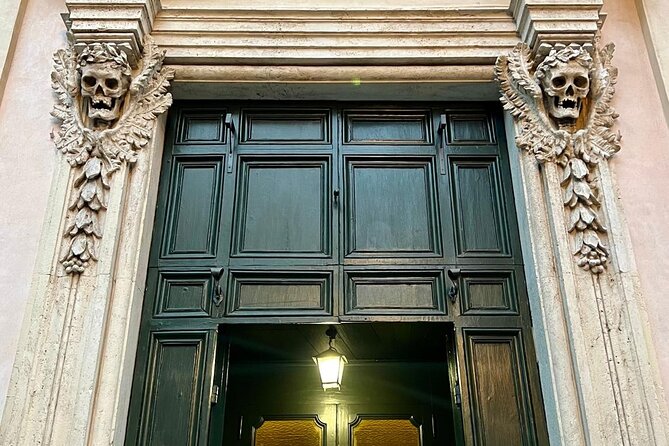
At Chiesa di Santa Maria dell’Orazione e Morte, the tour describes a Baroque church built by a secretive confraternity dedicated to retrieving and burying abandoned corpses. Inside, the vibe is said to include skulls, bones, and death symbolism.
This stop is unsettling by design. It is the tour’s “death is not a rumor here” moment. And even if you do not love heavy content, it is historically interesting because it shows how religion and ritual responded to the reality of death in the city.
If you are sensitive to graphic themes, you should be mentally prepared for this stop to feel darker than the street legends.
Fontana del Mascherone and the Getty kidnapping crime-scene story
Next up: Fontana del Mascherone on Via Giulia. The highlight is the massive stone mask that seems to grimace while water comes from its mouth. It is also described as a crime scene connected to the kidnapping of John Paul Getty III.
This stop is a nice reminder that “mystery” is not always centuries old. Sometimes the suspense is recent compared to Rome’s deep timeline, and the tour uses that contrast to keep the stories from feeling like pure ancient superstition.
Campo de’ Fiori after dark: market life, execution memories
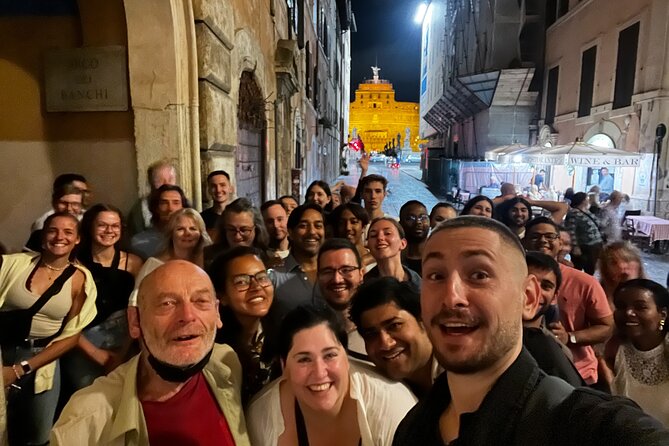
The walk ends at Campo de’ Fiori, a historic square known by day for a busy market of produce and local goods. At night, it becomes the kind of meeting point where people eat, drink, and linger.
The tour also connects it to a darker past, including the story shadow of Giordano Bruno and executions tied to the Inquisition. So while you are standing in a fun evening setting, the guide keeps pulling the narrative back toward why this square has been shaped by fear and punishment.
It is a good ending because you leave with contrast. Rome is not just monuments and fountains. It is also consequences, and the city’s public spaces carry those stories.
How scary is this tour really?
This is where you should set your expectations. The tour is not a paranormal investigation, and it is not a stage show with jump scares. It is a walk where the guide tells legends, mysteries, and darker history while you look at the actual settings.
So you should think “chilling stories” more than “spooky effects.” If you want your fear delivered through atmosphere and grim history, you’ll likely enjoy it. If you want true haunt-style thrills, you may find it more like dark storytelling than horror entertainment.
That also explains why some reviews praise the guide’s humor and clarity, while others wish for more ghostly thrills. The theme is real, but the delivery style is grounded.
Guide style at night, including Ivan and Simone
The tour is led by licensed guides, and multiple guide names show up in the experience feedback, including Ivan and Simone. Guides are described as enthusiastic, clear in how they point out details, and willing to keep the tone light even when the subject matter turns grim.
That balance is part of why a short night tour works. If you want the group experience to stay fun, the guide’s timing matters. The tour can also feel fast because the guide keeps the story moving instead of pausing for long lectures.
One practical heads up: night walking tours can be harder to hear if the group spreads out. Keep close to your guide and you’ll get more of the story beats.
What to bring and how to handle the night walk
You do not need special gear for this tour, but a few things can make your evening smoother.
- Wear comfortable shoes. You’ll be walking between multiple landmarks.
- Bring layers or a light rain cover. Evening weather can change quickly in Rome, and the route is outdoors.
- If you want the most out of the stories, treat it like a guided storytelling session. Stay attentive, not just scenic.
Also, because the walk runs at night and in a group, it can feel reassuring compared with wandering alone. You get company, pacing, and a clear route.
Who this tour is best for
This is a great fit if you are:
- Short on time but want a night activity that feels different from museums
- Interested in how Rome’s institutions, religion, and folklore tangled together
- The kind of traveler who enjoys true-crime style history, but not necessarily Hollywood scares
- Happy to follow a guide’s flow for about 90 minutes
It is less ideal if you:
- Need an overtly paranormal experience with investigations or effects
- Are traveling with kids under 12, since the tour includes sensitive graphic topics
- Want purely light history with no execution-era themes
Should you book Ghosts Legends and Mysteries of Rome?
Book it if you want a short, guided, evening walk with real landmarks tied to legends, crime-era punishment, and religious mystery. The value is in the format, the small-group size, and the guide-led storytelling that turns well-known sites into something darker and more memorable.
Skip it, or at least rethink it, if you want jump scares or a true ghost-hunt experience. This is history-led spooky storytelling, not a paranormal show, and it includes serious content.
If you are the kind of traveler who likes Rome with its lights dimmed a bit, this tour is an easy yes.
FAQ
What time does the Ghosts Legends and Mysteries of Rome Walking Tour start?
The tour starts at 8:00 pm.
How long is the tour?
It runs for about 1 hour 30 minutes.
What language is the tour offered in?
The tour is offered in English.
Where do I meet the guide, and where does the tour end?
You meet at Lungotevere Castello, 50, 00193 Roma RM, Italy, and the tour ends in Piazza Campo de’ Fiori, 00186 Roma RM, Italy.
How big is the group?
The tour has a maximum group size of 24 travelers.
What is included in the tour price?
It includes a licensed tour guide, a walking tour, haunted places, and urban legends and ghost stories.
Is the tour tip-based?
Yes. Tips are not included, and it is described as a tip-based tour.
Is this tour suitable for children?
It is not recommended for children under 12 because the tour includes CSA topics and graphic information.
Are service animals allowed?
Yes, service animals are allowed.
Do I need to pay separate entry fees for the sights?
The itinerary lists admission ticket free for the stops on the route, so you should not need separate entry tickets for those specific sights.
More Walking Tours in Rome


More Tours in Rome
More Tour Reviews in Rome
Not for you? Here's more nearby things to do in Rome we have reviewed






Walking Tours, compared.
 ★ 4.9Trastevere & Campo de Fiori Street Food Walking TourFrom $512,768 reviews
 ★ 4.9Paranormal Night Walking Tour & Secret BackstreetsFrom $341,921 reviews
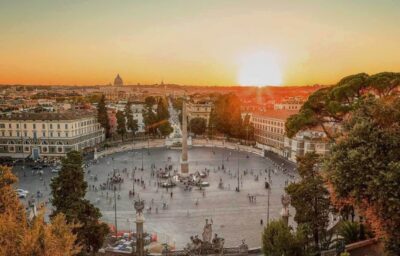 ★ 4.4Guided City Center Evening Sightseeing Walking TourFrom $46953 reviews
 ★ 4.5Best of Rome Walking Tour including Trevi FountainFrom $4923 reviews
 ★ 4.8Under the Moonlight Evening Walking TourFrom $28852 reviews
 ★ 4.9Forbidden History Walking Tour & Pub Crawl with DrinksFrom $61688 reviews
 ★ 5.0Guided Small Group Walking Tour of City HighlightsFrom $30682 reviews
 ★ 4.5Rome Walking Tour with Piazza Navona, Trevi Fountain and PantheonFrom $35676 reviews
Browse the lists this tour appears in