
The Colosseum feels bigger when you skip the scramble. This timed-entry walk links the Colosseum with the Roman Forum and Palatine Hill, and you can even add the arena floor.
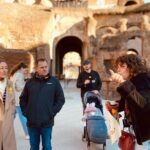
I love the timed entry that keeps the day moving, and I love that you hear your guide clearly through a headset, with guides like Laura or Alberto setting the tone.
One possible drawback: it is mostly outside, with uneven ground, stairs, and plenty of standing, so the 3-hour loop can feel like a workout in hot weather.
Key takeaways before you go
- Timed ticket bundle: Colosseum plus Roman Forum and Palatine, with set entry times
- Optional arena floor access: available when you book the arena option
- Clear audio with headsets: easier listening in big crowds
- A smart route across Roman power centers: triumphal arches, Via Sacra, Forum core, and Palatine viewpoints
- Small group cap (up to 25 people): helps with pacing, photo stops, and asking questions
Timed Entry Begins at the Arch of Constantine
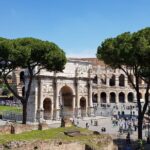
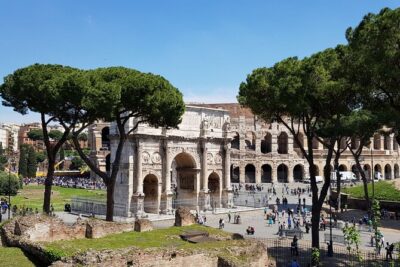
You start near the Arch of Constantine, right between the Colosseum and Palatine Hill. That location matters. It helps you orient fast, because you can look across and understand how this whole area works as one historical complex, not three random ruins.
The arch itself is a great first stop because it tells you what you are about to see: it celebrates Emperor Constantine’s victory at the Battle of the Milvian Bridge. Once you know that, the Colosseum stops being just a famous oval building and starts feeling like part of an era of power and propaganda.
Practical note: you’ll spend time walking on varied terrain. Even before you hit the Colosseum, you are already switching between level paths and steps. Comfortable shoes are not optional here.
You can also read our reviews of more tours and experiences in Rome.
Entering the Colosseum: What the Tour Gets You
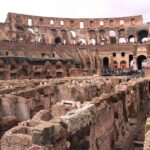
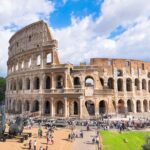
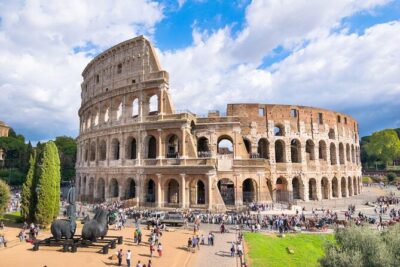
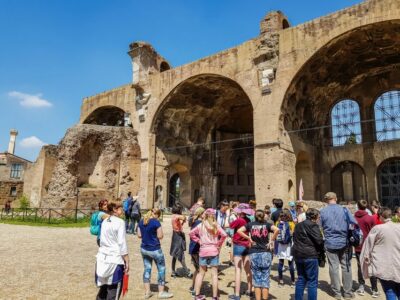
Your timed entry brings you into the Colosseum, where you get to stand close to the same space gladiators once used. The value is not only access. It’s interpretation. With a live guide (and headsets), you are less likely to miss the big architectural ideas, like what made this amphitheater work and why it looked the way it did.
The tour is built to move quickly. You typically spend about 30 minutes at the Colosseum, so it’s not a slow sit-down museum visit. Instead, it’s designed to help you connect details to the bigger story: how the building functioned, what you are looking at, and why it mattered politically and culturally.
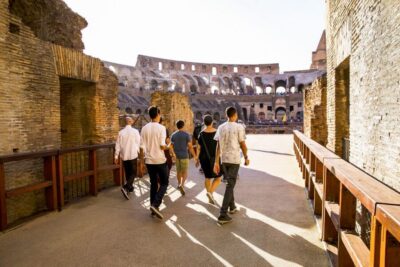
If you add the arena floor option, you get a different perspective, because you are closer to the action zone. Just know it can feel more crowded and more “on your feet” than the standard route. If you are deciding between options, I’d match it to your priorities: arena floor for perspective, standard access for comfort.
The Roman Forum Core, Plus the Streets That Made Rome Work
After the Colosseum, you move into the Roman Forum, often described as the heart of ancient Rome. This section is short, roughly 20 minutes, but it hits the essentials: you’re walking among ruins of major government buildings, the kinds of places where public life happened.
The Forum works best when you understand the layout. That’s where a guide adds real value. Without context, you may stare at broken walls and think, I’m seeing stone, but what did it do? With a good explanation, the Forum becomes legible: you begin to understand sightlines, civic spaces, and how people moved through the political center.
Then you connect those ideas to Via Sacra, the main street of ancient Rome. This is the route of the Roman Triumph, lined with important religious sites. When you walk this stretch, you are basically walking a stage set built for major processions, which makes it easier to picture ceremonies and crowds.
Via dei Fori Imperiali and the Speeches from the Rostra
Next comes Piazza del Colosseo, a square named after the Colosseum and positioned between Via dei Fori Imperiali and Via Claudia. This is where the tour gives you quick stops that deepen your mental map, including the Meta Sudans and the Colossal statue of Nero in the broader area.
Then you get to Via dei Fori Imperiali, described as a scenic boulevard connecting Piazza Venezia with the Colosseum. Here’s the practical benefit: you can see monumental stretches of multiple imperial forums in one glance, including forums of Caesar, Augustus, Nerva, and Trajan. It turns “I visited the Forum” into “I understand the imperial building plan.”
After that, you head to the Rostra, the remains of a platform where public speakers delivered orations. This is one of my favorite kind of stops on these tours, because it turns archaeology into a human activity. You’re not only looking at government stone, you’re imagining speeches and debate in a real civic setting.
Temples, Triumphs, and the Arches That Mark Empire
The route then shifts from political spaces to sacred and commemorative landmarks.
At the Temple of Venus and Roma, you’re dealing with a temple that is thought to have been extremely large for its time. The dedication to Venus Felix and Roma Aeterna matters because it links the divine to the idea of Rome as eternal. Even in ruins, the message is clear: the empire didn’t separate religion from politics.
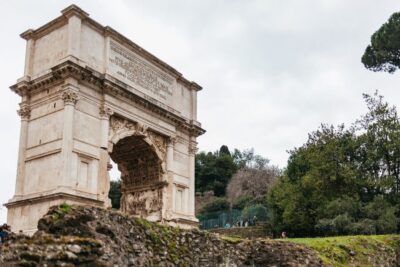
You also visit the Arch of Titus, with a single archway and Roman art that commemorates Emperor Titus’s victories, including the Siege of Jerusalem. This is a good moment to slow your thinking, because the arch is not just decorative. It’s a visual record of conquest, built to be seen and remembered.
Finally, you stop at Tempio di Antonino e Faustina, which later became the church of San Lorenzo in Miranda. This is where you learn something that helps you travel smarter in Rome: many Roman structures survived because they got reused. The “ruin” is not the end of the story, it’s the beginning of a longer life.



Palatine Hill Views and Circus Maximus from Above
Your final big concentration is Palatine Hill. This is the site tied to the city’s foundation and also the area of former palatial homes of emperors. You’re not just walking on history, you are standing in the kind of elevated position that rulers chose on purpose.
The view is a feature, not a bonus. From here, Circo Massimo becomes understandable in a new way. You do not enter the circus itself here, but the view down onto the space where Romans cheered for chariot races can be spectacular. It helps you picture the roar of crowds and the scale of the event.
This is also a practical reason Palatine works at the end of the tour: it’s a natural place to absorb what you’ve learned and then keep exploring at your own pace after the guided portion ends around Palatine Hill.
Arena Floor Option: Worth It or Skip It
The arena floor access is an add-on you choose at booking. The ticket value jumps from the standard timed entry amount to a higher value when arena access is included, so you are paying for something tangible.
For me, the decision comes down to stamina and perspective:
- If you want the closest-feeling Roman “inside the building” experience, arena floor access is the reason to upgrade.
- If you prefer easier walking and more time keeping cool, stick with the standard Colosseum entry and spend the extra energy on the Forum and Palatine details.
Either way, your tour timing is built around a tight loop, about 3 hours total, so you won’t feel trapped in a half-day production.
Price and What Your Money Actually Covers
The price is listed at $59.28 per person, for roughly 3 hours. What makes it feel fair is that the paid portion is not only a ticket. The timed-entry includes Colosseum plus Roman Forum and Palatine, and there’s also a reservation fee included.
So you are effectively paying for:
- your set entry into the Colosseum (plus Forum and Palatine)
- support services that cover getting you through the timed process
- headsets if you book the guided version
If you’re comparing alternatives, the key is to compare like for like. A plain ticket can get you in, but it won’t automatically give you a route that makes the Forum and Palatine feel connected.
Guided vs Audioguide: Choose Based on How You Want to Experience Rome
You have two paths with this product: a guided tour using headsets, or an audioguide/app option.
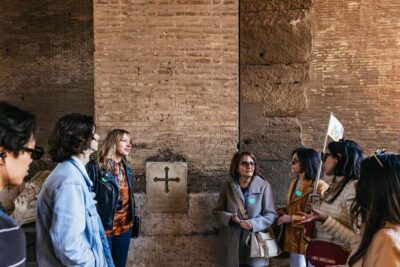
If you want live explanation, go for the guided format. The headset is what makes it workable in a loud, crowded site, and the guide can answer questions on the spot. In feedback I saw names like Laura, Patrizia, Viola, Alberto, Donatella, and Alessandra, and the common thread is that the best moments came from pacing plus the story behind what you see, including shaded breaks when it gets hot.
If you choose the audioguide/app option, you should treat it like self-guided time with an app. You must use your own smartphone and earphones. You can download for offline use, and a download link is provided about one day prior if you choose the audioguide option. Still, it is wise to do that download before you arrive, on solid Wi-Fi, because you do not want to waste Colosseum time stuck at a loading screen.
Also, the audioguide option means you will be responsible for navigating your own route decisions. If you love spontaneity, that can be a plus. If you want someone to keep the big picture in order, guided is the safer bet.
What to Know Before You Start Walking
A few logistics points can make or break the day:
- No large luggage or bags are allowed in the venues.
- Your ticket names must match your identity documents exactly, because names are used to issue non-transferable tickets.
- The tour is primarily outdoors, with stairs and varied terrain.
- Colosseum hours can change due to weather, and the operator states you’ll be offered a change of date or a full refund in those cases.
One more Rome-real-world note: during the Jubilee period, some monuments may be under restoration. That means your route could experience small changes depending on what’s open, so keep an eye on any messages you receive close to your date.
Should You Book This Colosseum, Forum, and Palatine Tour?
Book it if:
- you want timed entry to the Colosseum without wasting your morning in lines
- you like a structured route that turns Forum ruins into a real story (Via Sacra, Rostra, imperial temples, triumphal arches)
- you are comfortable with a 3-hour outdoor walking route
Consider a different style if:
- you hate guided stopping moments and want constant movement every minute
- you strongly prefer a fully free-form visit with no route structure, because the tour format is designed for a focused loop
- you have limited mobility, since the experience includes walking, standing, uneven terrain, and stairs
If your goal is to leave Rome’s most famous ruins with a clear mental map, this is a solid, practical way to do it, especially with the guided option and headsets.
More Tour Reviews in Rome
Not for you? Here's more nearby things to do in Rome we have reviewed





Colosseum Tours, compared.
 ★ 4.8Colosseum, Palatine Hill and Roman Forum Guided TourFrom $5232,814 reviews
 ★ 4.7Guided Tour of Colosseum, Roman Forum & Palatine HillFrom $5527,897 reviews
 ★ 4.2Colosseum & Forum with Audio Guide App -Optional ArenaFrom $4124,770 reviews
 ★ 4.5Colosseum, Roman Forum and Palatine Hill Guided TourFrom $5923,903 reviews
 ★ 4.4Colosseum, Forum & Palatine Hill Tour & Optional ArenaFrom $5813,839 reviews
 ★ 4.6Colosseum, Palatine Hill & Roman Forum Guided TourFrom $5112,703 reviews
 ★ 4.7Colosseum: Underground and Ancient Rome TourFrom $16012,691 reviews
 ★ 4.6Colosseum Arena, Palatine Hill & Forum Guided TourFrom $7310,584 reviews
Browse the lists this tour appears in