
Reviewed · ROME
Rome by Ape Calessino Auto Rickshaw
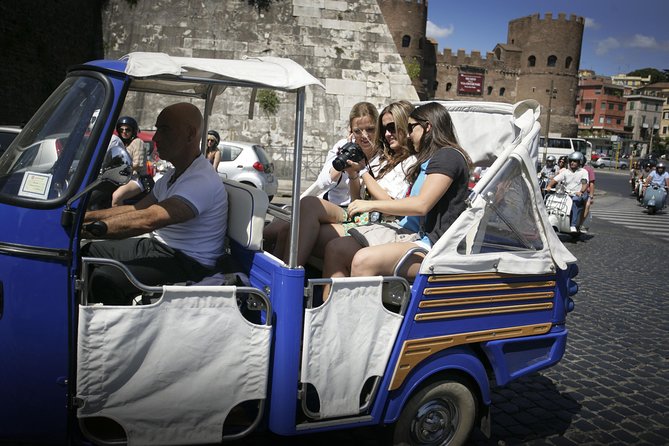
Rome feels different when you are zipping through it. This private Ape Calessino tour turns crowded streets into quick photo stops, with a guide who can steer your route. You will also get a real break built in, like a caffè or gelato.
I especially like the easy logistics: hotel pickup and drop-off, helmets included, and a small group setup for about 3 hours. I also love the mix of big-name views and quieter corners, from the Circus Maximus area to the keyhole look from Piazza dei Cavalieri di Malta.
One thing to think about: this is panoramic, so it does not include entrance fees into the Colosseum, Baths of Caracalla, or the Vatican. If you want to go inside those places, budget extra and plan for tickets.
Key things to know before you ride
- Ape Calessino / Tuk Tuk style transport: a fun way to beat traffic and get angle-after-angle photos
- Private for up to 3 people: easier questions, slower stops when you want them, less waiting around
- Hotel pickup and drop-off: you start and end right at your door
- Helmets are required, and they are provided for the ride
- Coffee and gelato stop included: a built-in pause in the middle of the sights
- No entrance fees included for major sites like the Colosseum and Vatican
The Ape Calessino Experience: A fun, practical way to tour Rome
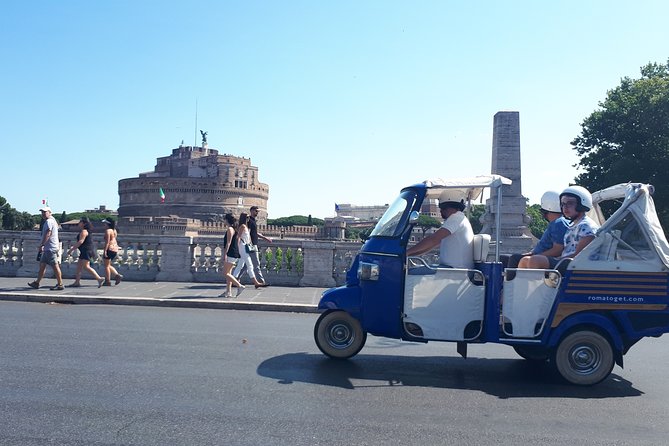
Rome has two speeds. There is walking speed, and then there is the speed of a city that is constantly stopping and starting. The Ape Calessino approach sits in the sweet spot. You get motion through busy areas, but you also stop often enough for real views and pictures.
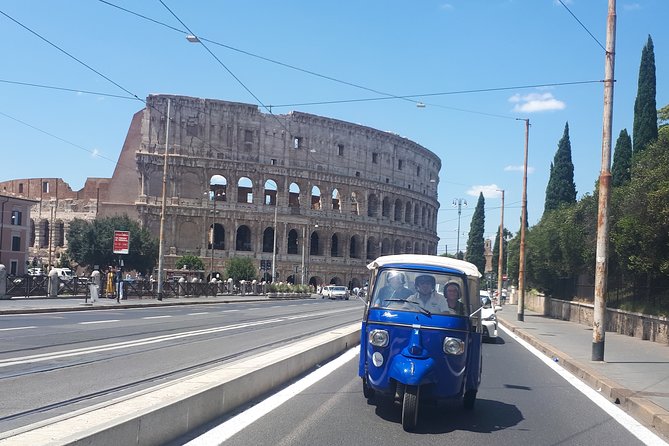
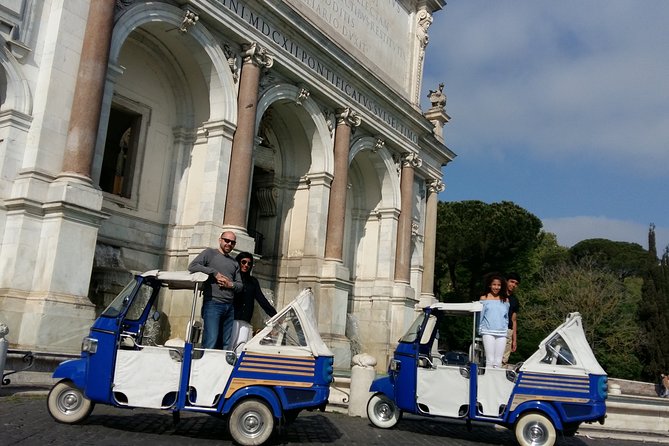
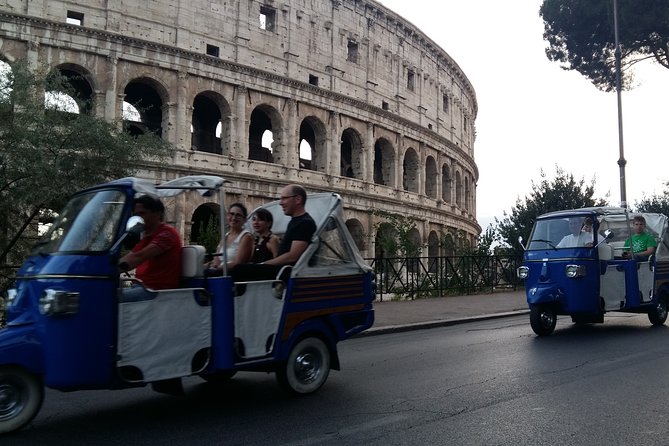
The vehicle itself is part of the charm. It is an Italian-designed Ape Calessino from the 1960s, and you will notice how similar it is to the tuk tuk style you might see across Asia. That matters because it keeps the vibe playful, not stiff and museum-only. It is also a nice choice for a first day, or for any trip where you want orientation fast without locking yourself into a fixed walking circuit.
For me, the best value here is that the fun transport is not the only point. You get a guide on board, plus a flexible plan that can pivot to what you care about. In the feedback I reviewed, names like Ricardo, Marco, and Michael came up repeatedly for being friendly, informative, and happy to answer questions. That is exactly what you want when the goal is a quick but meaningful overview.
You can also read our reviews of more tours and experiences in Rome.



Price and what you really get in a 3-hour private ride
The price is listed as $505.23 per group, up to 3 people, for about 3 hours. For many Rome tours, the cost jumps fast when you add private service. Here, the per-group structure is what makes it feel more reasonable. If you are traveling as a duo or small trio, this format can compare well to the cost of multiple separate tickets or less personal shared tours.
What you get is not just a ride. It includes:
- Hotel pickup and drop-off
- A driver/guide and professional guide
- Transport by private vehicle
- Helmets
- A caffè/cappuccino/gelato stop
Two budget thoughts you should keep in mind. First, entrance fees are not included for the Colosseum, Baths of Caracalla, and the Vatican. Second, because you are touring major areas as panoramas, the “value” is in the angles, context, and stops, not in paid access inside those sites.
Where and how you start: pickup, helmets, and short-stay planning
This tour is set up around convenience. Pickup and drop-off happen at your hotel, Airbnb, or private accommodation in Rome, so you do not need to wrestle with transit or meet far from where you are staying. The tour also uses a mobile ticket, so you are not hunting for paper.
Helmets are required, and they are included. That is a good sign for comfort and safety, and it also helps the tour run smoothly without passengers worrying about gear.
Weather is another practical detail: it operates in all weather conditions. Rome can go from sun to drizzle fast, so dress for the conditions you are likely to face that day. Also, because the tour spends time in and around outdoor viewpoints, bring sunglasses if the forecast looks clear, and something light if it is warm.
The big Rome landmarks you see from the road: Vittoriano to the Colosseum area
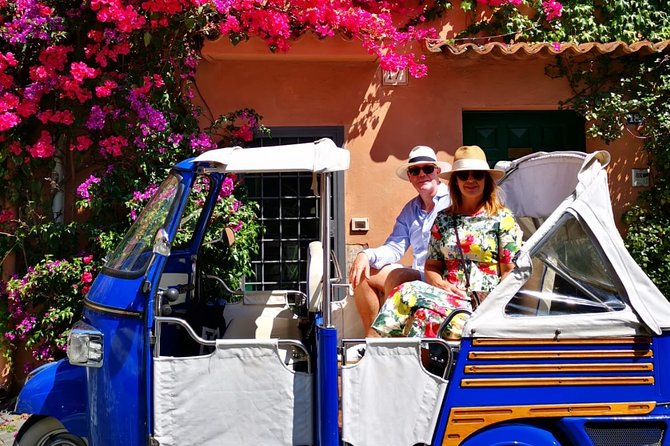
You start by zipping toward Piazza Venezia, with a view of Vittoriano, one of Europe’s largest monuments. From the Ape Calessino, these stops feel more like rolling viewpoints than a long bus ride. You get that “I can frame this in a photo” moment without spending 30 minutes trying to find the right spot on foot.
Then you roll toward the Imperial Forum area. Even if you are not entering anything, the perspective from the street helps you connect what you see later on a map. It is easier to understand Rome when you can visualize where the empire’s civic spaces sit relative to today’s city.
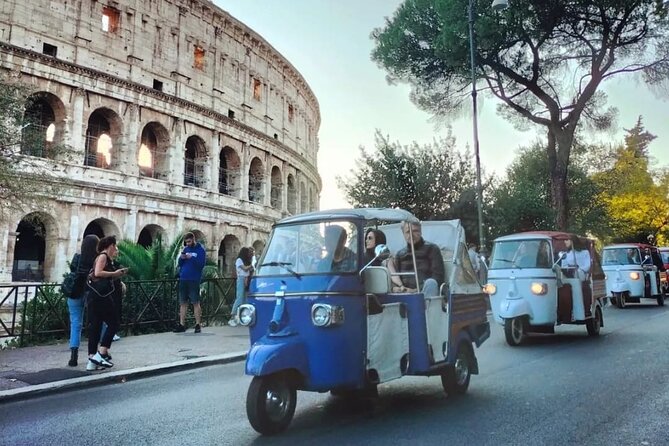
Next comes the Colosseum viewpoint, where the tour keeps it panoramic. You will learn what you are seeing, but you will not be doing a timed entry inside. If you want the inside experience, plan a separate visit with tickets later. If you want a fast orientation and some strong photos now, panoramic is actually a great fit.
Terme di Caracalla on a motorized route: what to look for
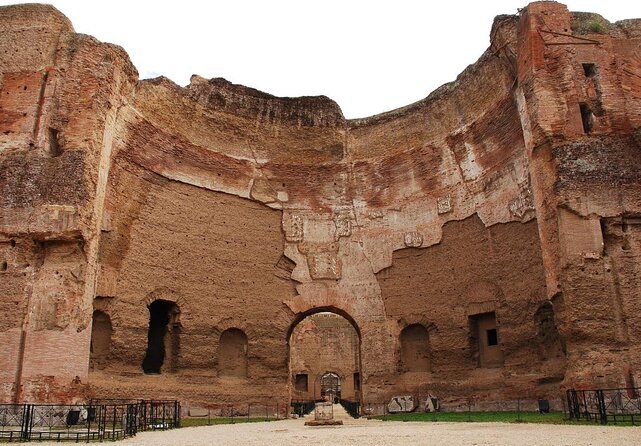
One of the most impressive stops is Terme di Caracalla. These baths date to construction begun under Emperor Septimius Severus in AD 206 and completed under Caracalla in AD 216. They were among Rome’s major public bath complexes, designed for around 1,600 bathers.
Even without entering, the exterior ruins and the scale are the point. This site is described as the most extensive surviving Roman bathing establishment. When you stand near the ruins, you can picture how the different zones worked. The bath complex included:
- Frigidarium (cold room)
- Caldarium (hot room)
- Tepidarium (lukewarm room)
The stop also highlights the architecture, including large vaulted chambers and spaces that connect to open-air areas for exercise and games. If you like Roman engineering, you will enjoy how the layout is still readable, even in fragments.
Consideration: because entrance is not included, you will not get the full indoor walkthrough experience. Still, it is a strong stop for understanding daily life and Roman leisure culture, and it pairs well with the rest of the ride that emphasizes angles and “where things were.”





Circus Maximus: the chariot-era spectacle you can still feel
From the route, you will also see Circus Maximus, Rome’s huge hippodrome. The numbers here make the scale click. It was built starting in the time of Julius Caesar and could seat an estimated 150,000 spectators at one point. Later enlargements pushed it much higher, with a maximum size often described around 250,000.
The structure is U-shaped, with seats on three sides and a central track where chariots raced. There is also the mention of two large Egyptian obelisks in the middle spine area, which helps you imagine why this place was so iconic in the imagination of storytellers and filmmakers.
This is one of those stops where you do not have to understand every detail to get the point. You just need to look around and picture the crowd motion, the speed, and the noise. The Ape Calessino format helps because you are not stuck staring at one tiny section. You can get a better sense of the oval sweep and where the action would have run.
Appian Way and Rome’s “long-distance road” feel
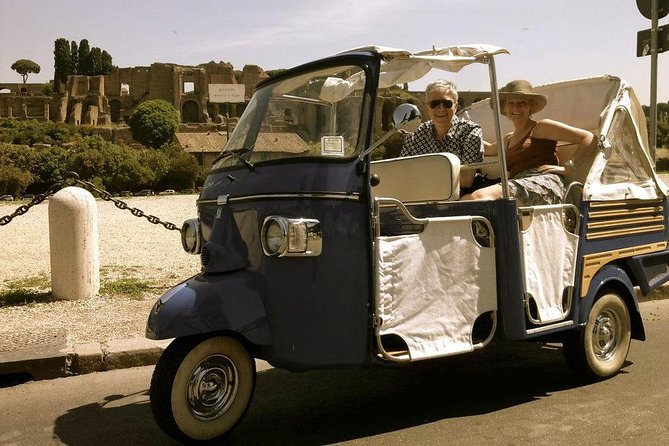
A highlight for many people is Appian Way, Via Appia Antica. This is one of the most famous roads in the ancient world, and the tour focuses on why it mattered. It was started in 312 BCE by the censor Appius Claudius and served as the key highway out of Rome toward southern Italy and the Mediterranean connections.
What you will learn helps you “read” the road rather than just watch cars. The road averaged about 20 feet (6 meters) wide and used a foundation of heavy stone blocks with lime mortar, topped with polygonal lava blocks fitted together. It was built with drainage in mind, so you understand it was engineered for use, not just monumentality.
Even on a short stop, the value is in context. You will also see that the early stretches have monuments and inscriptions along the remains of the road. This is a big part of why Roman roads still feel special. They are not just a route, they are a timeline.
One practical note: the stop is brief, so wear shoes that work well for quick transitions and getting on and off the vehicle. You do not need hiking gear, but you do need comfort for short outdoor viewing.
Aventine and Janiculum views, plus the Vatican area
The plan includes viewpoints from both Aventine and Janiculum Hills, plus stops that connect to Circus Maximus and the Vatican area. This matters because hills change how Rome looks. You see layers: domes, rooftops, and the way neighborhoods spread.
Even if you are not entering Vatican buildings, seeing the Vatican area from a hill viewpoint is one of the easiest ways to get a satisfying “big picture” moment. It is a good option if you want to keep your schedule simple for day one.
Pyramid of Cestius, the Knights of Malta keyhole, and Campo de’ Fiori
This tour also mixes in sites that are quick but memorable.
First is Pyramid of Cestius, a rare survivor of ancient Egyptian-style pyramids in Rome. It is about 36 meters high and was built in the first century BC as a tomb for Caius Cestius. Construction took 330 days, according to an inscription, and later the pyramid was incorporated into the Aurelian Walls. This is one of those stops that feels like a plot twist in Rome, and it is great if you like odd, unexpected structures.
Then you hit Piazza dei Cavalieri di Malta for the famous keyhole view of Saint Peter’s Basilica. The charm here is simple: you line up for the little doorway and see a perfectly framed scene. The tour keeps it light and fast, and it is listed as free.
Finally, there is Campo de’ Fiori, a central square that shifts character between day and night. In the daytime, it is tied to market life. Later, it becomes an aperitivo and cocktail spot for locals. It is also well positioned for walking connections, since it sits close to areas like Piazza Navona, the Pantheon, Via del Corso, Trastevere, and the Colosseum corridor.
If you have limited time, Campo de’ Fiori is a smart last or mid-tour stop because it gives you atmosphere. It is also a good place to point your next plan toward, like dinner.
Coffee and gelato stop: when it hits and what to order
You get a caffè, cappuccino, or gelato as part of the tour. This is not just a nice perk. It is strategically helpful in a 3-hour ride because it gives your feet and brain a reset.
If the day is warm, I lean toward gelato. If the day is chilly or you want a quicker caffeine hit before more walking, go for caffè or cappuccino.
One tip based on guide comments in the feedback: some guides, including people like Michael, have recommended pastries and small treats during the break. You can do the same in your own way. Ask what is best that day, and if you see a local pastry case, it often beats guessing.
What this tour is best at, and where another visit may beat it
This is a tour built for three goals:
- Orientation fast: you see major districts and monuments in a short window
- Photo angles with less fatigue: the Ape Calessino format reduces long walking gaps
- Context from a guide: you learn what you are seeing without getting stuck in timed ticket lines
What it is not built for is deep, paid entry experiences inside major sites. Since the Colosseum, Baths of Caracalla, and Vatican entrances are not included, you may still want to add those later if your travel style is “inside first.”
So my practical advice is this:
- If you want to see the classics and understand the layout, this tour is a strong pick.
- If you want only ticketed interiors, you will need a separate plan for entrances.
Who should book Rome by Ape Calessino?
I think this works especially well if you are:
- Traveling as a couple or small group (up to 3)
- Short on time and want a first-day orientation
- Interested in Roman sites but prefer a mix of big stops and quick side stops
- Someone who likes asking questions while moving around, instead of following a long script
It is also a good fit for travelers who want a fun vehicle and a guide who can adjust when you ask to spend extra time at a specific viewpoint. In the feedback I saw, guides were praised for flexibility and friendliness, with names like Marco and Mimmo showing up.
If you are the type who only enjoys museums and inside tours, you might still enjoy this for the viewpoints, but you should plan additional ticketed visits.
Should you book it?
Yes, I would book Rome by Ape Calessino Auto Rickshaw if your priority is getting a fast, guided overview with strong viewpoints, minimal walking stress, and a fun transport experience that helps you understand where things sit.
Book it especially if you can travel in a group of two or three to make the per-group pricing feel like a win. Just be sure you are fine with the fact that it is panoramic for the big ticket entrances. If you want inside access at the Colosseum, Baths of Caracalla, or the Vatican, treat this as your best pre-game, then add entrances separately.
If you want Rome with personality, this is a very smart way to do it.
FAQ
How long is the Rome by Ape Calessino tour?
It runs for about 3 hours.
Is this tour private?
Yes. It is a private tour/activity, and only your group participates. The price is per group (up to 3).
Where do you get picked up?
Pickup and drop-off are at your hotel, Airbnb, or private accommodation in Rome.
What language is the tour offered in?
The tour is offered in English.
Is there an entrance fee included for major sites like the Colosseum or the Vatican?
No. The tour is panoramic and does not include entrance fees inside the Colosseum, Baths of Caracalla, or the Vatican.
What food or drinks are included?
A caffè, cappuccino, or gelato is included.
Are helmets provided?
Yes. Helmets are provided, and all guests must wear them.
Does the tour run in bad weather?
Yes. It operates in all weather conditions, so dress appropriately.
What should I do to confirm my booking?
You receive confirmation at the time of booking, unless you book within 9 days of travel, in which case confirmation is received within 48 hours, subject to availability.
Are children allowed?
Children must be accompanied by an adult.











