
Reviewed · PRIVATE
Raphael and Caravaggio in the Roman Churches Private Tour
Raphael and Caravaggio hit different in dim church light. I like how this private tour lines up two masters in the settings where their work was made to be seen, with the guide pointing out what changes from one artist to the other. You also get a real private professional guide at your side, with Giuseppe specifically showing up in the feedback as the kind of instructor who explains paintings so they click fast.
The best part is how focused the timing feels, about three hours total. The churches are active places of worship, so one consideration is the dress code: you need knees and shoulders covered, and you’ll be doing some walking between stops.
Key Highlights You’ll Appreciate on This Private Church Walk
- Chauffeur pickup with luxury transportation, so you spend less time figuring out logistics and more time looking closely
- A private English-speaking guide, with Giuseppe repeatedly praised for clear, engaging explanations
- Four Roman church stops with admission built in, so you can focus on the art instead of ticket hassle
- Caravaggio in context, especially at the Contarelli Chapel where the subject matter is tied to how the chapel was commissioned
- Raphael alongside Caravaggio, which makes the contrast in style easier to understand than in a museum lineup
- Audio support is mentioned by past guests, like headsets or radios, which helps you hear the guide in dim interiors
Price, Time, and Value for a 3-Hour Art Sprint
At $656.87 per person for about three hours, this is not the budget choice. But it can feel fair when you compare what’s included: pickup and drop-off with a private chauffeur, a private guide, and entrance coverage for multiple churches.
You are paying for time and access. In Rome, that matters. Instead of spreading your day across a dozen stops, you get a tight route built around major works by Raphael and Caravaggio inside churches where they belong.
You can also read our reviews of more private tours in Rome

How the Pickup, Private Guide, and Mobile Ticket Pay Off
The tour is private, meaning only your group goes along. That changes the pace in a good way. You’re not stuck waiting for slow walkers, and the guide can adjust explanations to your level and interests.
You’ll also have a private escort and entrance coverage for the church stops. The mobile ticket helps you avoid last-minute stress, and the chauffeur pickup helps you avoid time-wasting transit hops between neighborhoods.
If you’re the type who likes to see art without feeling rushed, the setup is built for you. If you want a long, open-ended wandering day, you may find three hours a bit tight.
Stop 1: Santa Maria del Popolo and the Art That Wasn’t Supposed to Be There
Your first stop is Chiesa di Santa Maria del Popolo, a church with a story that starts in legend. Local lore linked the site to Nero’s ghost and a bewitched walnut tree full of crows, then later shifted into church building when Pope Paschal II ordered the tree cut down and a Romanesque chapel commissioned in 1099.
What makes this stop feel special is how layered it is artistically. In 1513, influential artists including Raphael, Caravaggio, Bernini, Pinturicchio, and others were brought in to decorate the walls and ceilings. That means you’re not just looking at one “star painting,” you’re seeing a whole creative program.
Practical tip: Santa Maria del Popolo’s interior can be dim, and that darkness is part of the effect. Caravaggio’s world plays especially well in low light, with strong contrast doing half the teaching for you.
Stop 2: Sant’Agostino and Caravaggio’s Pilgrim Madonna
Next you head to Basilica S. Agostino in Campo Marzio, a church that comes with a specific Caravaggio commission story. The work known as the Madonna di Loreto, often called the Pilgrim’s Madonna, was commissioned thanks to a legacy left by Ermete Cavalletti for a family chapel.
The contract matters here: the subject was specified in 1603, tied to devotion to Our Lady of Loreto by the deceased Marquis. The result is a painting that isn’t how you might expect the theme to be shown.
Instead of the Holy House setting and angel wings that often appear in other depictions, here Madonna di Loreto is shown as a more ordinary figure. She stands before a doorway, holding a clearly lit Infant Jesus who blesses. That “commoner in front of a doorway” approach makes the scene feel more human, and the guide’s job is to help you notice how the lighting and pose guide your eyes.
Timing note: this stop is around 20 minutes. Go in with one mindset: pick out the faces and the light first, then let the details come next.
Stop 3: Santa Maria della Pace, Baroque Stagecraft in a Church
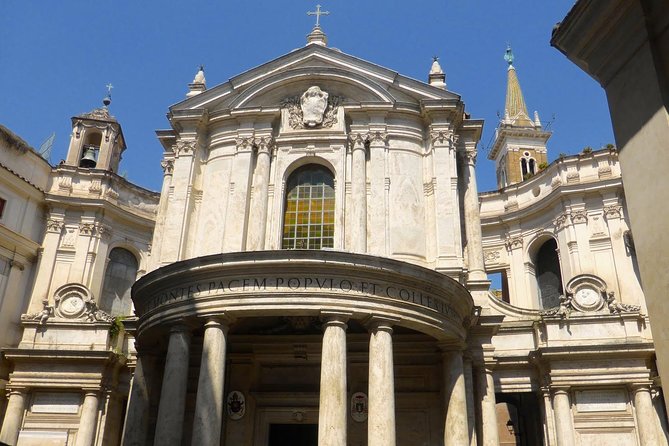
At Chiesa di Santa Maria della Pace, you get the baroque side of Rome. The site started from earlier foundations, with the medieval chapel of Sant’Andrea de Acquaricariis, and then the late 15th-century commission of the main structure.
Later, the church you see today was rebuilt by Pietro da Cortona, including a facade with a semicircular pronaos. The key idea is that the square around it turns into a kind of baroque stage, so the church is not isolated. It’s part of how the neighborhood performs visually.
Inside, the focus shifts back to art. Raphael and Maderno are part of what you’ll see, plus the Cloister of Bramante. Even if you do not know the names of every panel at first glance, the guide can help you read the space like a curator would.
Drawback to consider: baroque churches can feel busy. With only about 20 minutes here, lean on the guide to choose what to look at, rather than trying to absorb everything yourself.






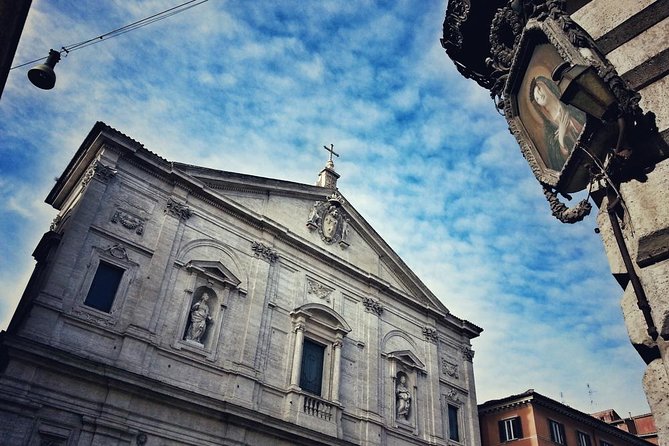
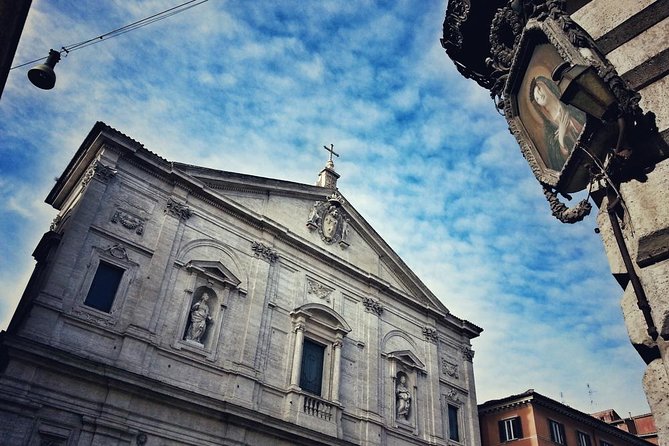
Stop 4: San Luigi dei Francesi and the Contarelli Chapel Triptych
The highlight for many art lovers is the Church of St. Louis of the French, also known for the Contarelli Chapel. This is where you see Caravaggio’s triptych: The Martyrdom of St. Matthew, The Vocation of St. Matthew, and St. Matthew and the Angel.
This chapel is named for Cardinal Mathieu Cointrel, Italianized into Contarelli, who commissioned Michelangelo Merisi (Caravaggio) to create three altarpieces focused on San Matteo. The commission setup helps you understand why each painting “answers” the others.
Caravaggio’s visual choices also get more interesting when you know the order of work. The Martyrdom of San Matteo was the first canvas created for this chapel. It’s described as overcrowded with a tangle of bodies, more connected to Mannerism, while still showing Michelangelesque nudes.
If you’ve ever felt like Caravaggio’s realism is hard to summarize, this chapel is where it becomes easy. The human drama is built into gestures and light. And because it’s in a chapel designed for viewing, the lighting effect can feel sharper than the same painting behind glass.
Timing note: this is the longest stop at about 30 minutes. Give it that full time. In this chapel, the “small” movements of eyes and hands are often what your guide will help you notice first.
Two Masters, One Route: How Raphael and Caravaggio Feel Together
Seeing Raphael and Caravaggio in the same day changes how you understand both.
Raphael, as a High Renaissance master, tends to feel balanced and structured, even when the scene has emotion. Caravaggio feels more immediate, more physical, more confrontational. His chiaroscuro is not just style, it’s a storytelling tool that forces your attention.
When the guide explains them in sequence across four churches, you start to see the real contrast:
- Raphael often helps you sense harmony and design
- Caravaggio often makes you feel the weight of the moment
One extra plus from past guests: some mentioned audio support like headsets and radios, which makes it easier to follow the explanation even in darker interiors. That helps a lot when you’re trying to match the guide’s points to what you’re actually seeing.
What to Watch For in Each Church (So You Don’t Miss the Point)
I recommend going with a simple game plan at each stop. Instead of trying to spot everything, focus on two things the guide will likely emphasize.
1) The faces and light
Caravaggio especially rewards this. Chiaroscuro can be dramatic in church interiors, and the dark surroundings make the painted light feel more punchy.
2) The action and the gestures
In the Contarelli Chapel, the body language is the plot. In other churches, the “still” moments often carry tension through posture and eye direction.
If you like art history, you’ll enjoy the commission stories too, like Caravaggio’s contract for the Madonna di Loreto or how Contarelli’s commission shaped the triptych themes. But even if you just enjoy strong visual experiences, those stories make your viewing feel less random.
Dress Code, Comfort, and Practical Tips for Church Interiors
This tour takes you into working churches, so the dress code matters: you need knees and shoulders covered. If you show up with bare shoulders or short shorts, you may be turned away or forced to adjust last minute.
Also, plan for low light and cool interiors. Churches are often dim, and it’s part of the art experience, but it can make reading small details tougher. A light layer helps, and comfortable shoes matter because you’ll be moving from one church to the next.
Since the stops run in short blocks, I suggest you arrive ready to look, not to browse. If you’re the kind of person who loves lingering, you’ll enjoy the guide’s direction, and you might even want to stay a few extra minutes on your own at the final stop if timing allows.
Who This Tour Is Best For
This is a smart fit if you:
- want major Raphael and Caravaggio works without committing to a full museum day
- like private, guided explanations more than self-guided audio
- have limited time in Rome and want a concentrated route
- care about the contrast between Renaissance balance and Caravaggio’s dramatic realism
It may feel less ideal if you want a long, slow walk with lots of free time at each site, or if you’re not comfortable with the church dress code.
Should You Book This Raphael and Caravaggio Private Tour?
If you’re torn, here’s the simplest way I’d decide. Book it if you want a focused route, a private guide who can explain what you’re seeing in plain language, and church interiors that make chiaroscuro and High Renaissance style feel real, not textbook.
I’d skip it if you prefer giant art institutions, or if you need lots of personal downtime between stops. This tour is designed to run like a guided art lesson, with tight timing and clear priorities.
Given the strong track record, with a 5 star rating and consistent praise for organization and the guide’s ability to make both artists click, this is one of those “worth it if you care about quality” choices. For $656.87 per person, the value depends on whether you’re buying access and expert direction, not just sightseeing.
FAQ
What is the duration of the tour?
The tour is approximately 3 hours.
How much does the tour cost per person?
The price listed is $656.87 per person.
Does the tour include pickup and drop-off?
Yes. Pickup and drop-off with luxury transportation and a private chauffeur are included.
Is this a private tour?
Yes. It is a private tour/activity, and only your group will participate.
Are church entrances included?
Entrance is included for Santa Maria del Popolo, Sant’Agostino, Santa Maria della Pace, and San Luigi dei Francesi.
What dress code is required for churches?
You must cover your knees and shoulders to enter the churches.
Are food and drinks included?
No. Food and beverages are not included.
Is there a child rate?
A child rate applies only when a child is shared with 2 paying adults.
More Private Tours in Rome
More Tours in Rome



More Tour Reviews in Rome
Not for you? Here's more nearby things to do in Rome we have reviewed












Private, compared.
 ★ 5.0Private Vatican Highlights Guided Tour with Sistine ChapelFrom $302983 reviews
 ★ 5.0Private Vatican Museums and St. Peter’s Basilica Early Bird TourFrom $356980 reviews
 ★ 4.5Rome Private Food Tour with 6 or 10 TastingsFrom $140902 reviews
 ★ 4.7Caracalla Baths & Circus Maximus — Private or SharedFrom $77835 reviews
 ★ 4.4Civitavecchia Port: Private or Shared Guided Tour of RomeFrom $134826 reviews
 ★ 5.0Private/Group 4 Hours Golf Cart SightseeingTourFrom $168780 reviews
 ★ 5.0Explore Rome on a Golf Cart: Private TourFrom $83757 reviews
 ★ 5.0Colosseum, Roman Forum and Palatine Hill Private TourFrom $260724 reviews