
Reviewed · WALKING TOURS
Rome Fountains & Squares Walking Tour–Small Group w/ Local Expert
Rome’s fountain stories run deeper than you expect. This 2-hour small-group walk in central Rome is a smart way to connect Piazza Navona to the city layers under your feet, with a local expert keeping the pace friendly and the context clear. I like the small-group size, which makes it easier to ask questions and get photo help. I also love how the route ties together architecture, myth, and politics, so the squares stop being just pretty backdrops. One possible drawback: the schedule moves briskly at each stop, so if you want long photo sessions, you’ll need to work with the group pace.
You start and finish in easy-to-find central piazzas, so you are not spending your whole day hunting street corners. Since the tour is in English and uses a mobile ticket, it is set up for quick, low-stress mornings. Think comfortable shoes, a water plan, and a mindset of short stops with big payoffs.
If you are into Roman art and urban design, you will enjoy how this walk spotlights baroque fountains and the “old Rome” geometry hiding in modern streets. If you want a slow, sit-and-stare type of tour, this may feel a bit too efficient.
Key highlights worth showing up for
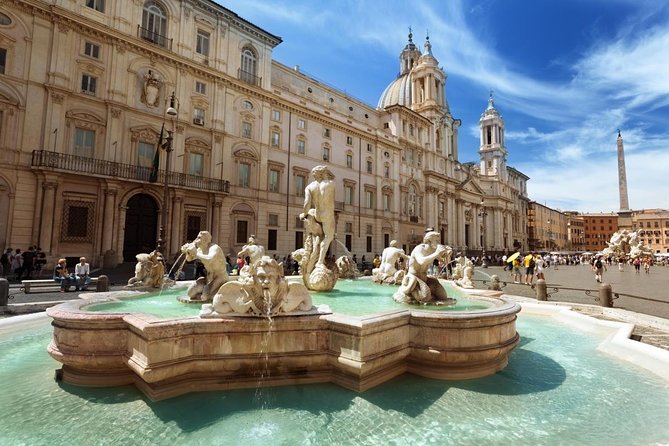
- Up-close fountain focus at Piazza Navona and around the Spanish Steps, with stories that make the sculptures click.
- Small-group attention, capped at 15, so you are not shouting over bus audio.
- Classic Rome route in 2 hours, built around central piazzas that are easy to get to on foot.
- Layers of Rome, from a stadium arena under Piazza Navona to the Pantheon’s reuse.
- Photo and question time, not just a drive-by walkthrough.
- English-speaking local expert, with real on-the-ground tips for seeing Rome comfortably.
How This 2-Hour Route Makes Rome’s Fountains Make Sense
Rome can feel like a collage of masterpieces, and that is wonderful, but it can also be random. This tour helps you see the logic behind the landmarks. You are walking through a chain of squares that were designed for public life, big statements, and parade-like city drama.
At $67.29 per person for about two hours, you are paying mostly for interpretation and timing. You could DIY this route, sure, but you would miss the “why this was built here” angles, and you would probably spend extra time figuring out what to notice first. With a maximum of 15 people, the guide can point out details without treating you like a line item.
Pacing is the tradeoff. Each stop is set for quick context, then you move on. That is great for first-time visitors who want a strong overview. It is less ideal if you want long museum-style time at any one spot.
You can also read our reviews of more walking tours in Rome


Piazza Navona: The Baroque Showpiece Built on a Roman Stadium
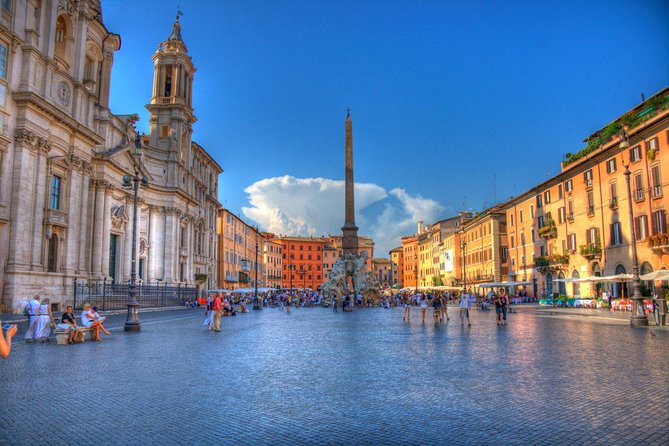
Most people think of Piazza Navona as a fountain square, and that part is true. What makes it special is the way the square is literally shaped by older Rome. The plaza is defined from the 15th century, but the footprint comes from the ancient Stadium of Domitian, a horseshoe arena for foot races built in the 1st century AD.
You get a close look at the plaza’s three major fountains: Fontana dei Quattro Fiumi, Fontana del Moro, and Fontana del Nettuno. The guide’s job is to help you see them as a system, not separate attractions. That is where the tour adds value. Instead of just pointing at carved figures, you learn what political power, symbolism, and patronage are doing in plain sight.
If you are someone who loves architecture but hates vague explanations, this is a good match. Piazza Navona is the kind of place where a short guided stop can turn a pretty view into a story you remember.
Fontana dei Quattro Fiumi: Bernini’s Symbol Power in Stone
Fontana dei Quattro Fiumi is often the centerpiece at Piazza Navona, and you will spend real time with it. This fountain was designed in 1651 by Gian Lorenzo Bernini for Pope Innocent X, whose family palace faced the piazza. That detail matters, because it explains why the whole composition feels like a message.
You will notice the structure: a basin with travertine rocks rising up to four river gods, and above them, a copy of an Egyptian obelisk topped with the Pamphili emblem of a dove with an olive twig. The guide connects the symbolism to a world view. The four rivers are portrayed as the Nile (Africa), the Danube (Europe), the Ganges (Asia), and the Río de la Plata (the Americas), representing papal authority spreading across continents.
Here is the practical takeaway for you: when you understand the “who paid for it and what they wanted to say,” the fountain stops being decoration. It becomes branding, power, and worldview in marble and bronze-like forms.
Campo de’ Fiori and Giordano Bruno’s Statue: Public Space with a Past
From Piazza Navona, you move to Campo de’ Fiori. In the morning, it functions as a marketplace, and in the evening it shifts into a nightlife hub. The guide keeps this grounded in history rather than treating it like a stop for photos and snacks.
Campo de’ Fiori was also the site of executions. In the middle stands the statue of Giordano Bruno, placed at the exact location of his execution. The statue was created in 1888, and that year comes up for a reason: it is part of how later Rome chose to remember.
This stop gives you a useful contrast. You see baroque art and grand urban design, then you hit a square that carries a harsher memory. That mix is very Rome, and it makes the rest of the walk feel more real.
The Stadium of Domitian Under Piazza Navona: Old Arcades, Visible Geometry
One of the best surprises on this tour is the Stadium of Domiziano, also known as the Circus Agonalis. This athletic venue sat north of the Campus Martius, and it was used mainly for contests. The striking part for you is the overlap: Piazza Navona sits over the interior arena, and the sweep of buildings around the plaza includes the stadium’s original lower arcades.
Even if you are not an archaeology expert, you can grasp the point quickly. Rome’s “new” city plans often grew directly on older structures. The guide helps you notice how that layering shapes the streets and facades around you.
This is also a good moment to slow down just a bit, because you are getting a different kind of Rome than the postcard fountain views. You are looking at the logic of the city, literally underneath.






Pantheon in Piazza della Rotonda: Why It Survived So Well
The Pantheon is one of the best-preserved ancient monuments in Rome, and that is not just hype. It is a rare case where the building story includes a second life. The Pantheon is explained as the reutilization, from a Christian perspective, of a sacred building consecrated to all gods.
The guide places it in context: it stands in the heart of the ancient Campus Martius, in one of the lower parts of Rome. The imposing facade dominates the southern side of Piazza della Rotonda, so you get a strong visual anchor for the walk.
You also learn about the Pantheon’s role after it stopped being only an ancient temple. In 1870, it became a shrine of the kings of Italy. It hosts the mortal remains of Victor Emanuel II, Humbert I, and Margaret of Savoy. You will also hear that the Renaissance artist Raffaello Sanzio is buried there.
If you want a shortcut to understanding why Rome feels so layered, this stop does it. One building, two belief systems, centuries of reuse.
Fontana della Barcaccia and the Spanish Steps: Barberini Symbols and Best Angles
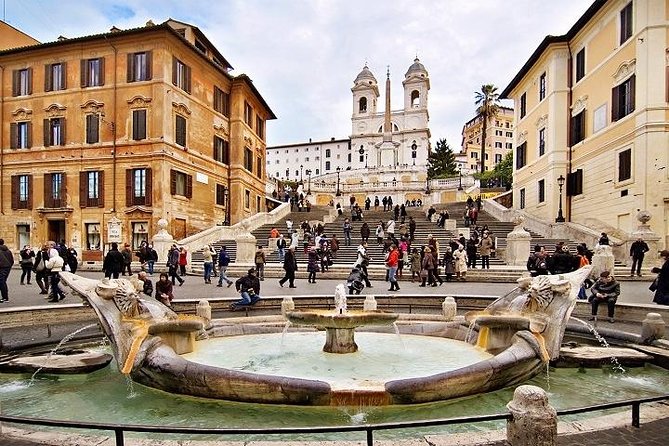
Next you head to the Piazza di Spagna area, and the focus shifts from grand ancient engineering to baroque theatricality. At the foot of the Spanish Steps sits Fontana della Barcaccia. This baroque fountain features two Papal coats of arms. Water gushes out of the mouths of two suns, linked to the Barberini family symbolism.
The guide’s value here is practical. You learn how this fountain functions as a visual “front door” to the Spanish Steps area, not just an object in the corner. It helps you plan where to stand so you can see both the fountain and the steps in one coherent frame.
Then comes Trinità dei Monti, the church of the Santissima Trinità dei Monti. The church sits above the Spanish Steps in a commanding position, and the tour notes that the church and the surrounding area, including Villa Medici, are French State property.
For me, the Spanish Steps are the kind of place you can walk past without truly seeing. With this tour, you get the key names and why the area is important, including how the location connected to Spain’s embassy to the Holy See.
Spanish Steps to Trevi Fountain: From Diplomatic Names to the World’s Largest Baroque Fountain
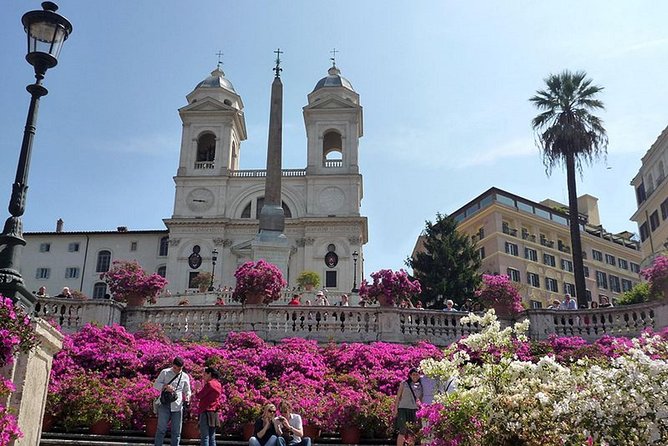
Piazza di Spagna is famous partly because of its name. It ties to the Palazzo di Spagna, seat of the Embassy of Spain to the Holy See. Nearby is the Column of the Immaculate Conception of the Blessed Virgin Mary, so there is plenty to notice beyond crowds.
In the middle of the square sits Fontana della Barcaccia, dating to the beginning of the baroque period. Pietro Bernini and his son, Gian Lorenzo Bernini, are connected to its sculpting story, and the guide’s job is to keep all the names from turning into noise.
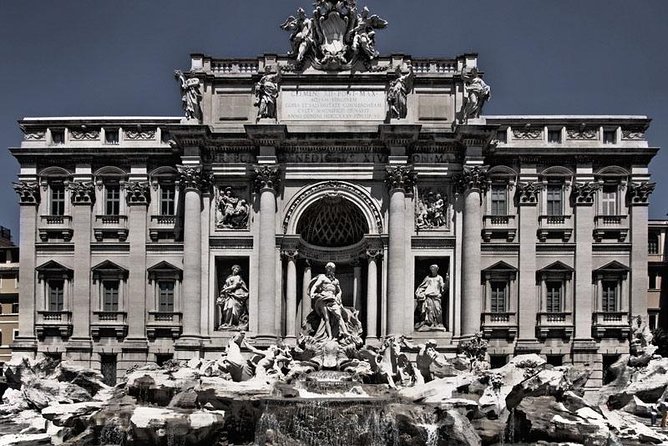
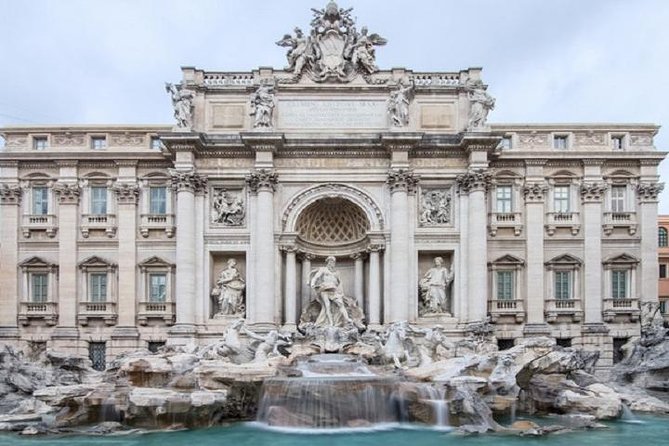
Finally, you reach Trevi Fountain, the walk’s big finale. It is an 18th-century fountain in the Trevi district designed by Nicola Salvi and completed by Giuseppe Pannini in 1762, along with other contributors. It is huge: 26.3 meters high and 49.15 meters wide. That scale is why it feels so iconic, and the guide explains why it is considered the largest Baroque fountain in Rome and one of the most famous fountains worldwide.
Practical note: Trevi is a magnet, so you will not get a quiet, empty view. But you can still get good photos and meaningful looking time if you follow the guide’s positioning tips and keep your timing flexible.
What $67.29 Buys You, and Why Small Group Matters Here
Let’s talk value honestly. Paying $67.29 for about two hours might sound steep compared with free self-guided wandering. But in Rome, free walking can turn into wasted walking if you do not know what to focus on.
This tour gives you:
- A structured route through major squares and fountains
- A local expert who explains connections, like Bernini’s patronage in Piazza Navona and papal symbolism tied to the Four Rivers
- A group size that caps at 15, with time for questions and photos
The reviews help show what people love, especially the feeling that the guide makes the details click. Guides such as Felice, Luisa, Federico, Gigi, Louisa, and Valentina show up in the experience record, and the common thread is storytelling tied to the landmarks themselves, not just a recitation of facts.
Possible drawback to keep in mind: one person felt the guide rushed fountains and squares. So set expectations that you will get a solid overview rather than an ultra-slow photography session. If that sounds like you, you might want to save extra time for the two places you care about most, like Piazza Navona and Trevi.
Tips That Actually Help You Enjoy the Walk
Rome walking tours succeed or fail on comfort. Wear comfortable shoes, because the route is compact but still real pavement and steady movement.
If you are visiting in summer, bring a hat and sunglasses, and plan for sun time. The guide will keep the flow moving, so you want basic gear ready.
For photos, do not wait until you are already at the curb. Listen for what the guide wants you to notice first, then position yourself. That is how you avoid the classic mistake of snapping random shots without getting the full composition.
And because the tour ends in Piazza Navona, you have a built-in reason to keep wandering after the walk. Use the tour to learn where everything sits, then enjoy the unstructured part with better instincts.
Should You Book This Rome Fountains and Squares Walking Tour?
Book it if:
- You want a fast, high-impact intro to Rome’s fountain squares
- You like architecture and symbolism, not just postcard views
- You prefer a small group of up to 15 for better questions and photo help
- You want the city layers explained, like the Stadium of Domitian beneath Piazza Navona and the Pantheon’s reuse story
Skip or reconsider if:
- You need lots of time per stop to take your own photos at length
- You are looking for a deep museum experience, since this is a walking tour format with short stop times
If it is your first day in Rome, this tour is a smart way to get your bearings and learn what to look for while you still have fresh energy. Even if you plan to return later on your own, the guide’s context will make your second visit feel more like discovery and less like revisiting a list.
FAQ
How long is the Rome Fountains & Squares Walking Tour?
The tour lasts about 2 hours.
What is the price per person?
The price is $67.29 per person.
How big is the group?
It is a small group with a maximum of 15 participants.
What language is the tour offered in?
The tour is offered in English.
Where does the tour start and end?
It starts at Piazza Barberini (P.za Barberini, 00187 Roma RM, Italy) and ends at Piazza Navona (00186 Roma RM, Italy).
Is there pickup or dropoff?
No, pickup and dropoff are not included.
Do I need admission tickets?
Entrance tickets are not included, and the listed stops are marked as free admission.
Will I receive a mobile ticket?
Yes, the tour includes a mobile ticket.
What should I wear or bring?
Comfortable shoes are recommended. In summer, a hat and sunglasses are recommended.
Is free cancellation available?
Yes. You can cancel up to 24 hours in advance for a full refund.
More Walking Tours in Rome



More Tours in Rome



More Tour Reviews in Rome
Not for you? Here's more nearby things to do in Rome we have reviewed












Walking Tours, compared.
 ★ 4.9Trastevere & Campo de Fiori Street Food Walking TourFrom $512,768 reviews
 ★ 4.9Paranormal Night Walking Tour & Secret BackstreetsFrom $341,921 reviews
 ★ 4.4Guided City Center Evening Sightseeing Walking TourFrom $46953 reviews
 ★ 4.5Best of Rome Walking Tour including Trevi FountainFrom $4923 reviews
 ★ 4.8Under the Moonlight Evening Walking TourFrom $28852 reviews
 ★ 4.9Forbidden History Walking Tour & Pub Crawl with DrinksFrom $61688 reviews
 ★ 5.0Guided Small Group Walking Tour of City HighlightsFrom $30682 reviews
 ★ 4.5Rome Walking Tour with Piazza Navona, Trevi Fountain and PantheonFrom $35676 reviews
Browse the lists this tour appears in