
Reviewed · ROME VESPA TOURS
Rome 3 hours Vespa Sidecar Private Tour with Gelato
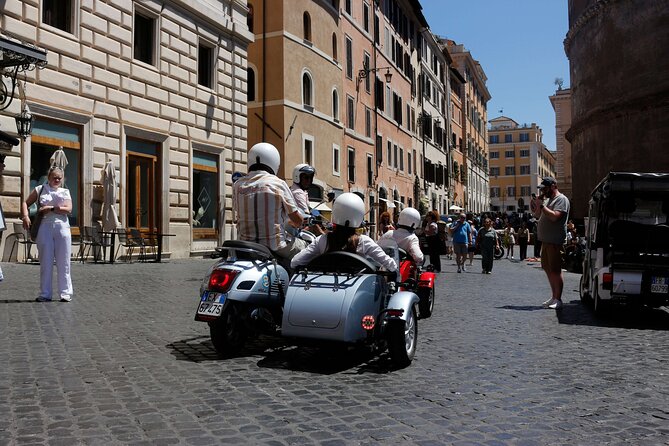
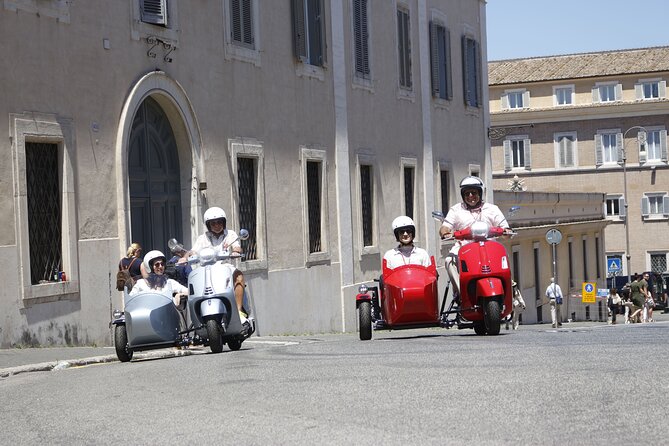
Rome feels different from the sidecar.
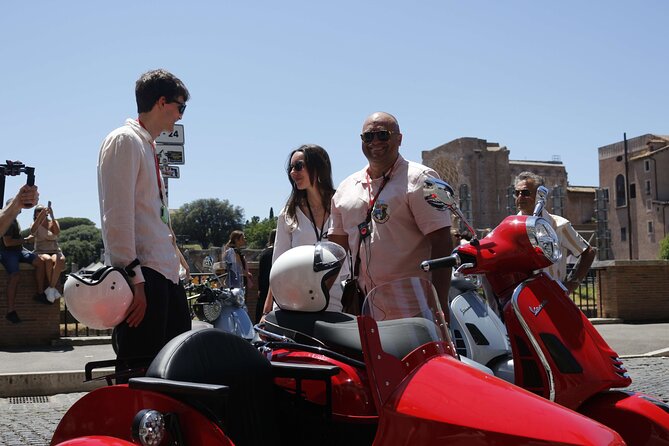
This private Vespa with sidecar tour strings together big sights fast, from Trastevere to Trevi Fountain, without you doing the stop-and-go walking dance. I love that the driver handles the traffic, so you can focus on the views and the street-level atmosphere.
Two things I especially like: first, the included headsets mean you hear the live commentary clearly while you ride. Second, the route saves time for the fun stuff, including a gelato stop in historic alleys that fits the day’s pace.
One possible drawback: this kind of outdoor ride depends on good weather, and each landmark is only given a short window, so you will not linger for long if you want to take your time everywhere.
Key points to know before you go
- Private, full-drive experience: you’re on the Vespa ride, not wrestling with walking routes and crowds.
- Live commentary through headsets: you get the story without straining to hear over traffic.
- Safety gear included: CE helmets with sterilized disposable head covers, plus full insurance.
- Gelato stop in historic alleys: built into the itinerary, not something you have to hunt down.
- A route that mixes Rome’s moods: bohemian Trastevere, big monuments, and the quieter Aventine.
- Guide energy matters: the name Pietro comes up for keeping the ride fun and making you feel safe.
Why Rome on a Vespa sidecar works so well in 3 hours
Rome is a city you can over-plan. This tour is the opposite. In about three hours, you get a whole stack of recognizable places, but you experience them in motion, with the city sliding past at Vespa speed.
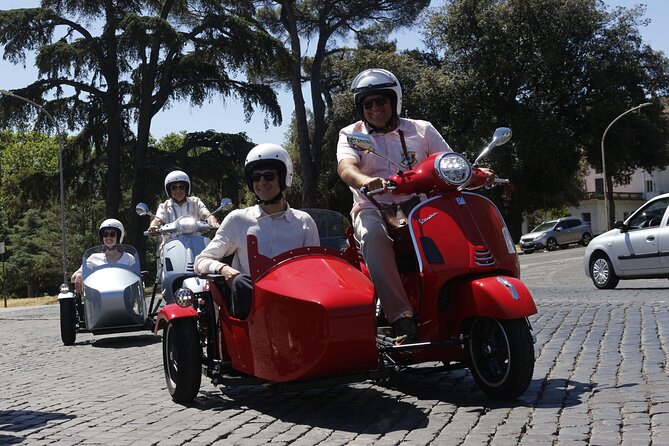
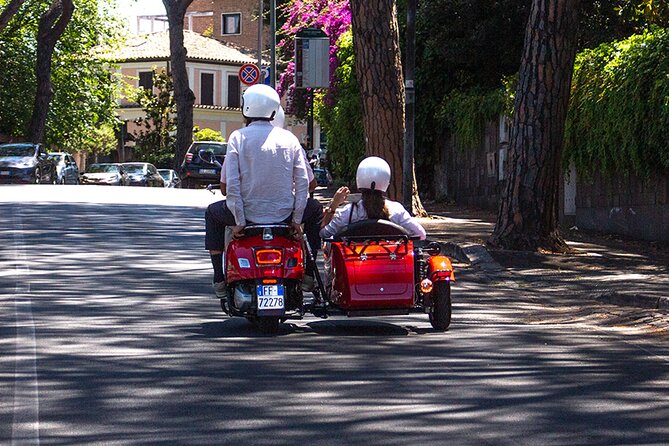
The sidecar changes your perspective. You sit back, watch, and let the route do the work. It turns “I have to see that” into something more like “look at this, right now.”
And because it’s private, the pace feels like it fits your group. You can take photos, ask quick questions through the headset, and reset at each stop without waiting for a long group shuffle.
You can also read our reviews of more private tours in Rome


Price and value: is $268.53 per person fair for this ride?
At $268.53 per person for roughly three hours, you’re paying for three things at once: a private ride, safety gear, and a structured highlights route.
If you tried to DIY this by combining taxis, timed entries, and multiple long walks, the costs can stack quickly, and you still wouldn’t get the “skip the hard part” experience. Here, the driver does the navigation, and the tour gives you a logical sequence of sights.
You also get included add-ons that matter in Rome. Helmets with disposable covers, headsets for live narration, and full insurance remove a lot of the uncertainty you usually feel when you’re riding in a crowded city.
That said, the “value” hinges on one mindset. If you want slow, museum-style pacing at one or two places, three hours won’t be enough. If you want a fast, memorable hit of Rome’s main icons plus a calmer neighborhood or two, this price starts to feel reasonable.
Helmets, headsets, and the ride setup you should understand
This is not just a fun ride, it’s also set up to keep you comfortable and safe.
You get CE helmets with sterilized disposable head covers, and the tour includes a full insurance policy. There’s also headset audio so you can hear live commentary from your driver guide while riding.
The vehicle setup is important for planning who sits where. Each Vespa can accommodate two people at a time: one in the sidecar and one behind the driver. If you book only one seat, you’ll share the vehicle with another guest, and you may swap seats during stops so everyone gets a turn in the sidecar.
There are also weight and height limits. The max weight for riding on the back of the saddle is 118 kg / 260 lb. The sidecar can hold up to 110 kg / 242 lb and has a maximum height limit of 1.90 m.
Kids have specific rules too. Children must be accompanied by an adult, and the minimum age is 5 years. If a child is not taller than 150 cm, they have to sit in the sidecar rather than behind the driver.
Start at Piazza della Trinità dei Monti, then get moving
The tour starts at Piazza della Trinità dei Monti and ends back there. That round-trip structure is handy in Rome, because you’re not forced to figure out how to get across town on your own after you’re done.
You can choose morning, afternoon, or evening departures. I like having options because Rome light and street rhythm feel different depending on the time. If you’re the type who wants classic monument photos with softer lighting, you’ll likely prefer a later start.
The route is also designed around quick transitions. Most stops are only 10 to 20 minutes, with a longer stretch at Trevi Fountain. Translation: you will be seeing a lot, but you’ll be doing short, purposeful “arrive, look, photograph, move” blocks.
Stop 1: Trastevere lanes and a drive through the Jewish Ghetto vibe
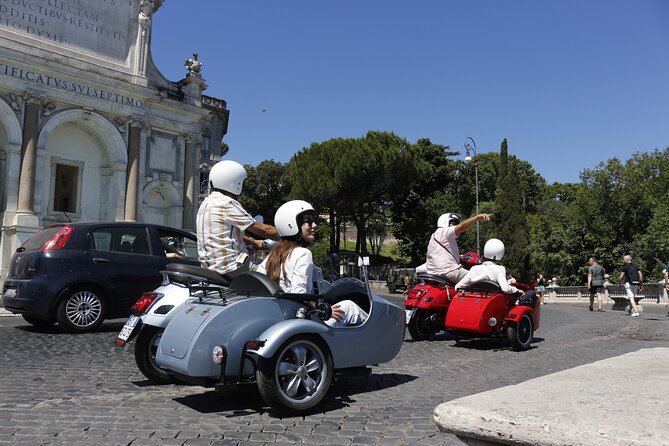
Your first major neighborhood stop is Trastevere. This is where you get that Rome feeling of narrow alleys, old-school trattorias, and a more bohemian vibe than the grand boulevards.
You’ll also pass by the picturesque Jewish Ghetto during the drive. Even though the time is short, this matters, because it anchors the tour in lived-in Rome, not just postcard Rome.
Trastevere is also one of those places where the “best view” is often the street itself. You’re not just looking at a single monument. You’re getting the shape of the area, and that makes the later big landmarks feel even more dramatic.
A practical note: the stop is about 15 minutes, so don’t expect a deep neighborhood exploration. Use this time for orientation and one or two photos that capture the mood.
A few more Rome tours and experiences worth a look

Stop 2: Terrazza del Gianicolo on Janiculum Hill
Next comes Terrazza del Gianicolo on Janiculum Hill. Janiculum is often called Rome’s eighth hill, and it’s a different kind of break from the city traffic and tight streets below.
The big value here is the reset. You get a peaceful pause near the city center, plus a panorama that feels like Rome spread out in layers.
Janiculum also has a strong historical role in the defense of the city, and the paths include sculptures of heroes, including Giuseppe Garibaldi. That makes the hill more than a viewpoint. It’s a walk through a memory, with views as the reward.
Since the stop is around 15 minutes, you’ll want to keep your plan simple. Go for the best viewpoint spot, take the photos, and then enjoy the short stroll without trying to see every corner.
Stop 3: Piazza Venezia and the Altare della Patria experience
At Piazza Venezia, the tour focuses on Monumento Nazionale a Vittorio Emanuele II, also known as Altare della Patria. This is a massive, imposing structure, and even from the outside it reads like a statement.
The monument opened in 1911 in honor of Victor Emmanuel II, the first king of Italy after unification. If you’re curious about what’s inside, the tour time here is about 10 minutes, and admission is not included.
Still, there’s a standout detail worth knowing: since 1921, the monument includes the tomb of the unknown soldier, where an eternal flame burns and is guarded by two soldiers. Even if you don’t go in, that idea gives the location weight.
Because the time is short and admission is not included, this stop works best as a quick orientation and photo moment.
Stop 4: Palazzo del Quirinale, one of Italy’s official residences
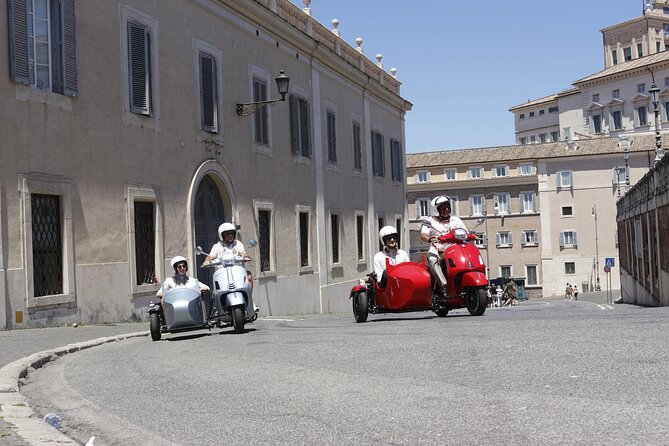
Next is Palazzo del Quirinale. This palace sits on Quirinal Hill, the highest of Rome’s seven hills, in the Monte Cavallo area.
It’s one of the official residences of the President of the Italian Republic. The data on its past occupants is striking: it has housed thirty popes, four kings of Italy, and twelve presidents of the Italian Republic.
The stop is about 10 minutes, and admission is free but not necessarily the focus. In the time you have, you’re mostly there to recognize the setting and absorb the scale of a place that operates at the level of national leadership.
Stop 5: Trevi Fountain, with enough time to actually enjoy it
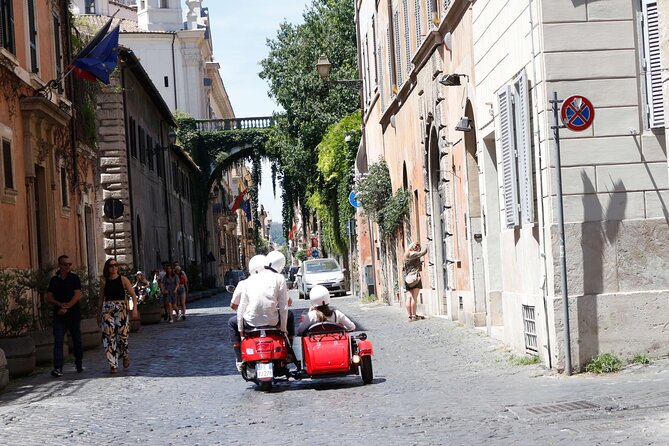
Then you hit one of the world’s most famous photo magnets, Trevi Fountain. This one gets about 30 minutes, which is long enough to see it, take photos, and find your own spot for a breather.
It’s about 20 meters wide and 26 meters tall, and it’s also the largest fountain in the city. The origin goes back to 19 B.C., connected to the Aqua Virgo aqueduct.
The current design took shape in stages. A Renaissance fountain came under Pope Nicholas V, and the final appearance dates to 1762, completed after works by Nicola Salvi and finalized by Giuseppe Pannini.
One more detail that makes the fountain feel less random: the name “Trevi” comes from Tre Vie, three ways, because the fountain was the meeting point of three streets.
Admission here is included, so you’re not paying extra to experience the stop. Still, 30 minutes can vanish quickly if you get stuck in a photo line, so aim to spend time looking first, then switch to photos.
Stop 6: Spanish Steps, quick seating time with a view
After Trevi, you stop at the Spanish Steps. These steps, built in the early 18th century, connect Piazza di Spagna with the Church of Trinità dei Monti.
This stop is built for a specific kind of Rome moment: find a spot, sit or stand for a bit, and enjoy the view around you. Since the itinerary calls for about 15 minutes, treat it like a reset and photo checkpoint, not a long wander.
Admission is included. That’s a plus because it removes friction if you want to plan your time without thinking about tickets for every stop.
Gelato stop in historic alleys: when Rome actually tastes like Rome
One highlight is a Super Gelato stop in a historic alley. This is the kind of included food break that feels like it belongs on a Vespa day, because you’re already moving through Rome’s lanes and viewpoints.
Gelato is also one of those “simple but perfect” moments in Italy. You get something cold and sweet, then you’re ready for the next hop on the route without eating a full meal schedule into your timeline.
If you have dietary needs, you might want to plan ahead, because the data here only confirms a gelato stop, not flavors or options. But the inclusion alone is a strong value point.
Stop 7: Piazza del Popolo, Rome’s northern gateway feel
Next is Piazza del Popolo, meaning the People’s Square. It’s located inside the northern gate area, once called Porta Flaminia, and it was the main entrance to Rome during the Roman Empire.
You get a different architectural rhythm here. The square is at the start of Via Flaminia, and three important streets radiate out: Via del Babuino on the left, Via di Ripetta on the right, and straight ahead Via del Corso.
That street layout matters for orientation. If you’ve ever felt turned around in central Rome, seeing how the main roads fan out from one point helps you later.
Time is about 15 minutes and admission is included, so it’s another “look and lock it in” stop.
Stop 8: Centro Storico, where the route turns into free street time
After the big squares, you land in Centro Storico. This area is described as having several beloved piazzas close together, especially around Navona, Pantheon, and Campo.
This is also where you get permission to slow down in a practical way. The itinerary keeps you moving, but it points you toward the kind of spontaneous wandering Rome rewards.
The streets here can feel lively, with cyclists, Vespa drivers, street vendors, merchants, and locals. Since the stop is about 15 minutes, you’ll get a taste of the area’s energy without losing your whole day.
Admission is included. That helps if you want to step into a nearby monument or small interior space, but 15 minutes means you’ll probably choose one best option and move on.
Stop 9: Turo Aventi, the Aventine’s quiet side of Rome
Next comes Turo Aventi, a stop aimed at a quieter Rome mood. The Aventine is often treated like an oasis compared to the busier center, with churches, gardens, embassies, and private homes forming a more relaxed atmosphere.
The value of this stop is contrast. After the grand monuments and main squares, the Aventine gives you a calmer pacing, plus a chance to see Rome in smaller, more intimate frames.
Expect about 20 minutes here. Admission is included, so you can use the time for small stops around the area.
Stop 10: Giardino degli Aranci and the famous keyhole moment
Right after that, you reach Giardino degli Aranci, part of Parco Savello, beside the ancient Santa Sabina church. This is a viewpoint garden stop and it comes with a specific kind of curiosity built in.
The description highlights a famous detail near the Knights of Malta entrance, the clever keyhole view. This is the sort of Rome mini-ritual that works perfectly on a short stop, because you either find it and look through or you don’t, and the whole thing stays light and fun.
Giardino degli Aranci is about 20 minutes and admission is included. The time is enough to walk a bit, find the keyhole, and take in the garden viewpoint without turning this day into an all-day stroll.
One more historical angle noted in the description: look for 1960s architecture built atop an older wall from the 4th century B.C. That blend of old and newer design is part of what makes Rome feel layered.
Stop 11: The Pantheon, 10 minutes of marble and the big dome effect
The final monument stop is the Pantheon. This building is dedicated to seven planetary divinities, and inside it’s known for gorgeous marble and the iconic sense of space created by the dome.
This stop is about 10 minutes, and admission is not included. So you’ll have to decide what you want most: quick exterior photos, or spending the limited time making it inside if you’re willing to pay separately.
In 10 minutes, your best move is to set a target. If you care about the interior impact, go in as soon as you can and then get your main photos quickly.
Even with the short timing, the Pantheon tends to land hard because it is so distinctive. You’ll feel why it became one of Rome’s must-see icons.
Choosing morning, afternoon, or evening, and how timing affects your ride
You get departure choices: morning, afternoon, or evening. I’d use that freedom to match your own touring style.
If you want to move before the day feels too thick, morning may be best. If you want softer light for monuments like Trevi and the Spanish Steps, consider a later departure. If you prefer cooler temps for a mostly outdoor ride, evening can help.
None of this changes the structure of the route, but it changes your comfort level while riding between stops.
Also remember you’ll be outside most of the time, so whatever your weather tolerance is, plan around that.
Weather, restorations, and why flexibility matters in Rome right now
This experience requires good weather. If it’s canceled due to poor weather, you’ll be offered a different date or a full refund.
There’s also a note about the Jubilee, with some monuments possibly under restoration. That means your guide might have changes based on what’s accessible on the day, so it’s worth reading any messages you receive close to your departure.
This matters more on a short, structured route. If one stop shifts, it can affect the flow. The good news is the tour is designed to adapt through the route, and you’re not left totally stranded.
Who this private Vespa sidecar tour suits best
This tour fits you if you want Rome with less physical strain and more motion. It’s especially good if you like classic landmarks, but you also enjoy neighborhood character like Trastevere and the Aventine.
It’s also a solid choice if your group has mixed interests, because you’re hitting major squares and viewpoints, plus calmer districts. Everyone gets something, even if you’re not all museum people.
It’s also a smart pick for first-time Rome visitors who feel overwhelmed by distance. The route gives you a “greatest hits” sequence without making you do all the hard logistics.
And if safety gear and clear live audio matter to you, this checks those boxes right away.
Should you book this Vespa sidecar Rome tour?
I’d book it if your priority is a high-impact Rome highlights day with a low-effort ride. The included headsets, helmets, insurance, and the included gelato stop help justify the price, and the route covers both big monuments and more local-feeling areas.
I’d skip it if you want slow pacing, long time at indoor sites like the Pantheon, or you know your group will struggle with short stop windows. Also, if weather is an issue for your dates, keep your expectations flexible.
If you want Rome to feel like a lived-in story, not a checklist, this is a fun way to do it. You’ll come away with recognizable sights, plus that special sensation of seeing Rome move past you on a sidecar.
FAQ
How long is the Rome Vespa sidecar tour?
It’s about 3 hours.
Where does the tour start and end?
It starts at Piazza della Trinità dei Monti, 00187 Roma RM, Italy, and ends back at the meeting point.
Is this tour private?
Yes. Only your group participates.
Is gelato included?
Yes. There is a gelato stop included in historic alleys.
Does the tour include headsets?
Yes. You get headsets to listen to live commentary from your driver guide.
What happens if the weather is poor?
The experience requires good weather. If it’s canceled due to poor weather, you’ll be offered a different date or a full refund.
Are there height or weight limits for riding?
Yes. The max weight for riding on the back of the saddle is 118 kg / 260 lb. The sidecar can hold up to 110 kg / 242 lb, and it has a maximum height limit of 1.90 m. Children must be at least 5 years old, and children behind the driver must be taller than 150 cm; otherwise they must ride in the sidecar.
More Private Tours in Rome
More Tours in Rome






More Tour Reviews in Rome

Not for you? Here's more nearby things to do in Rome we have reviewed












Rome Vespa Tours, compared.
 ★ 5.0Rome Vespa Scooter Tour with Professional PhotographerFrom $66857 reviews
 ★ 4.9Highlights Vespa Sidecar Tour with Coffee and GelatoFrom $141747 reviews
 ★ 5.0Rome Afternoon Sightseeing Vespa Sidecar Tour with Gourmet GelatoFrom $163692 reviews
 ★ 5.0Rome Vespa Tour with Professional PhotoshootFrom $81576 reviews
 ★ 5.0Vespa Sidecar Tour In Rome with Pickup, Drop-off, Gelato includedFrom $143472 reviews
 ★ 5.0Rome by Vespa: Classic Rome Tour with Pick upFrom $119321 reviews
 ★ 5.0Rome by Vespa – Live the City Like a LocalFrom $180297 reviews
Vespa Tour with Pro PhotoshootFrom $80276 reviews
Browse the lists this tour appears in