
Reviewed · PANTHEON TOURS
Rome Private Walking Tour including Pantheon access
Rome makes sense on a 3-hour walk. This private route strings together big-name sights with smart local context, with Pantheon access as the anchor. I especially like the tight sequence of piazzas and churches, and I love that the guide can answer your questions as you go. One drawback to plan around: a few church stops note admission as not included, so you may need to budget time or extra ticket costs.
If you like tours that help you actually navigate Rome, this one has that feel. You start at Piazza del Popolo, then work your way through main streets like Via del Corso and fashion-famous Via dei Condotti, finishing near Castel Sant’Angelo. I also like the practical delivery of a mobile ticket and that the tour is offered in English, with guides who get praised for being personable.
Key things to know before you go
- Private format means your pace and your questions get priority, not the usual rush of a big group.
- Pantheon access is the headline, and the route is built to support it with nearby context.
- You cover Rome’s iconic “postcard” stops fast, including Spanish Steps and Trevi Fountain.
- Church architecture shows up multiple times, not just monuments, so you get a fuller view of the city.
- You walk through everyday streets, like Via del Corso and Via dei Condotti, so you leave with useful orientation.
Why this Rome private walk feels like a smart first move
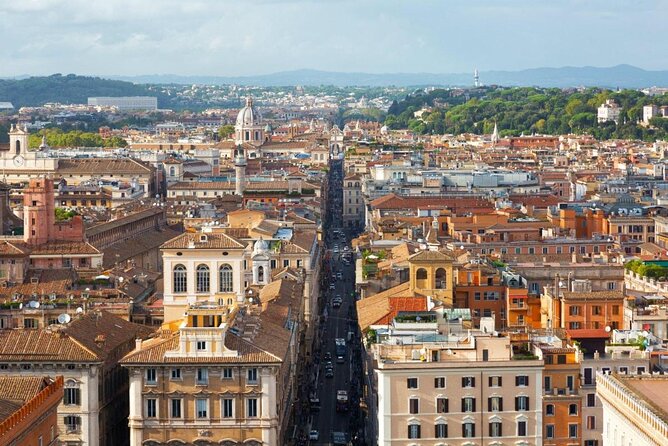
A first trip to Rome can feel like drinking espresso through a fire hose. This tour helps you slow that chaos down, by turning a handful of must-sees into a simple walking story you can remember.
You cover major landmarks across the center in about 3 hours, without needing trains, transfers, or constant map-reading. The route is designed to connect areas that look different on postcards but share real urban logic. And since it’s private, you’re not stuck matching your timing to a stranger’s photo habits.
You can also read our reviews of more walking tours in Rome


Price, and what you are really paying for at $161.77 per person
At $161.77 per person for a 3-hour private walking tour, you’re not buying a “see everything” deal. You’re buying something more specific: a guided, curated route through top Rome sights, plus a more personal interaction with a real person on the ground.
Here’s the practical value angle. You save time because you do not have to figure out the best order of stops yourself. You also gain context at the points where Rome can otherwise feel like a blur of stone and statues. In feedback for this experience, the guide praise is consistent: people call out a guide like Valerio for being both personable and very good at answering questions. Another guide named Serena is also mentioned positively for explaining the churches and sites along the way.
One consideration: a few specific stops list admission as not included, so part of your budgeting might depend on which interiors you choose to enter and how you handle any ticket timing for the Pantheon area.
Meeting at Piazza del Popolo, then using the Flaminio Obelisk as your compass
You begin at Piazza del Popolo at Piazza del Popolo, 21. This is a smart start point because it’s wide and legible. You get a clear sense of where you are, and from there the walking route fans out into the city’s major corridors.
The first stop is the Flaminio Obelisk, one of Rome’s ancient obelisks, located right in Piazza del Popolo. It’s 24 meters high, and the base plus cross brings it to 36.50 meters. The guide uses this as a quick entry into the bigger story of obelisks in Rome, since Rome has thirteen ancient obelisks. Even if you only catch the sight for a moment, it gives you a strong anchor for the rest of the day.
Practical tip for your own comfort: since you start in a major square, it’s a good place to regroup and set expectations with your guide. If you’re prone to losing track of time in Rome, this helps.
Santa Maria dei Miracoli and Santa Maria in Montesanto: the churches you might skip
After the wide-open start, the tour turns toward church architecture, and this is where you often learn more about Rome than you do from the big “name” sights.
Santa Maria dei Miracoli (not included)
You’ll pause at Chiesa Santa Maria dei Miracoli, which began in 1675 and finished in 1681. The church has a circular plan, and it also features an elegant 18th-century bell tower by Girolamo Theodoli plus an octagonal cupola.
Admission here is listed as not included, so if you care about interiors, you’ll want to ask your guide how they plan the timing. If you keep the visit exterior-focused, you still get value from the architectural notes, because the circular layout and tower details are easier to “see” once you know what you’re looking for.
You can also read our reviews of more private tours in Rome




Santa Maria in Montesanto (not included)
Next is Santa Maria in Montesanto. This church was erected over an older church with the same name, originally at the beginning of Via del Babuino. It was also occupied by Carmelite monks.
Again, admission is listed as not included, but the historical note about the site replacing earlier worship gives you a real feeling for Rome as a layered city. One moment you’re in a street scene, and the next you’re thinking about what stood there before.
Piazza del Popolo and Via del Corso: the “People’s Square” to the main drag
Now you’re back in open space, then on to a street that many visitors only see from the edges.
Piazza del Popolo
Piazza del Popolo is described as a large urban square. The modern Italian name ties to People’s Square, but the historical origin is said to relate to poplars. It’s the kind of place where the guide can help you read what you’re seeing, not just point.
Via del Corso
From there, you walk along Via del Corso, Rome’s main street in the historic center. It’s straight in a city that otherwise favors narrow alleys and small piazzas. The street is about 10 meters wide and roughly 1.5 kilometers long.
This segment is useful for you because it trains your sense of direction. After walking Via del Corso with a guide, the rest of the city becomes easier to navigate on your own, especially when you start reaching back toward the big monuments.
Via dei Condotti and the Spanish Steps: fashion street meets classic Rome
Via dei Condotti
Via dei Condotti is a busy fashion street, and it’s one of those places where you can feel Rome’s modern identity rubbing shoulders with old-world streets. Your walk includes a stop near Caffè Greco, often cited as a famous café established at Via dei Condotti 86 in 1760.
The street is also lined with high-end storefronts, including brands like Dior, Gucci, Hermès, Armani, and Louis Vuitton among many others. Even if you do not shop, you’ll likely enjoy watching how this narrow corridor functions as a social and shopping artery.
Spanish Steps
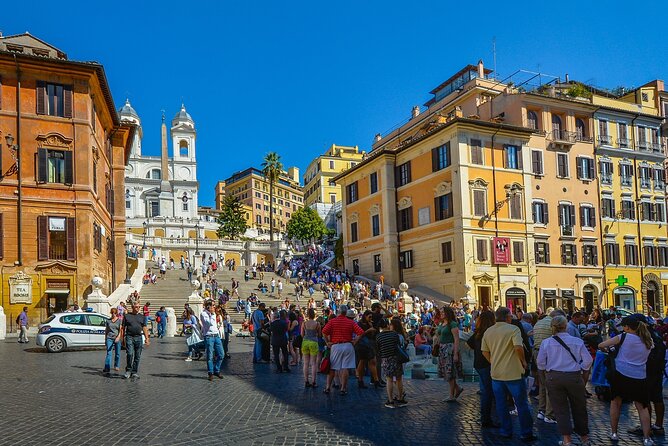
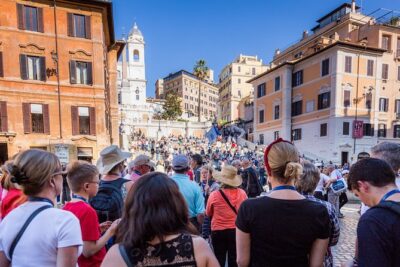
Then comes the iconic Spanish Steps. You’ll climb a steep slope between Piazza di Spagna at the base and Piazza Trinità dei Monti near the top, which is dominated by the Trinità dei Monti church.
This is a strong photo moment, but it’s also a useful walking experience. The steps physically connect two key squares, so you feel the city’s elevation changes instead of just reading about them.
Trevi Fountain: planning your coin moment in the middle of real crowds
The tour includes Trevi Fountain, one of the world’s most recognizable fountains. It’s an 18th-century Baroque masterpiece, 26.3 meters high and 49.15 meters wide, making it the largest Baroque fountain in Rome.
You get the design story, too. It was designed by Nicola Salvi and completed by Giuseppe Pannini and others. The experience also includes the classic tradition: you’ll toss a wish coin into Trevi Fountain.
Here’s what I’d plan for. Trevi is famous, which means it can get chaotic around the best viewing spots. A private guide helps because they can time you into the best angle and keep you from spending your best Rome minutes stuck in the wrong position.
St. Ignatius of Loyola and Piazza Navona: Baroque religion and old-stadium geometry
After Trevi, you shift into two spots where Rome’s planning shows up in the ground under your feet.
Chiesa di Sant’Ignazio di Loyola
You’ll stop at the Church of St. Ignatius of Loyola (Sant’Ignazio di Loyola) at Campus Martius. This is a Latin Catholic titular church dedicated to Ignatius of Loyola, founder of the Society of Jesus. It’s built in Baroque style and was constructed between 1626 and 1650.
Admission is listed as free for this stop, which is helpful if you want to keep your day simple. Even without entering any special ticketed areas, you’ll likely leave with clearer context for why Baroque churches look the way they do, and why Rome’s religious architecture is still visually commanding.
Piazza Navona
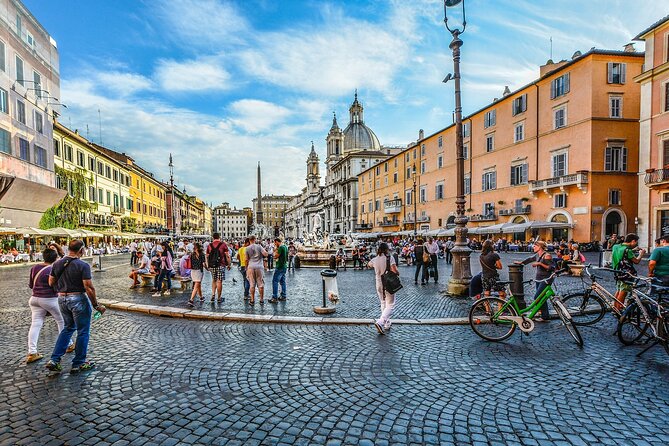
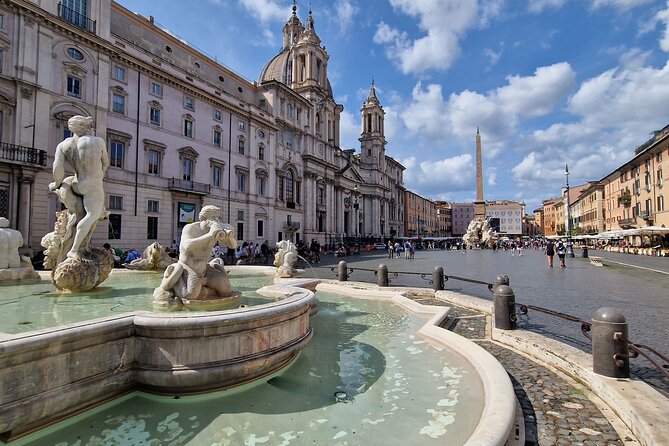
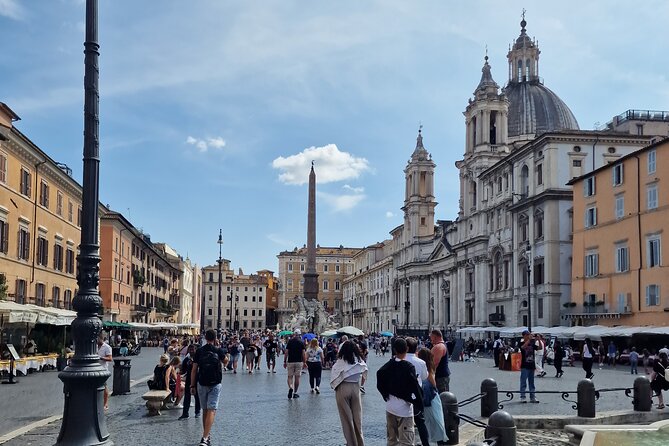
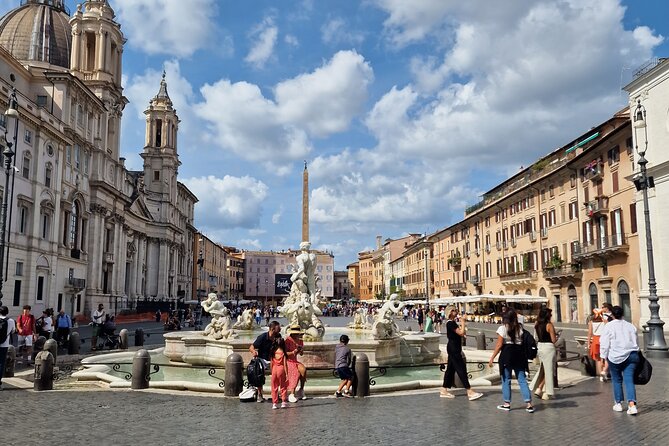
Then you move to Piazza Navona, a public open space built on the site of the Stadium of Domitian from the 1st century AD. The square follows the oval shape of the old stadium. That detail matters, because it explains why the space feels the way it does.
Piazza Navona is also a classic place to take a pause, grab a drink later on your own, and watch the flow of people without feeling like you are stuck in a single spot all day. It’s one of those moments where Rome’s past is still shaping the present city map.
Castel Sant’Angelo as your finish: mausoleum to museum fortress
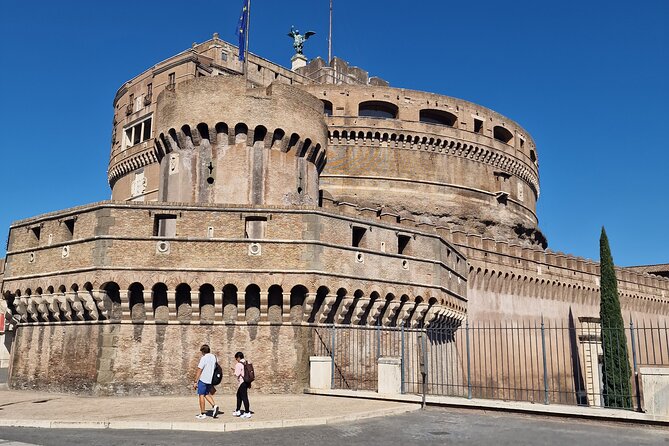
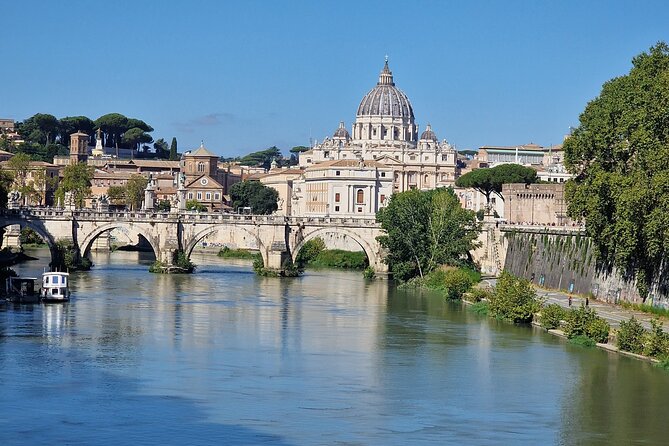
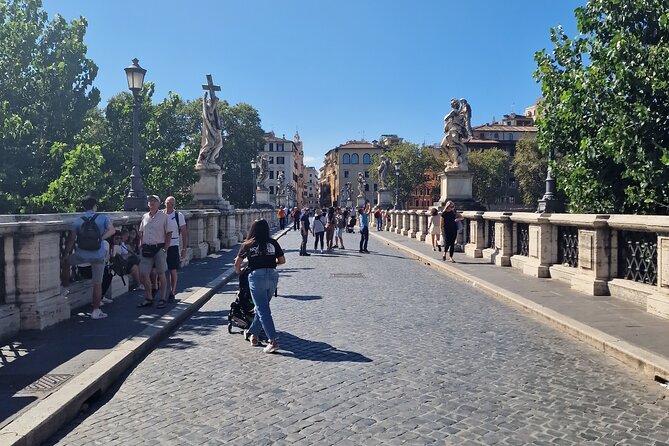
The walk continues to Castel Sant’Angelo, described as a towering cylindrical building in Parco Adriano. It started as a mausoleum commissioned by Emperor Hadrian for himself and his family. Later, the popes used it as a fortress and castle. Today, it functions as a museum.
Your tour data also notes it was once the tallest building in Rome. Even if you do not go inside that day, the exterior presence does a lot for your sense of scale at the end of the route.
This is a practical finish point, too. You end near Lungotevere Castello, 50, in the Castel Sant’Angelo area. From there, you’re well placed to continue exploring along the river or transition to whatever you have planned next.
Pantheon access: the big moment, and how to handle tickets smartly
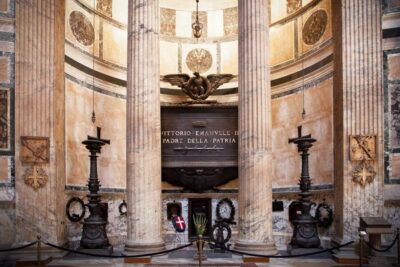
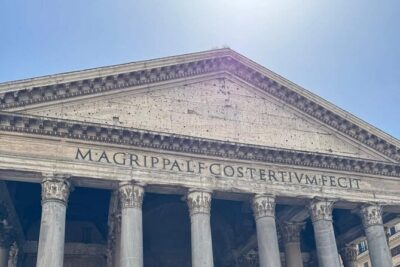
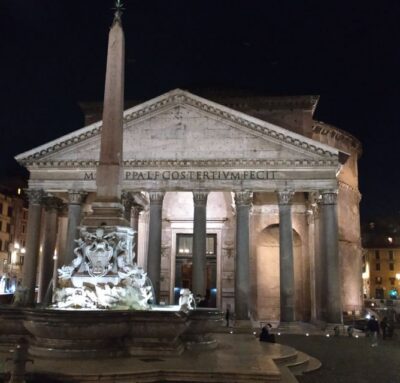
The Pantheon is the headline stop: a former Roman temple, later a Catholic church since 609 AD, known formally as the Basilica of St. Mary and the Martyrs.
You’ll also get the core meaning. The Greek name translates roughly to temple of all the gods, and the Pantheon is one of the places where that ancient identity and Christian use overlap in the same structure.
One key consideration: the itinerary notes Pantheon admission ticket not included for this stop, even though the tour summary emphasizes Pantheon access. That means you should read the details at booking time carefully and ask your guide what is covered for your particular ticket situation.
How you can make this part feel smoother:
- Arrive with a clear expectation on whether entry is handled by the tour or requires an additional ticket.
- Keep your most patient mindset for the Pantheon. It’s popular for a reason, and good timing can make a noticeable difference.
Guide quality, and why private pacing matters in Rome
This tour’s strongest theme in the feedback I saw is the guide. People repeatedly praised guides like Valerio for being very personable and highly effective at answering questions, not just reciting facts. One common detail: Valerio went beyond the allotted time in some cases to walk people toward their next tour starting point, and others mention walking guests back toward their hotels.
Another name that comes up is Serena, who is praised for explaining the history and church context at several stops.
That’s the real value of a private format in Rome. If you care about understanding what you see, not just checking boxes, your guide becomes your translator. If you’re more in the mood for pictures, they can steer you toward good views and keep the schedule from drifting.
Who should book this Rome private walking tour
This is a good match if you:
- Want a first-day Rome walk that helps you orient across the center
- Prefer private time with a guide who can answer questions
- Like mixing obvious icons with a few architecture-minded church stops
- Appreciate walking through real streets like Via del Corso and Via dei Condotti, not only hopping between major monuments
It may not be the best fit if you:
- Hate walking and want a lighter pace, because the route covers a lot of ground across multiple districts
- Strongly want every interior site and need all tickets to be pre-included, since some stops list admission as not included
Should you book it?
I’d book this Rome Private Walking Tour including Pantheon access if you want a straightforward way to connect the dots between Piazza del Popolo, Spanish Steps, Trevi Fountain, Piazza Navona, and Castel Sant’Angelo, while still getting meaningful context at churches and key monuments. The 5-star feedback and consistent praise for guides like Valerio and Serena are a strong sign that the experience leans into explanations, not just sightseeing.
Just go in with one smart mindset: confirm how the Pantheon ticket works for you and plan for the church stops that note admission as not included. If you do that, this tour delivers a tight, memorable, genuinely useful introduction to central Rome.
FAQ
How long is the Rome private walking tour?
It lasts about 3 hours.
What does the tour cost?
The price is listed as $161.77 per person.
Is this tour private or group-based?
It is private, meaning only your group participates.
What language is the tour offered in?
The tour is offered in English.
Where does the tour start and end?
It starts at Flaminio Obelisk, Piazza del Popolo, 21, 00187 Rome, Italy, and ends at Castel Sant’Angelo, Lungotevere Castello, 50, 00193 Rome, Italy.
Which major sights are included on the route?
The highlights include Spanish Steps, Trevi Fountain, Pantheon access, Piazza Navona, and the route also covers Piazza del Popolo, Via del Corso, and Via dei Condotti, among other stops.
Is Pantheon admission included?
The tour summary says you get Pantheon access, but the Pantheon stop lists admission ticket as not included. You should confirm what you personally need to arrange at booking.
Are any stops ticket-free?
Many stops list admission ticket free, including Obelisco Flaminio, Piazza del Popolo, Via del Corso, Via dei Condotti, Spanish Steps, Trevi Fountain, Chiesa di Sant’Ignazio di Loyola, Piazza Navona, and Castel Sant’Angelo.
Are any stops listed as admission not included?
Yes. Santa Maria dei Miracoli, Santa Maria in Montesanto, and the Pantheon are listed as admission ticket not included.
What is the cancellation policy?
Free cancellation is available up to 24 hours in advance for a full refund.
Are service animals allowed and is it near public transportation?
Service animals are allowed, and the tour is near public transportation. It also notes that most travelers can participate.
More Walking Tours in Rome



More Tours in Rome






More Tour Reviews in Rome

Not for you? Here's more nearby things to do in Rome we have reviewed












Pantheon Tours, compared.
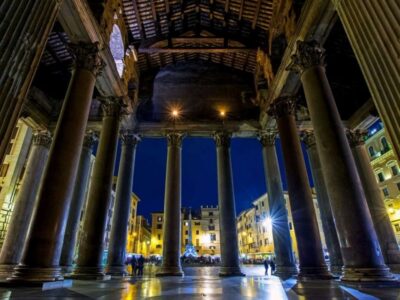 ★ 4.9Pantheon Timeless Marvel Guided Tour with Entry TicketFrom $214,002 reviews
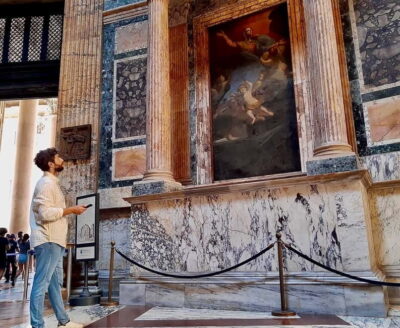 ★ 4.1Pantheon Priority Entry Ticket & Audio Guide AppFrom $63,234 reviews
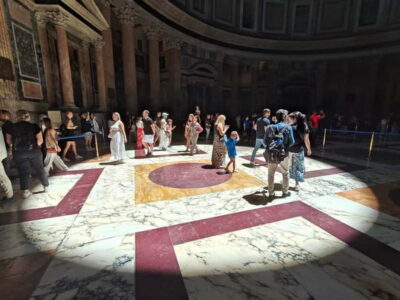 ★ 4.9Pantheon Small-Group Guided Tour with Entry TicketFrom $481,094 reviews
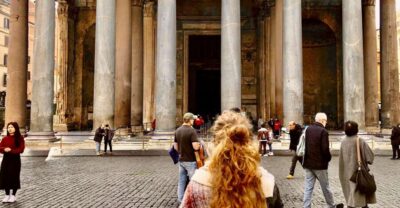 ★ 4.7Pantheon Small Group Tour and Skip-the-Line TicketFrom $531,008 reviews
 ★ 4.2Pantheon Guided Tour with Skip-the-line TicketFrom $28816 reviews
 ★ 4.5Rome Walking Tour with Piazza Navona, Trevi Fountain and PantheonFrom $35676 reviews
 ★ 4.5Pantheon Roma Fast-Track Entry TicketsFrom $7540 reviews
 ★ 4.9Spanish Steps, Trevi, Navona and Pantheon Sunset TourFrom $46522 reviews
Browse the lists this tour appears in