
Reviewed · ANCIENT ROME TOURS
Ancient Appian Way PRIVATE Bike Tour
That first pedal goes from Rome noise to open sky. This private e-bike tour trades hectic streets for the Via Appia Antica landscape and major ancient sights in a calm green corridor.
I especially love the mix of monumental stone and living park paths, from gates and tombs to aqueduct ruins you can actually ride next to. I also like that it is private, so the guide can slow down, answer questions, and adjust for your pace, like guides named Chris, Valerio, Alex, and Claudio have done for other guests.
One thing to consider: the ride can include city traffic for parts of the route, and the e-bikes are pedal assisted, not throttle bikes. If you get nervous around drivers, plan to focus on keeping a steady rhythm and staying alert.
Key Things You’ll Notice on This Appian Way Private E-Bike Tour
- Private attention: only your group, so you are not squeezed into a fast herd
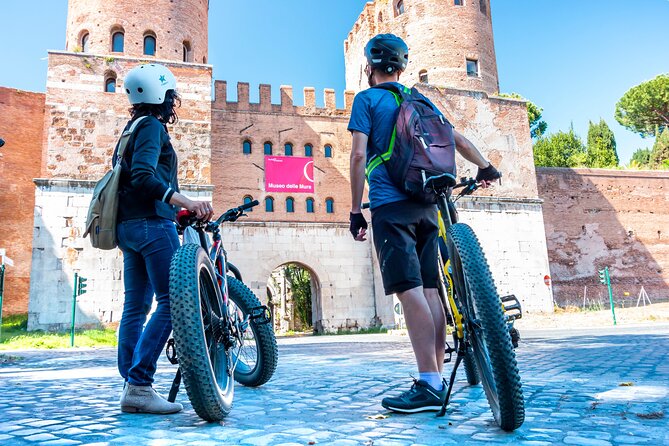
- Start at Porta San Sebastiano: an imposing gateway that also marks the beginning of the historic Via Appia Antica
- Aqueduct park power: Parco degli Acquedotti is one of the best places in Rome to see Roman engineering in open air
- Myth and masonry in the same ride: Ninfeo di Egeria adds a love-story layer to the ruins
- Family friendly setup: child seats are included, and kids get a reduced price with height conditions
Why the Ancient Appian Way Feels Different Than Usual Rome
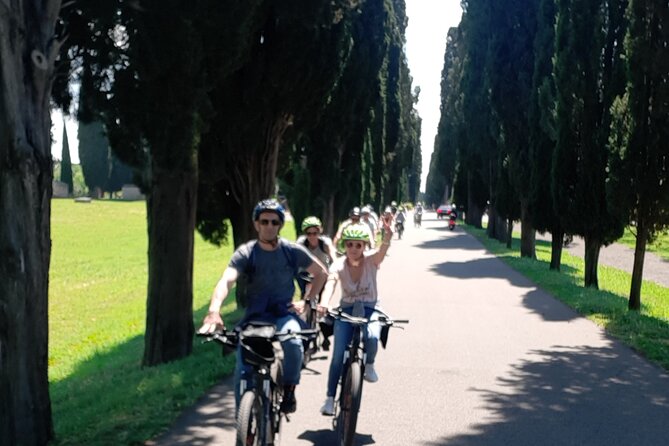
Rome can be loud, crowded, and a bit stop-and-go when you are trying to see big things fast. This tour changes the mood quickly, because you are heading out along a historic corridor where ruins sit inside parks and long stone-lined paths.
What makes it work is the pacing. The tour is about 4 hours, and it is built as a sequence of short visits, each around 20 minutes. That means you can actually look at what is in front of you, not just speed through photo stops.
You also get an e-bike, which is a practical advantage here. The Appian Way area has stretch after stretch of outdoor scenery, and the energy you save makes the difference between arriving at the end tired or still curious. If you have ever walked this kind of route in summer heat, you already know why this matters.
And yes, you are still in Rome. Expect cobblestones, occasional street segments, and the need to stay comfortable riding a bicycle. The tour notes are clear that you must know how to ride a bike well.
You can also read our reviews of more cycling tours in Rome

Meeting Point and Route Basics You Should Know First
The tour starts at Via dei SS. Quattro, 58, 00184 Roma RM and ends back there. That is convenient because you do not need to worry about finding your way at the end of a half-day ride.
It is offered in English, and you get a mobile ticket. Confirmation happens at booking time, so you should feel set once you reserve.
In terms of physical effort, the tour asks for moderate fitness and makes it clear you should be comfortable riding. You also get helmets plus a few ride supports: a mobile phone holder and handlebar holder. If you like using maps or taking photos on the move, those holders reduce the fiddling.
One more useful detail: this is a private tour, so your group is the only group on the route. That usually translates into more time spent at each stop and fewer moments of feeling rushed.
Porta San Sebastiano: The Southern Gateway That Sets the Tone
Your first big scene is Porta San Sebastiano, an imposing southern gateway tied to the Aurelian Walls around 275 AD. This is not just a nice photo spot. It is a structural reminder that Rome built defenses, then later people walked through and carved their stories into the city.
One of the details that really works on this stop is the presence of medieval graffiti. It is the kind of evidence that helps you feel the centuries layering on top of each other, from ancient passage to later pilgrim flow.
At around 20 minutes, this is enough time to take in the gate shape, notice the wall context, and then move on before the group gets restless. It is also a good warm-up for the ride, psychologically as much as physically.
The practical takeaway: arrive with your eyes open. This is one of those moments where looking slowly pays off more than shooting quickly.
Parco della Caffarella: Rome’s Green Breath Beside Ancient Paths
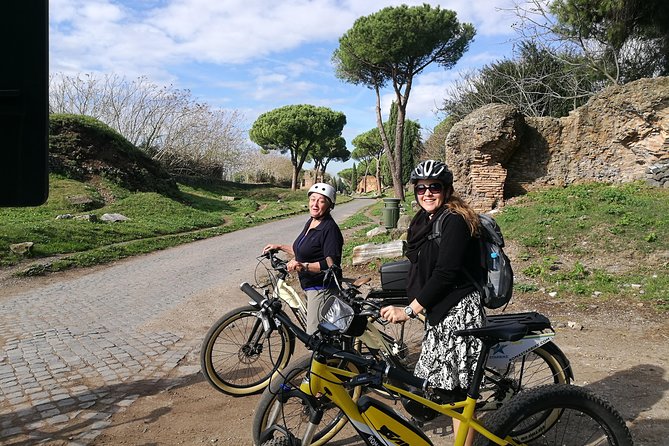
Next you switch into Parco della Caffarella, part of the Appia Antica Regional Park. This is one of the largest green areas in Rome and Europe, and it changes your pace immediately.
What I like about this section is the combination of nature and surviving traces. The park paths and groves sit close to remains of ancient buildings, so you are not just moving through scenery. You are moving through a landscape that has archaeological texture.
At about 20 minutes, you will likely stop where the views and ruins line up, then rejoin the bike route. If you want the most benefit, look up and around, not only at the ground. Parks on the Appian Way can feel open, and the skyline matters for appreciating how far you are from central Rome.
Drawback to plan for: this is still outdoors, and summer heat can hit fast. Bring water and expect shade to be patchy depending on the day.
Ninfeo di Egeria: A Myth Stop That Makes the Stones Feel Human
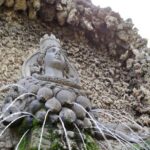
Then comes a gentler scene: Ninfeo di Egeria. This sacred site connects to the love story of the nymph Egeria and Numa Pompilius, with the myth explaining how grief gave life to a spring.
What makes this stop memorable on a bike tour is contrast. You have been seeing gates and park structures; now you get a place where the meaning is emotional, not just architectural.
Even if you do not care about Roman mythology as a genre, this kind of story gives you something to hold onto as you ride. It turns the route into a sequence of human themes, not just a list of monuments.
Also, it is a free admission stop on the route, so you are not spending time negotiating tickets and lines. You are simply there, listening and looking.
You can also read our reviews of more private tours in Rome


Parco degli Acquedotti: Aqueduct Ruins That Still Feel Impressive
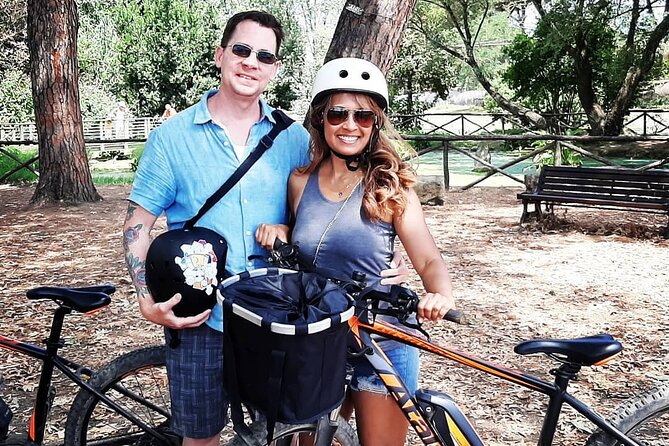
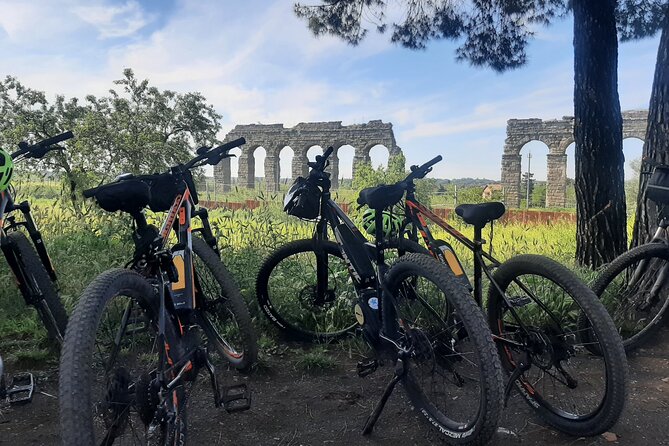
If you only care about one part of the whole half-day, I’d put my money on Parco degli Acquedotti. This is the Parco Archeologico dell’Appia Antica area crossed by an ancient water network, where Roman engineering is visible at a grand scale.
You are in a huge green space that helps you understand why aqueducts were life support. The remains show how water infrastructure shaped the city. The tour specifically calls out Roman engineering through aqueduct remains, including surprisingly some places where water still functions.
Another detail I think is worth your attention: the park ties into broader road history, including the Via Latina, described as the oldest road in Rome. So while you are biking among aqueduct fragments, you are also standing at intersections of transportation and water systems.
Practical tip: wear comfortable shoes and stay ready to slow down. Even when the bike glides, this is a stop where you will want to stand still, tilt your head, and take in the sheer scale.
Villa dei Quintili and Santa Maria Nova: Where Power Shows Up in Ruins
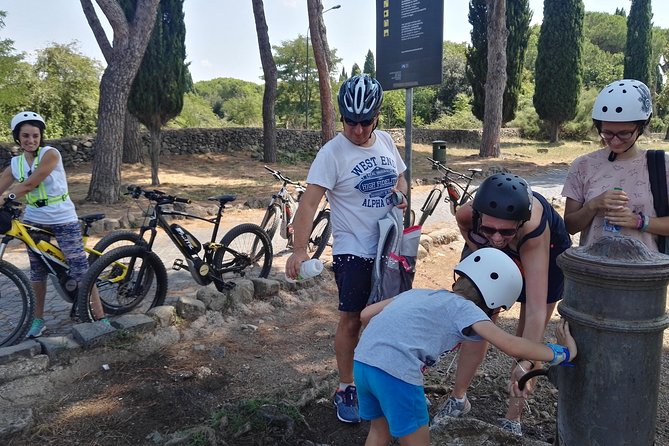
At the fifth mile of the Appian Way you reach the Villa dei Quintili area and Santa Maria Nova within the Appia Antica archaeological park.
The Villa dei Quintili belonged to the brothers Sesto Quintilio Condiano and Massimo Valerio, consuls in the second century AD. The tour information also notes they were killed by Commodus I, after which the villa became imperial property.
Why this stop matters for you: villas are where you see Rome’s private side, not only public monuments. You get a sense of wealth and politics, how status could shift hands, and how imperial power could repurpose property.
As for Santa Maria Nova, the tour frames it as part of the same area visit. In practice, this is a good stop for listening time, because the guide can help connect what you see to what it meant in Roman life.
This is also a free admission stop on the route, so you are spending energy on observation, not on logistics.
Mausoleo di Cecilia Metella and Castrum Caetani: Tomb and Fortress in One View
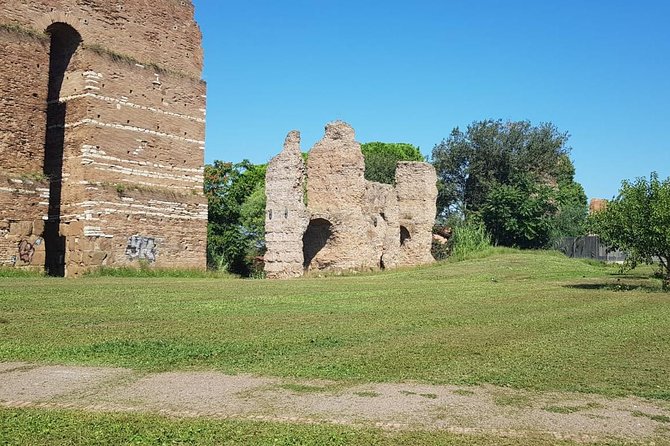
Next you get one of the most dramatic contrasts on the tour: Mausoleo di Cecilia Metella with Castrum Caetani. This mausoleum is dedicated to Cecilia Metella and dates back to the first century BC.
The tour notes it as the best preserved mausoleum on the Via Appia Antica, which is exactly why it is a standout. When a tomb survives with clarity, you can actually read the structure. You feel the original purpose more than with scattered ruins.
It also includes medieval layers. The mausoleum was incorporated into the Castrum Caetani, and you can appreciate remains of the Caetani family’s medieval house. There is also mention of the church of San Nicola, with only the perimeter walls still standing.
If you like when history has multiple eras stacked in one footprint, this is your stop. You can walk the edges, notice what changed, and feel how later generations used earlier stone.
Practical consideration: bring your camera, but also plan to take a minute with no lens. This is one of those places where your eyes need time to map the form.
Circus of Maxentius: The Shape of Entertainment Across Millennia
Then you ride to the Circus of Maxentius. This is described as the best example of a Roman circus surviving to this day.
A circus is different from a theater. It is long, open, and built for motion and spectacle. Here you can see the spina, still visible, which is central to understanding how the event layout worked.
The tour also connects the spina to later history. It housed the Agonale obelisk, which was moved during the Renaissance to the Fountain of the Four Rivers in Piazza Navona.
That connection is valuable for you because it ties far-flung Rome together. If you plan to visit Piazza Navona during your trip, you can connect it to something you just saw outside the city core.
At about 20 minutes, you will get enough time for the outline and context. Just do not expect a full stadium experience. This is ruins, but they are readable ruins.
Terme di Caracalla: Giant Baths and Roman Water Logic
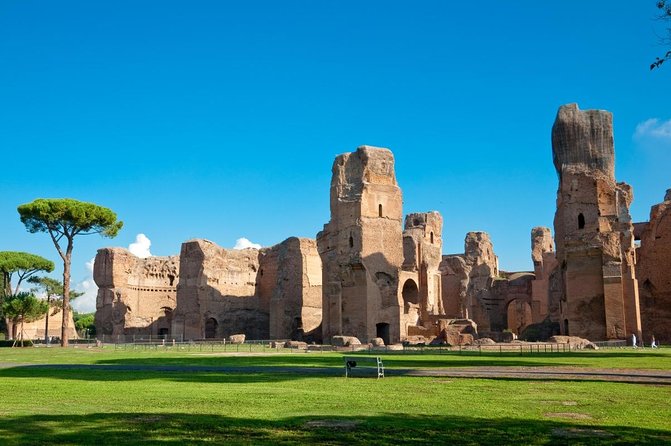
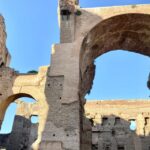
The final major stop is Terme di Caracalla. These baths were built by Emperor Caracalla and were for about a century the largest public baths ever built, with today most of their structure preserved.
The tour notes that an Aqua Marcia branch brought water to the baths via the Antoninian aqueduct. It also adds that small remains can be admired at the Porta di San Sebastiano.
So by the time you reach the baths, you have the full story arc: roads, aqueducts, then water turned into daily life. It is a satisfying loop.
What to expect on the ground: you will spend your time looking at preserved structures and getting oriented to the scale. Even from a distance, Caracalla’s baths feel big because the architecture was built for crowds and multiple functions.
Time wise, it works well as a closer. You finish while the day still feels fresh, not when you are completely cooked.
E-Bikes, Riding Style, and What Could Slow You Down
Let’s talk about the ride itself, because it is half the experience.
You get a high quality e-bike plus a helmet and holders for your phone and handlebar. But the tour information and one review point out an important detail: there is no throttle. It is pedal assisted. That means you will still be pedaling.
The upside: it keeps you in control and helps you ride naturally. The downside: if you are expecting a lazy mode, you might feel like you are working more than you planned.
Also, the tour requires you to know how to ride a bike well, and it lists moderate fitness. For most people, this means steady comfort on two wheels, not athlete level stamina.
Finally, plan for shared-road moments. One review notes about 20 percent of the ride happens in city traffic. That is not the majority, but it is enough to matter. If you are cautious, it helps to say so at the start so the guide can pace you and choose the safest line.
What Private Guiding Adds, Especially When You Want More Than Photos
A private tour matters most when you care about context. On this ride, the guide role is a big deal because the route is full of places that look similar if you do not have names, dates, and stories.
You can end up with a guide who links the details into a clean narrative. In past groups, guides like Chris, Alex, and Valerio have been praised for patient explanations and history that actually sticks.
It also helps that the guide can adjust. There are mentions of flexibility in how the ride fits requests, which is exactly what you want if your group includes kids, slower walkers, or someone who just needs a few extra minutes at an aqueduct view.
If you are traveling with family, child seats are included until 25 kg, and there is a child discount for ages 6 to 10 with a height limit specified as less than 4/7 feet (143 cm). That matters because it affects whether kids ride in a trailer bike setup rather than alone.
Value Check: What You’re Really Paying For at $147.54 Per Person
At $147.54 per person for about 4 hours, the price is not low, but it is not out of line for a private e-bike experience that takes you away from central chaos.
Here is why it can feel like good value:
- You get the e-bike, helmet, and practical mounts, so you are not renting extra gear.
- The private format means you get attention, not just transportation.
- The route is packed with major sites in a single half-day, including Porta San Sebastiano, the aqueduct park area, Circus of Maxentius, and Terme di Caracalla.
- Many of the listed stops are free admission, so your time is spent on the experience rather than paid entry fees.
If you were hiring separate taxis, doing bus hops, and trying to connect these sites on foot, you would burn time and energy. Even if you can technically reach some of these places independently, this tour is buying you flow and guidance.
So I’d frame it like this: you are paying for a smoother day and fewer decision headaches, while getting the kind of context that makes Appian Way ruins feel alive.
Should You Book This Ancient Appian Way Bike Tour?
Book it if you want a half-day that feels like a break from central Rome, with e-bike comfort and serious Roman scenery. It is a great fit for families that can handle moderate riding, and for couples who want history plus fresh air without a full-day slog.
I would skip or rethink it if you:
- are not confident riding a bike well,
- get very anxious in traffic segments,
- or expect a throttle-free, effortless experience.
If you do your part, keep your pedaling steady, and communicate your comfort level, this tour can turn a handful of Roman names into a real sense of place, from Porta San Sebastiano’s gate power to the aqueduct engineering and the scale of Caracalla’s baths.
FAQ
How long is the Ancient Appian Way PRIVATE Bike Tour?
It is approximately 4 hours.
How much does the tour cost?
The price is $147.54 per person.
Is this tour private?
Yes. It is a private tour/activity, and only your group participates.
What language is the tour offered in?
It is offered in English.
Are helmets and bike gear included?
Yes. The tour includes a helmet, plus a mobile phone holder and handlebar holder, along with the high quality e-bike.
Do kids need their own bike?
A child seat is included until 25 kg. A child discount for ages 6 to 10 applies only if the child is under 4/7 feet (143 cm), because they will use a trailer bike rather than riding alone.
Do I need to be in good physical shape?
The tour asks for moderate physical fitness, and you must know how to ride a bike well.
Is there a throttle on the e-bike?
The e-bikes are pedal assisted with no throttle, so you will need to do a lot of pedaling.
Which stops are included on the ride?
The route includes Porta San Sebastiano, Parco della Caffarella, Ninfeo di Egeria, Parco degli Acquedotti, Villa dei Quintili and Santa Maria Nova, Mausoleo di Cecilia Metella and Castrum Caetani, Circus of Maxentius, and Terme di Caracalla.
Is admission charged at the sites?
The listed stops on the route are marked as free admission.
More Cycling Tours in Rome
More Tours in Rome


More Tour Reviews in Rome
Not for you? Here's more nearby things to do in Rome we have reviewed





Ancient Rome Tours, compared.
 ★ 4.7Colosseum: Underground and Ancient Rome TourFrom $16012,691 reviews
 ★ 4.4Colosseum, Ancient Rome Tour or Self AudioGuided TourFrom $392,866 reviews
 ★ 4.9Appian Way, Catacombs, & Roman Aqueducts E-bike TourFrom $851,421 reviews
 ★ 4.9Appian Way E-bike Tour with Catacombs, Aqueducts & FoodFrom $961,210 reviews
 ★ 5.0Appian Way Aqueducts Bike Tour (Catacombs & Lunch Option)From $78975 reviews
 ★ 4.7Appian Way, Aqueducts, and Catacombs TourFrom $64942 reviews
 ★ 4.7Caracalla Baths & Circus Maximus — Private or SharedFrom $77835 reviews
 ★ 4.7Colosseum Arena Access and Ancient Rome Guided TourFrom $94774 reviews
Browse the lists this tour appears in