
Reviewed · ANCIENT ROME TOURS
Ostia Antica Archaeological Park with Italian Gelato
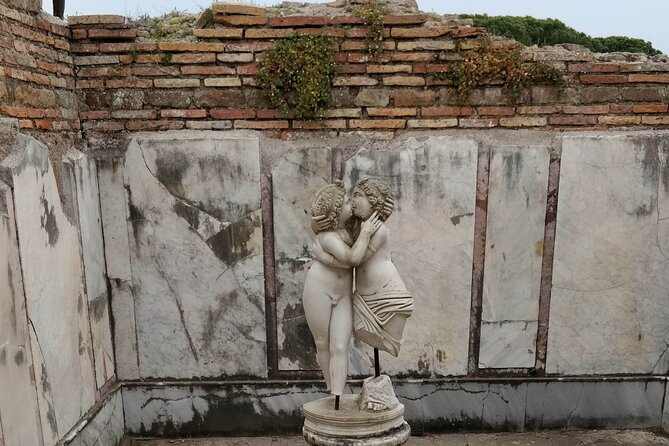
Roman Rome without the crowds. I love the guided walk through Ostia Antica, a real working Roman port, and I love ending in the Borghetto for Italian gelato. One thing to plan for: the archaeological park entrance fee is not included, so budget a little extra beyond the $119.27.
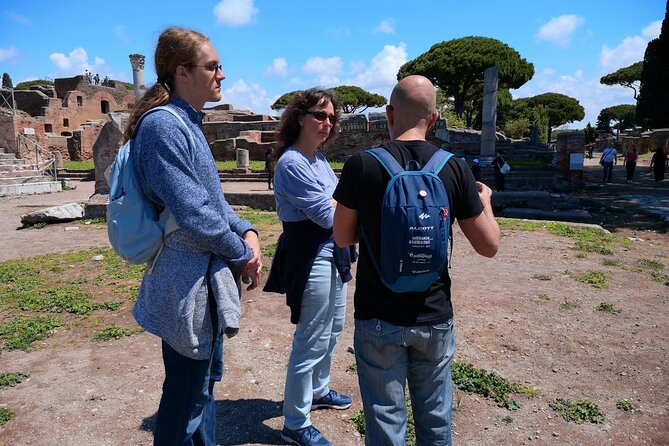
What you get is a story told on foot. You move through monumental tombs, baths with famous mosaics, forums, and the city’s harbor edges, with an English guide who connects the dots between how people lived, traded, and worshiped. Then you switch centuries, walking into a medieval citadel where a castle courtyard sits inside that older Roman river-world.
The experience runs with a small group size (max 6), which means you can ask questions and actually hear the details. If you hate walking outdoors, this is still manageable, but you will be on your feet for a good chunk of time.
Key Things You’ll Love About This Ostia Antica and Gelato Tour
- Small-group attention (max 6), so the guide can slow down for your questions
- A tight highlight route across the Roman port, from necropolis to harbor sidewalks
- Neptune Baths mosaics and viewpoints, a strong photo stop when the light is right
- Borghetto and the Giulio II castle courtyard, a rare medieval layer right next to Rome
- Italian gelato included, perfectly timed after the walking
- Guided in English, with guides like Chiara and Federico who clearly enjoy explaining the site
Why Ostia Antica Feels Different From the Rome You Know
Ostia Antica sits just outside Rome, yet it does not feel like another “look but don’t touch” museum visit. This is an archaeological park where the ruins still read like a city. The big idea I took from the tour is that this place functioned. You are not just seeing grand monuments, you are seeing a commercial world built around a port and a busy river economy.
A lot of people come to Rome for the famous imperial center. Ostia gives you a different angle: a working Roman city that served the Republic first and the Empire later, then kept changing as centuries rolled on. In practical terms, that means you understand the ruins as parts of daily life, not just as isolated big-ticket sights.
I also liked that the tour pace keeps the story clear. You get a structured walk across major zones, without the “wandering until you’re tired” problem. And because this is a smaller group, the guide’s explanations land better. The site can feel spread out on your own. With the route planned, you stay oriented.
You can also read our reviews of more tours and experiences in Rome.

Morning Logistics: How the Meeting Point Works and How to Get There
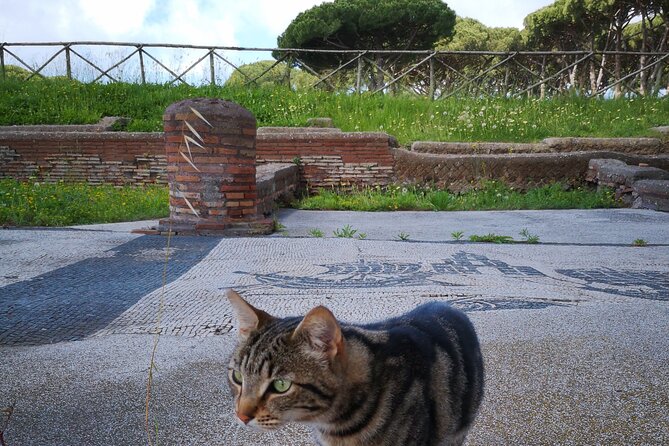
The tour starts at 9:30 am and meets at Viale della Stazione di Ostia Antica, 00119 Roma RM, Italy. It ends back at the same meeting point, so you are not left figuring out transportation after you’re tired.
The meeting point is near public transportation, and the easiest way out of Rome is often a mix of metro and commuter rail. One simple route to know is: take the metro to Piramide station (it connects with Porta San Paolo), then switch to the Ostia-Lido commuter train. From there, you are set up for a short, straightforward walk to where the guides meet you.
You’ll use a mobile ticket, and the tour is offered in English. That matters because the guide can keep the tempo while explaining details, rather than losing time to language confusion. Also, if you’re someone who likes to plan a low-stress morning, having a set start time and a return to the same meeting area helps a lot.
Stop 1: The Ostia Antica Archaeological Park Walk (About 2 Hours)
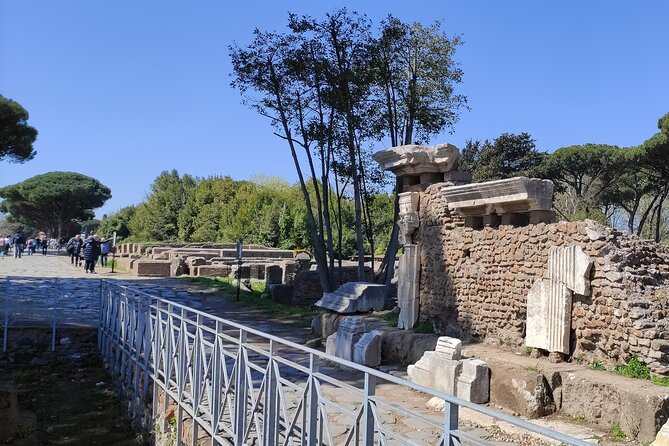
This is the core of the day, roughly two hours on foot inside the Archeological Park. The admission ticket is not included, so before you go, make sure you’ve budgeted for that separate entry. Once you’re inside, the guide leads you through an organized route through the city’s most important zones.
Necropolis and the idea of a city’s outer world
You begin with the Necropolis of Ostia Antica, where monumental tombs and mausoleums set the tone. It’s a useful start because it shows that people lived with death nearby. Then, as the walk moves inward, you can sense how the city’s design pulled people through public areas, trades, and religious spaces.
Romana gate and Victory Square on the Decumanus Maximus
From there, you get orientation through the big street grid. The Decumanus Maximus is a key axis, and the Romana gate and Victory Square help you understand the city’s scale and civic pride. The guide’s job here is to make these names meaningful, not just historical labels.

Neptune Baths mosaics and a view from above
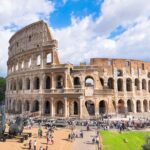
One of the most talked-about stops on the route is the Neptune Baths. Expect majestic mosaics and at least one moment where you’ll look down from a higher viewpoint. Even if you skip any optional climbs, this section is still worth it for the combination of art and architecture.
Roman Theatre, Corporation square, and the ARA of Romulus and Remus
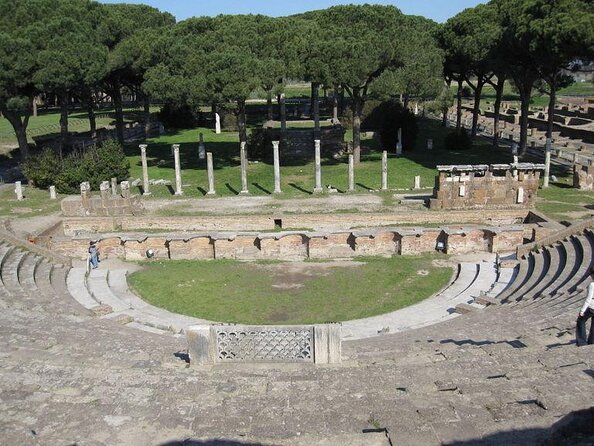
Next comes the Roman Theatre, then the Corporation square and the ARA of Romulus and Remus. This cluster helps you understand Ostia as both entertainment and organization, not just stone ruins. The corporation spaces connect to trade and guild life, which is exactly what makes Ostia feel like a working city rather than a frozen postcard.
Baths, forums, and sacred space
As you move into the Forum baths, Forum, Capitoline Triad temple, and the Castrum, the tour starts to feel like you’re reading the city’s “public brain.” These stops show you how civic life, religion, and defense were woven together. The forum area is especially helpful because it’s where everything converges, so you get better context for what you saw earlier.
Painted houses, Diana’s house, and a thermopolium
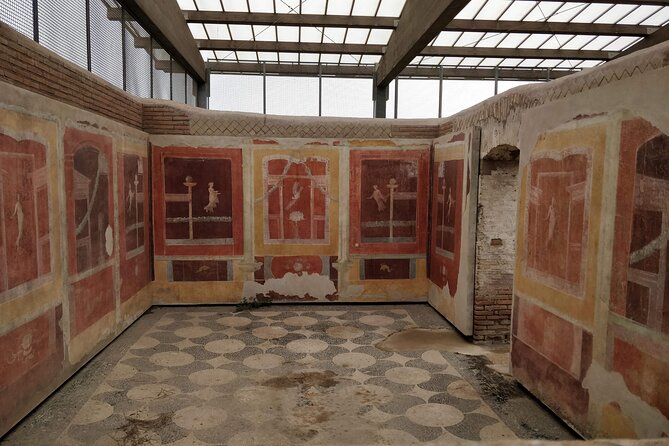
The route continues with residential and commercial details: painted houses, Diana’s house, and the Thermopolium. This is where Ostia stops being purely monumental and starts feeling human. Painted rooms and everyday food service cues give you a sense of what visitors and locals might have done between big events.
Guild life, mills, and firemen headquarters
Then you hit the practical, work-focused side of the city: Silvano’s Mills, the Guild of Pistores (bakers), and Firemen headquarters. I love stops like this because they make the ruins specific. Instead of only thinking of emperors, you’re thinking of workers, suppliers, and organized services that kept a port city functioning.
Cisiari’s Baths and the Harbor sidewalk
The walk finishes along the edges, including Cisiari’s Baths and the Harbor’s sidewalk. That last stretch matters because Ostia’s story is tied to movement, trade, and river traffic. Even if you do not do a long linger at each spot, arriving at the harbor zone gives you a satisfying sense of the whole system.
Practical note on walking: You’ll cover about three miles according to what people report, and there can be short steep stair sections for views. If stairs are an issue, you can usually choose to skip the climb without breaking the tour, since the route is designed around your pace.
Stop 2: Borghetto, Giulio II Castle Courtyard, and That Medieval Change of Pace
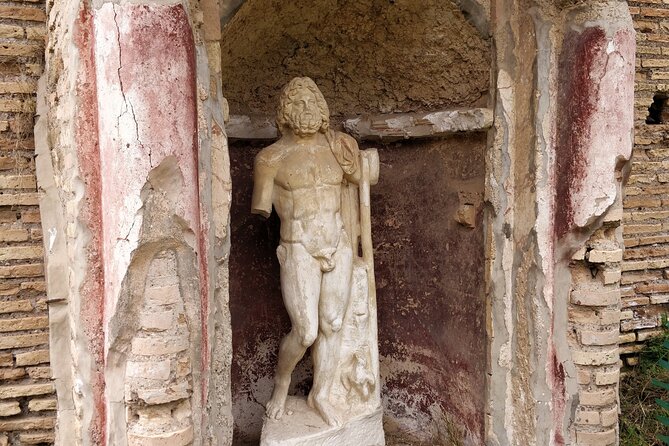
After the archaeological park, the tour shifts to Centro Storico di Ostia Antica, known as the Borghetto. This part is about 30 minutes, and it is a smart reset. You trade Roman stone for a medieval citadel atmosphere.
The Borghetto dates back to the 9th century A.D., and the centerpiece is the Giulio II castle, a 15th-century castle built on a design linked to Michelangelo. The reason it was built is especially interesting for anyone who likes context: the Papal State needed control of river trading on the Tevere and protection for farmers from raids by the Saracens.
Walking the citadel courtyard gives you a different kind of history. It is not “look at ruins from the outside.” It’s more like stepping into a defended neighborhood layer that grew up because of the same river economy that made Ostia the port city it became. That continuity is what makes the stop feel more than a quick photo break.
The Included Italian Gelato: Small Treat, Good Timing
Right outside the medieval walls, you get Italian gelato as part of the experience. This is not just a sugary bonus. It’s a timing win. After time in open-air ruins, you’ll appreciate an easy, fixed payoff that keeps the day feeling fun instead of overly academic.
If you’re choosing this tour because you want your day to feel human, gelato at the halfway point of your mental history shift is a nice touch. It also gives you a natural moment to regroup before you finish back at the meeting point.
Guides, Group Size, and Why the Explanations Actually Matter
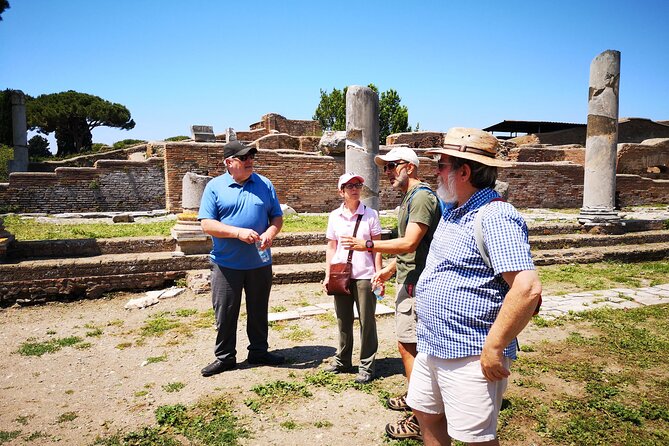
This tour caps at 6 travelers, and that small size is one of the strongest reasons to book it. When you’re walking through complex ruins, a guide who can manage questions without rushing makes the experience feel smoother.
In the field, the names you might see associated with this tour include Chiara and Federico. People specifically call out their ability to connect facts to what you can see. That matters because Ostia can be confusing if you arrive with only a guidebook and no route plan. With a focused highlight walk, you understand why each stop fits into the big picture.
Also, the tour is in English, which keeps the commentary flowing. You’ll get historical details, but the real benefit is clarity. You are not left translating your way through the site.
Price and Value: What $119.27 Really Covers (And What It Does Not)
At $119.27 per person, you are paying for a guided experience and the included Italian gelato, plus the structured walk through the park and the Borghetto stop.
What’s not included is the archaeological park entrance fee. That is the main add-on cost to keep in mind. Before you book, factor in that entry price so you don’t get surprised later.
Is it good value? I think it can be, especially if you like guided context and you want to avoid crowd chaos. Ostia Antica is quieter than central Rome, and the route is designed to show the big highlights without turning your day into a 6-hour slog. Add the small group size and English guidance, and the ticket price starts to make sense as more than just “someone walking you from point A to B.”
Weather, Comfort, and Who This Tour Best Fits
This experience requires good weather, so if rain is likely, plan a backup day. Also, since a good chunk is outdoor walking, dress for sun or cool mornings depending on the season. Bring comfortable shoes, and expect you might want water.
This tour is best for:
- People who want Roman sites outside the usual high-traffic circuit
- Families or teens who like history when it is explained clearly and paced well
- Anyone who prefers a small group over big bus tours
- Travelers who enjoy hands-on interpretation, not just reading plaques
It may not be the best choice if you have limited mobility. You can skip some steep stair bits for viewpoints, but the overall structure still involves walking through uneven outdoor ruins.
Should You Book This Ostia Antica and Gelato Tour?
I’d book it if you want a Rome day that feels grounded, not exhausting. The mix is smart: two hours of guided Roman port ruins, then the Borghetto for medieval atmosphere, then gelato to make the day feel fun again.
Choose it over DIY if you want the route to make sense on the ground. The site is big and the names are not self-explanatory. Having a guide like Chiara or Federico explain how the spaces connect to a real commercial city will save you time and make your photos better too.
Skip it only if you are mainly looking for the absolute biggest Roman monuments. Ostia is different. It’s not trying to replace the Colosseum or Vatican. It’s offering something else, a working city story that you do not get in Rome proper.
FAQ
How long is the Ostia Antica Archaeological Park with Italian Gelato tour?
It lasts about 2 hours 30 minutes (approximately).
Is the tour guided in English?
Yes. The tour is offered in English.
What is included in the price?
The tour includes the walking tour as described and snacks Italian gelato. The archaeological park entrance fee is not included.
Do I need to buy an entrance ticket for Ostia Antica?
Yes. Admission to the archaeological park is not included, so you should budget for the entry fee separately.
Where do I meet, and when does the tour start?
The meeting point is Viale della Stazione di Ostia Antica, 00119 Roma RM, Italy, and the tour starts at 9:30 am.
How big is the group?
The tour has a maximum of 6 travelers.
Is the tour dependent on weather?
Yes. The experience requires good weather.
FAQ
What happens if the weather is poor?
If the tour is canceled due to poor weather, you’ll be offered a different date or a full refund.
Is free cancellation available?
Yes, free cancellation is available up to 24 hours in advance for a full refund.
Does the tour end back at the meeting point?
Yes. The activity ends back at the meeting point.
More Tour Reviews in Rome
Not for you? Here's more nearby things to do in Rome we have reviewed







Ancient Rome Tours, compared.
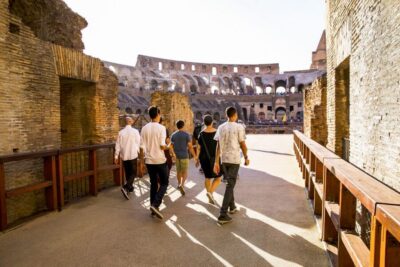 ★ 4.7Colosseum: Underground and Ancient Rome TourFrom $16012,691 reviews
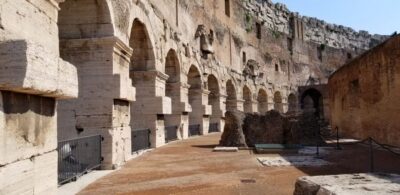 ★ 4.4Colosseum, Ancient Rome Tour or Self AudioGuided TourFrom $392,866 reviews
 ★ 4.9Appian Way, Catacombs, & Roman Aqueducts E-bike TourFrom $851,421 reviews
 ★ 4.9Appian Way E-bike Tour with Catacombs, Aqueducts & FoodFrom $961,210 reviews
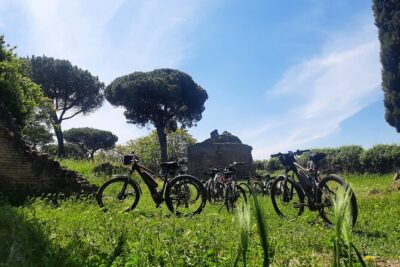 ★ 5.0Appian Way Aqueducts Bike Tour (Catacombs & Lunch Option)From $78975 reviews
 ★ 4.7Appian Way, Aqueducts, and Catacombs TourFrom $64942 reviews
 ★ 4.7Caracalla Baths & Circus Maximus — Private or SharedFrom $77835 reviews
 ★ 4.7Colosseum Arena Access and Ancient Rome Guided TourFrom $94774 reviews
Browse the lists this tour appears in